Seeing Through State Propaganda
A Collection of Essays by David Hamilton
First Published as a Collection 2010
These essays first appeared on a number of websites
including Sarah: Maid of Albion and Conservative democratic Alliance
ePub by code81.net
Cover Artwork by Stuart Bainbridge
© David Hamilton 2010
All rights reserved
Contents
Lions and Foxes 5
Rescuing Our Children from State Control 8
Putting meaning Back into our World 11
I Am the Slime Oozing Out Of Your TV Set 14
Transferring Power 17
The British establishment nurtures terrorists 20
Political Judges at War with Britain 23
Changing Reality 27
The Invited conquest 30
Deceiving the British People 33
Defending the Natural Society 36
The Hidden Journey to Lisbon 39
Persecuting Wrong Thinking 42
What Did Churchill Really Think about Immigration? 45
The EU and Ethnocide 47
Behind the Pretence of Tolerance 49
Breaking their own people down for dispossession 52
Urban Planning and Identity 54
The Genocide of White South African Farmers 56
Is this all the intelligentsia have to offer? 60
Child Rape - The Spoils of War 63
Preface
This collection of twenty one essays is work which has been published in various places: websites such as Sarah:Maid of Albion. I have also
been published by Liberal-Marxist sites like; culturewars.org.
My governing idea is that traditional European and Anglosphere societes are being destroyed and their indigenous peoples replaced by imported outsiders who are behaving like invaders. I also realised during my researches that European Jewish communities are also in great danger from
Muslim immigration and I feel morally obliged to warn them as the influential Jews in the Western elites are bringing this new persecution on them.
I have a deep interest in our traditional arts and culture and have had several on this published by the New English Review and a similar article on architecture to number eighteen, Urban Planning, was published last Autumn in The Quarterly Review.
Early versions of some of these, were published by The Conservative Democratic Alliance.(2) They are meant to both expose current anti-British actions of the elites and to suggest ways we can deal with it: we must honour what our ancestors left us and have a duty to hand it on to our
descendants not dissipate it among foreigners.
Lions and Fox’s
The first essay gives insights into Italian sociologist Vilfredo Pareto’s Lions and Fox’s view of the nature of political rulers – cunning and interested in economics like the current elites or military and interested in history and religion like the traditional elites. I am not a theorist, I leave that to Marxist intellectuals but the this was to show how the “Circulation of Elites” and “Lion and Foxes” as types of ruler from Pareto bears more relation to reality than Marxism.
Rescuing Our Children from state Control
A serious consideration is the state taking over our children not only with propaganda to break their ties to their people and country but to have their fingerprints and other intimate details kept on file. This is why the police arrest so many people without cause – they keep the DNA innocent persons on record. Don’t forget the police like the education authorities are taking the side of Muslims against us.
Putting Meaning Back Into Our world
this was inspired by a visit to Jarrow and how people are living in the past when talking about the famous Jarrow marchers who marched for employment. Jarrow is now a high unemployment area but the locals have been trained to blame themselves - “We wouldn’t do the dirty jobs.” If that is not cause for a contemporary protest for work I don’t know what is! But they have been made passive by propaganda and welfare benefits and just put up with it. The essay tries to compare contemporary unrealistic ideologies with what is actually happening.
I am the Slime Oozing out of your TV set, is the fourth. It tries to show how the elites use the media to manipulate the population into believing the world is as they want us to think it is. Anyone with experience of life and human nature knows it is different from what they want us to
think it is.
The fifth, Transferring Power, is about the illusion that we are building an “Equal” or “Equitable” society of racial harmony. The reality is that the natural power in our country that should belong to us is being transferred to the imported immigrants and their communities which are taking our territory.
In the sixth I try to show how the British State Nurtures Terrorists. That British elites are building a Muslim terror state and refusing to extradite them to countries who ask for them! I believe that as in Italy they are allowed to train and plan here as long as they agree not to bomb
here, but they clearly intend to do that. Most of our political, bureaucratic elites are guilty of betraying our people to Muslim extremists. They have also re-introduced persecution of the Jewish communities over the troubles in Israel. They have created a potential new Holocaust here and throughout the EU especially if Turkey join they will not be able to restrain Muslims.
The seventh might seem far-fetched but all my examples can be checked. It deals with one of the main components of the creation of a terror state - the corrupt, emasculate and political judiciary. I cite many examples for doubters to read up on.
Eight, Changing reality, is again about propaganda, or making the masses believe something that is not true, and denying their experience and common sense. It is how we are victims of a race war but bamboozled into thinking we are ”racists” and “haters” instead of the victims
we actually are. The sick, psycho murders of two young Whites in Knoxville is typical. It was consistently kept from the public by the media as the murder of Kriss Donald was. I cite examples: so those who were unaware of these evil race attacks on Whites can research for themselves.
Nine, The Invited Conquest shows how immigrants are given preferential treatment by the elites while we are discriminated against in our own country!
Deceiving the British People, number ten, continues the theme of state deception of their own people for then benefit of outsiders. There are differences between the main parties but on the central issues like immigration and the EU there is unity. It also shows some influence of the
super rich on our politicians.
Our traditional, homogenous society was natural, is explicated in number eleven, Defending the Natural Society. What is imposed on us is un-natural and because different ethnic groups brought together in this unrealistic way have no natural bonds it has to controlled by a politicised
police and constant propaganda telling us things are working. It gives quotes from many famous British politicians and historical figures to show that what we think is the natural way of thinking and we always thought like this until Hitler made it look bad!.
Twelve, The Hidden Journey to Lisbon expresses how we have been deceived into the EU totalitarian state. If anyone labelled “right-wing” stand for office they are smeared yet the EU is run by left-wing extremists.
Thirteen, is back on the theme of how they deal with our wrong thinking. The techniques are Marxist and try to force us to believe in what they wish was happening as was done in the Soviet union.
Fourteen, is historical. I got so tired of dishonest academics misrepresenting Churchill as an anti-racist that I researched him in the Public records Office at Kew. In fact American Conservative Patrick J.Buchanan used my research was used in the appropriate chapter of his
last book “Churchill, Hitler and the Unnecesary war.” He acknowledges this on page 503 of the paperback edition. Churchill is truly a role model and an example for those of us fighting race replacement. He tried to get the Conservative party to use the logan “Keep England White” for the
1955 general election and it should be our watchword now!
Number fifteen might surprise some people. The EU and Ethnocide is an explication of the anti- White and anti-Jewish racism of the EU. The EU authorities are surrendering Europe to Arab countries in what is known as Eurabia. As usual I cite many examples so detractors can look for
themselves.
Behind the Pretence of Tolerance, is sixteen, and shows the wishful thinking in the attitudes and language used by elite writers like Fraser Nelson of the Spectator. They are too emasculated to deal with the race conflict so pretend everything is nice! Further, they are undemocratic and
immigration has been imposed on innocent people. I also quote senior Labour ministers making pro-Muslim anti-Jewish statements! This extends my theme that a new anti-Semitism is being pushed here and in Europe but by multi-racialists and supporters of Palestine who have formed an alliance against Whites and Jews. No wonder they see themselves in others and call their opponents Nazis!
Seventeen, Breaking their own People Down For Dispossession shows the hatred for White people exhibited by the elites and a special mention for evil Sir David Calvert-Smith was necessary to expose what they are really doing. It also shows how the anti-British ideologues look after each other when they fall.
Urban Planning number eighteen is a favourite theme of mine. My thesis is that architecture and town planning is not just aesthetics but is our physical history and helps determine our collective and historical identity which is why they want to change it. I understand when he was Mayor of London “Red” Ken Livingstone frequently granted permission for new developments because it destroyed our architecture. I have had a similar article in last Autumn’s issue of the conservative, cultural journal The Quarterly Review as well as one in the New English Review.(3)
The Secret Genocide of White South African farmers was a story I had to tell. I would do more if I could get the information. The real hero in defence of White South African farmers is my friend Sarah:Maid of Albion who has drawn attention to genocide on her excellent blog for some time.
At twenty, Is this all the intelligentsia have to offer shows the mindless cliches the apparently educated use to describe us. They mindlessly repeat out of date platitudes like unthinking parrots!
I end with the most disgusting of all: the widespread child-rape of young White girls by extended Muslim families. These cases can not be treated as ordinary criminal matters as it is one widespread community preying on a different community. I regard this as an Act of War! Preying on young women (I understand it also happens to young black and Indian girls) shows that Muslims regard us as not only “other” but as inferior and deserving only of child rape. The case of Charlene Downs(4) who was sexually abused by older Muslim men in Blackpool and allegedly chopped up and sold in Kebab meat is another one the media cover up so that the indigenous people don’t realise what is happening in their own country. This is clear evidence that they do not belong here and must be repatriated. I would like to write more about this and will if I can get the
information.
1. http://www.culturewars.org.uk/index.php/site/article/maggots_feeding_on_the_body_of_art
2. http://conservativedemocraticalliance.blogspot.com
http://conservativedemocraticalliance.blogspot.com/2007/08/churchills-last-stand-by-davidhamilton.
html
http://conservativedemocraticalliance.blogspot.com/2007/08/taming-gangs-sheffield-solutionbydavid.
html
3.http://www.newenglishreview.org/custpage.cfm/frm/60828/sec_id/60828
(4.http://www.timesonline.co.uk/tol/news/uk/crime/article1968964.ece
Lions and Foxes
Why has a country that has fought so many heroic battles and been so honourable sunk to its current level of deceit, degeneracy and cowardice? Once noble warriors we have deteriorated to a senior military man General Sir David Richards launching The Armed Forces Muslim Association in October 2009, to “forge closer relationships with Islamic communities across the UK” Richards: was “delighted” and “honoured” to be its first Patron and said it will make a “huge value in raising awareness and mutual understanding” in the armed forces. He added that the Afma would help to recruit from the Muslim community. A senior General encouraging those
who are at war with us to infiltrate our armed forces!
What were the wheels of decline? Why are we governed by liars, crooks and deceivers who are interested only in making money and clinging to power? Italian Sociologist, Vilfredo Pareto,clarified how this came about. In what follows I shall try to give an insight into how lying, manipulation and deceit are the contemporary methods of managing the population and am not necessarily expressing personal preferences or dislike of persons. Pareto is broadly right in his insights.
In his important book “The Triumph of the Political Class” on the immorality of contemporary politicians Peter Oborne uses the work on elites of Gaetano Mosca. Following Mosca Oborne sees power as vested in dominant elites in our society. I agree and do not think we are in a battle of ideas as some think but battles between groups. However, a dominant ideology, works like a like a dominant religion and people are promoted in society or held back by whether they conform or not and subjected to public Inquisition if they transgress as under Torquemada or Macpherson.
It also influences the type of people who rule or lose influence. Those who come to power promote their own kind and demote those who are different until the one type dominate. The “multiracial or antirascist” ideology is crucial to whether individuals have influence or are removed from power and I call this an “ideological caste” because expressing the right opinions is crucial to obtaining and maintaining one’s position.
Pareto described how power-elites change and developed notions of how rulers change called “the Circulation of the Elites”.
In all societies including Democracies there is a class that rules and a class that is ruled. On weak rulers he wrote, “ Any elite which is not prepared to join in battle to defend its position is in full decadence, and all that is left to it is to give way to another elite having the virile qualities it lacks. It is pure day-dreaming to imagine that the humanitarian principles it may have proclaimed will be applied to it. The knife of the guillotine was being sharpened in the shadows when, at the
end of the eighteenth century, the ruling classes in France were engrossed in developing their’
sensibility.”
There are two types of ruler - “Lions and Foxes.” This originated in Machievelli’s “The Prince”. Machievelli was formulating a rationalist plan of “how to rule” for new rulers who had no tradition to guide them. He advised the new ruler to be half beast and half man: “So, as a Prince is forced to know how to act like a beast, he should learn from the fox and the lion; because the lion is defenceless against traps and a fox is defenceless against wolves. Therefore one must be a fox in order to recognise traps, and a lion to frighten off wolves.”
The Lions have what Pareto termed Class 11 residues of “Group Persistence”. They have a sense of objectivity and permanence and believe in family, property, nation, church and tradition. They are cautious in economics and value saving and “sound money.” They esteem character and duty over education and wealth and will use force to uphold their values. They rely on their strength, stubbornness.
Foxes, tend to work in the talking professions like journalism or the law, and live by their wits, shrewdness, deceit and fraud. Pareto added Residues. There are six classes of Residues but the first two are characteristic of the era. Class 1 residue is the foxes’ instinct for “combination”. They tend to manipulate words and construct abstruse theories and ideologies. They do not have strong attachment to Church, family, nation or tradition but can exploit these loyalties in others. They are creative in economics and politics and promote change and novelty. They do not plan far ahead and do not look to a great future for their people. They rely on their wits to thwart challenges and ad lib answers to questions.
A feature of Foxes is their distaste for the Martial and a preference for Economics. Our defences are severely cut back and the elites act as if we are in a safe world and have no enemies and think they can buy everyone off with aid and good will both here and abroad!
The dominant anti-British tendency and favouritism for “the other” can be traced to well-named Charles James Fox and his type down to the present. He exhibited the Foxes tendency for abstractions and high-sounding ideals which is evident from his support for the principles of the French Revolution while ignoring the reality. He regarded our war with France as an attempt to crush a noble experiment in human liberty. In 1786 he said of the Rohilla charge,” by those laws which are to be found in Europe, Africa, and Asia – that are found among all mankind, those principles of Equity and humanity implanted in our hearts which have their existence in the feelings of mankind …”
Why then do things not stay the same? Why are we decadent and longer capable of defending ourselves? Modernist art critic Herbert Read wrote in “Form in Modern Poetry” that the nature of men had changed from character to personality. Character being permanent, solid traits; personality more fluid and changeable.
Pareto suggests that there is a “Circulation of Elites.” The ruling elites are not a stable ruling class but changing. Pareto thought this circulation occurs because each type has inherent weaknesses.
Thus whilst the Lions’ act forcefully they lack imagination and cunning; conversely, Foxes possess cunning but fail to act coercively. Examples are the police negotiating for too long instead of shooting the criminals, kidnappers etc. Pareto disputed that democracy was a progressive form of
government; it was, he said, another form of elite rule. A topical insight was that foxes often ignore invasions until it is too late. We should know. We are living through one!
The radical MP Samuel Whitbread was even more anti-British than Fox and excused the French while denouncing his own people. It was the dawning of our era when abstractions were coming to dominate and practical thinking was losing ground. Heroes like Nelson and Wellington were still at that time “role models” for young men, for their quiet manly courage, selflessness and high sense of duty.
On the French Revolution Edmund Burke foresaw the decline of Lions’ values: “It is gone, that sensibility of principle, that charity of honour, which felt stain like a wound…The age of chivalry is gone. The age of sophisters, economists, and calculators has succeeded.”
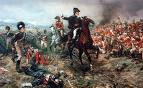
The Duke of Wellington was a famous lion. Like Churchill Wellington had been uninterested in education as a schoolboy. He shows the characteristics of a Lion. He was at the Congress of Vienna when Napoleon returned from Elba but sent to command the Allied armies in the Netherlands, where he cooperated with the Prussian general von Blücher.
Wellington was surprised by Marshal Ney at Quatre Bras and fell back on Waterloo, where he held on until Blücher came to his aid after the Prussian defeat at Ligny. Wellington won one of the most decisive battles in history. He was respected by his troops, who admired his composure under fire and his successes were due to his study of war, careful planning including supply, and realism.
He defeated by Foxes Cobden and Bright who promoted free trade to bring about world peace. In 1846, the year The Corn Laws were repealed, Cobden said” I believe that the physical gain will be the smallest gain to humanity from the success of this principle. I look farther; I see in the Free Trade principle that which shall act on the moral world as the principle of gravitation in the universe – drawing men together , thrusting aside the antagonism of race, and creed, and language, and
uniting us in the bonds of eternal peace.” The Victorian historian James Anthony Froude lamented that we had chosen economics over duty as Foxes were taking over from lions and this can be traced through the century as economics replaced values like “nobility”, “duty” and “honour”.
It was Disraeli who turned the Conservatives into an opportunistic party from one of tradition.
Disraeli was apparently determined to obtain independent means, and speculated on the stock exchange as early as 1824 on various South American mining companies he was a progressive Tory and only nominally a Conservative and was sympathetic to some Chartists demands and
argued for an alliance between the landed aristocracy and the working class against the increasing power of the middle class. He was a founder of the Young England group in 1842 to promote the view that the rich should use their power to protect the poor from exploitation by the middle class.
During the twenty years which separated the Corn Laws and the Second Reform Bill Disraeli sought Tory-Radical alliances though unsuccessfully. His rival Gladstone a Fox, was opposed to General Gordon, who expressed the values of lions in his journal about “honour to his country”.
Lord Kitchener was worshipped by the public but attacked in the Commons as a “butcher” and “Imperialist” by foxes and then pushed out of the War Cabinet by Lloyd George who formed the War Committee, which had dictatorial powers and took over the running of the war. A reformer,
Lloyd George also outmanoeuvred and replaced General Sir William Robertson, Chief of the Imperial Staff with one of his own kind, Sir Henry Wilson, who wrote more of the balls he attended and the dignitaries he met than anything honourable or noble. Robertson was forced to resign
on 11 February 1918, taking the lesser role of Commander-in-Chief of the British Home Forces (replacing Sir John French). Wilson had connived with Lloyd George to create the Supreme War Council which Robertson had vociferously opposed.
Robertson is the only man in history to rise to Field Marshall from private. A staunch supporter of Sir Douglas Haig, Robertson acted to prevent Lloyd George’s attempts to divert effort from the Western to the Eastern Front; unlike Lloyd George, Robertson was a keen ‘Westerner’, believing that the war could only be won on the Western Front.
In “Soldiers and Statesman 1914 –1916” (1926) Robertson repeatedly stresses “duty”. He highlighted the anti military bias of Foxes when he wrote of how Lloyd George and his war cabinet took a private house to seclude themselves from the Generals “where they sit twice a day
and occupy their whole time with military policy, which is my job; a little body of politicians quite ignorant of war and all its needs, are trying to run the war themselves.”
Stanley Baldwin turned the Conservative party from imperialism to offering inducements to voters such as “houses” and “prosperity”. A century of disarmament, on both sides of the Commons, when old Tories spent their time preaching appeasement and dozing in London clubs while Socialists had fantasies about Internationalism, disarmament and submitting to the League of Nations when we were the most powerful country – left us weak and nearly defenceless.
Before being removed or nullified The Lions were first “Stigmatised”. The Lion Churchill spent a decade in slandered obscurity as a “Warmonger” before being needed to fend off Wolves. A Lion called Enoch was sacked from the shadow cabinet by arch-Fox Heath, who has since admitted
misleading Parliament and thus the people into the federal state of Europe, which he claimed was merely a trading arrangement. Fox John Major deceived us when he pretended that we retained control over our borders after his legal advisors had advised him that had been signed away at
Maastricht.
We have constant moral outrages such as Blair’s infamous sending our troops to war on a lie and his habitual lying to the population. Michael Howard campaigned for election on immigration control when he knew that the European Union would not allow him to implement his plans even
had he meant to do so. In June 2004 it was revealed he is an investor in communications firm Incepta. A subsidiary company Citigate Lloyd Northover won 2 Home Office contracts to develop Websites and communications technology to speed up applications from immigrants to enter the
UK. The company also gained from the Immigration and Nationality Directorate website for the Government to facilitate admission and settling of asylum seekers.
Parato’s world has deteriorated even more to our time. He wrote:
“The plutocracy has invented countless makeshift programs, such as generating enormous public debt that plutocrats know they will never be able to repay, levies on capital, taxes which exhaust the incomes of those who do not speculate... The principal goal of each of these measures is to deceive the multitudes.”
When a society’s system of values deteriorates to the point where hard work is denigrated and
“easy money” extolled, where authority gives way to anarchy and justice to legal chicanery, such a society stands face to face with ruin.”
“It is a specific trait of weak governments. Among the causes of the weakness two especially are to be noted: humanitarianism and cowardice - the cowardice that comes natural to decadent aristocracies and is in part natural, in part calculated, in “speculator” governments that are
primarily concerned with material gain. The humanitarian spirit ... is a malady peculiar to spineless individuals who are richly endowed with certain Class I residues that they have dressed up in sentimental garb.”
Should the great Dead White Male Geoffrey Chaucer return to us he would behold not a Parliament of Fowls, but a Parliament of Foxes.
1. The Triumph of the Political Class. Peter Oborne (Pocket Books) 2008
For corruption and deceit in the global media see:
“Flat Earth News by Nick Davies (Chatto & Windus) 2008
Pareto’s most famous work is: “Mind & Society” which was published in 1916
http://www.bolenderinitiatives.com/sociology/vilfredo-pareto-1848-1923/vilfredo-pareto-theoryelites-
and-circulation-elites
Rescuing Our Children from State Control
I recently wrote about a politically interested judiciary attacking our ways and importing terrorists now I want to give an introduction to how young British people are being neutralised to prevent them defending themselves from colonisation. 1
Since the rise to power of the New Left, in the 1960 - ‘70s education has been gradually changed from developing the child’s abilities to instilling the correct attitudes. There has been a change in what is taught and how it is taught. In the Liberal system education imparted the Liberal internal
dialectic which is the way people reasoned within liberal parameters. You took pro and contra views and discussed their merits to reach a conclusion like finding truth through discussion.
But “Cultural Marxist” education abandons education for inculcating the correct opinions and attitudes to create an accepting frame of mind for contemporary “anti-racist” ideology. For example, only selected topics can be taught in history with the Second World War dominant because the fight with Nazism is used to stigmatise people who are trying to save their country as racists and frighten children away from Nationalist sentiments. They also teach Henry VIII to show tyranny and anti-feminism.
The surrender to Islam and the new anti-Semitism of Muslims is evident in education.
A Government funded study in April 2007 found that Schools are abandoning teaching the Holocaust in history lessons to avoid offending Muslim pupils whose do not believe the Holocaust happened and are frightened to teach the 11th century Crusades when Christians armies fought Muslim
armies for Jerusalem because a different version is taught in mosques. They also teach a version of the development of slavery, which omits the much longer and harsher Muslim slave trade to inculcate guilt in White children to control them. 2
Yet, children could be taught sex education from the age of four, under plans by MPs The Daily Mail of 27th August revealed. They want the Government to make advice pregnancy rate, which is among the highest in Europe. Sexually transmitted diseases are becoming increasingly prevalent
among youngsters after being brought from Africa by immigrants. But rather than face this up to this a group of MPs led by Chris Bryant, parliamentary aide to Harriet Harman, says that the solution is to educate children more about sex education from a much earlier age. “Bryant is
openly homosexual and BBC News reported on 2nd December 2003 he apologised for e-mailing a picture of himself in his underpants via a gay website. From 1994 to 1996 he was London manager of Common Purpose the controversial charity.”
The MPs claim that this is not enough and that children should be given relationship advice ‘in context’ if they are to make informed decisions about when to have sex. Many Muslims will opt out of this as it will be teaching homosexuality as equal to heterosexual relations. This ignores the
essential duty to re-produce. Propagandising homosexuality is a threat to our demographics. 3
My young niece looked at herself sidelong in a mirror and you could see the woman in her. Teaching her about sex would be wicked as she would not understand the words and putting this in her head could lead her to say things about adults without knowing what she was saying. The idea is the train people to have the type of relationships approved of by adherents to the dominant ideology of “Equality” and “anti racism.” They also teach about contraception and sexually transmitted diseases which is compulsory in primary and secondary schools.
Even worse, The Daily Mail of 22 August 2008, reported that almost a quarter of all babies in Britain are now born to immigrant mothers. In London the figure is 54 per cent, rising to 75 per cent in some boroughs....A report revealed that one in eight pupils speaks English as a second language...MPs and unions have called for urgent action to prevent schools being overwhelmed by the pressure. Migrant children take longer to understand lessons and divert the teacher’s energies from other pupils.
In 1965 Peter Griffiths Conservative MP for Smethwick called for special classes to teach immigrants English and was accused of wanting to start apartheid in schools.
Children are withdrawn for, bullying, unhappiness, failure to cater for SEN, or problems with teaching style and the curriculum but now we have to save our children from state manipulation.
The uniting of Capitalism with revised Marxism, Cultural Marxism.
Revisionists like Gramsci had realised that the working classes were not following Marx and the way to subvert Western civilisation was through the culture. They took over education and teachers training colleges and also jettisoned Marx’s economic arguments leaving the way open for corporations to use group rights in their entitlements programmes couched in olitically correct language and sponsor fashionable causes.
In the 1960’s the watchwords of The New Left were “Everything is political” and “The personal is political.” They wanted to “change attitudes” and “consciousness.” These are the seeds of the nascent totalitarian state we are in. 4
You may well wonder how these totalitarian ideas caught on! They were originally presented as “Liberal” - “new Liberalism” as opposed to “old Liberalism.” Traditional liberal beliefs like individual rights were replaced by group rights for specially designated victims and these were racial, gender and sexual orientation privileges.
What was known as identity politics was an inversion of Hitler’s persecution of different races, homosexuals and gypsies. These groups are beneficiaries of official prejudices over Hitlers favourite group Whites! Even now people who advocate Political Correctness describe themselves
as liberal and think they are tolerant!
Cultural Marxism (rather Cultural Nazism against us) is a total ideological system, imposing or manipulating opinions for all aspects of life . It is a version of Stalin’s Russia. This process begins with children at school and operates on different levels. It is not just minds to be controlled. Like the Communist states they want physical control and the means to correct ideological error. This is being implemented now and there have been warning signs: The State holds DNA records of nearly a million children, some as young as five, and has been secretly taking their fingerprints since 2001. Each week 20 schools introduce fingerprinting.
Ostensibly this helps them develop a love of books and reading. It replaces library cards by the child’s fingerprint and placing the print on a scanner opens their computer file with records of the books they have borrowed. Minister for Schools and Learning, Jim Knight, revealed that when
working on a crime police have access to the children’s fingerprints but parents are not told.
To remove the prints takes professional cleansing. The schools, education authorities and the Government say it is difficult to convert this code back though not impossible and a whiz with a computer could re- create the original fingerprints for identity theft.
In July 2006 The Observer reported that British children, possibly as young as six, will be subjected to compulsory fingerprinting under European Union rules being drawn up in secret. The prints will be stored on a database which could be shared with countries around the world. Under
proposed laws being drawn up secretly by the European Commission’s ‘Article Six’ committee, which is composed of representatives of the European Union’s 25 member states, all children will have to attend a finger-printing centre to obtain an EU passport. The Home Office wants to include children in its biometric passport scheme and automatically transfer their details and fingerprints to the new national identity database when they are 16. The Government is underhandedly building a
genetic database. Data has been used for genetic research without consent, including attempts to predict “ethnic appearance” from DNA profiles.
Leo McKinsty commented on our Olympic achievements in the Daily Mail of 20 August 2008: over the past weekend, our sailors, cyclists, swimmers and rowers won an unprecedented eight gold medals, by far the greatest haul by Britons in two days in a century of Olympic competition...
Of the 14 heroes pictured on the front page of yesterday’s Mail, six were educated at independent schools…The concept of a talented elite is despised rather than celebrated. Excellence should not be encouraged for fear of lowering the self-esteem of those who lag behind… there is the growing feminisation of the teaching profession, where more than 90 per cent of primary school teachers and 60 per cent of secondary teachers are women - a development that again leaves many sporty boys unchallenged.”
The new elites undermine male authority and attack masculinity patriarchy.
They see the main enemy as white racism and this justifies disadvantaging white pupils. No other ethnic group can be racist because they are sentimentally categorised as victims of our oppression and require “special
needs”. While we are stigmatised as oppressors our children are oppressed at school by telling them their clothes or views could offend the privileged groups. This means is moulding children into the correct way of acting and talking.
A notorious example was reported by The Times of 7 march 2006: “Traditional nursery rhymes are being rewritten at nursery schools to avoid causing offence to children. Instead of singing
“Baa baa, black sheep” as generations of children have learnt to do, toddlers in Oxfordshire are being taught to sing “Baa baa, rainbow sheep”. A spokesman for Ofsted, the watchdog which inspects Sure Start centres, confirmed that centres are expected to “have regard to anti-discrimination good practice” and that staff should “actively promote equality of opportunity. They are trying to destroy Christmas. This is the Soviet technique of making reality into what you wish it was.
The Daily Mail of 11th December 2006:”It is the time of year when parents and grandparents look forward to seeing their children dressed up as Mary and Joseph or the Three Wise Men. But the traditional Nativity play at Knowland Grove Community First School in Norwich has been axed in
favour of a celebration of a range of different faiths.”
But the most alarming was in the Telegraph of 8 July 2008. The National Children’s Bureau guidance to play leaders and nursery teachers advising them to look racist incidents among youngster’s in their care. This could be a child of three who says “yuk” to unfamiliar foreign food.
The guidance is designed to highlight potentially-racist attitudes in youngsters from a young age.
It alerts playgroup leaders that even babies can not be ignored in the drive to root out prejudice as they can “recognise different people in their lives”. The NCB receives £12 million a year, mainly from Government funded organisations and therefore the tax payer is having money taken to pay for their own children to be moulded by brainwashing into what the Cultural Marxist elites want them to be.
The authorities are tightening their control of children.
The school leaving age is to be raised to 18 making more time for state parenting as in school holiday clubs and breakfast clubs. This is to condition them for being monitored 24 hours a day in the EU.
Home educating parents receive income support until their youngest child is 16. But new legislation comes into force and when the youngest child is 12, income support will be replaced with job seeker’s allowance and the parents have to seek work. In 2010 the age limit for the youngest child will be reduced to 7 years old. The totalitarians want to take control of children.
There is legislation to force home educating parents to get a job and send their children to school. It costs about £5,000 per year to keep a child at school so this is not an economic decision but a political one. The government should give home schoolers a tax deduction to the same value
of sending their child to a state school. A voucher scheme would allow parents to either home school and use the voucher to pay for necessities like books, or, to send their children to state or public school and re-deem the voucher against the cost. Universities are open to Home Schooled
children.
Home schooling families could get together to form Home school co-ops. These groups could meet weekly to provide a classroom. They are support families who link to share their abilities and resources and broaden the children’s education. This enables children to do science experiments,
art projects, spelling bees, discussions; use museums, community centres, athletic clubs, afterschool programs, churches, science preserves, parks, and other community resources. There are sports fields and leisure centres to use. By forming groups we could get discounts for block bookings. Secondary school level students may take classes at community colleges, which typically have open admission policies. Parents could work as volunteers.
The one deep fear the elites have is “White man” turning so they want to take stronger control of children. If we awaken all this evil control will be swept aside as we are still numerically stronger and have great and noble traditions of winning wars that seemed lost.
1. http://sarahmaidofalbion.blogspot.com/2010/01/political-judges-at-war-with-britain.html
2. http://sarahmaidofalbion.blogspot.com/2008/03/myths-behind-white-guilt.html
3. http://isupporttheresistance.blogspot.com/2008/12/paedophile-supporters-defeat-bnp-in.html
http://newportcity.blogspot.com/2010/01/chris-bryant-minister-for-underpants.html
4. http://www.thegreenarrow.co.uk/index.php/writers/reconquista/1425-marxism-exposed-howlabour-
and-the-tories-are-destroying-britain
For advice contact on Home Schooling: “Education Otherwise”.
An excellent article by Troy Southgate
http://www.dissidentcongress.com/index.php?page=articles/schooling.html
Two excellent books about PC written from a old liberal perspective are
“The Politics of the Forked Tongue” by Aidan Rankin (New European Publications)
“Retreat from Reason” by Anthony Browne (Civitas).
Putting meaning Back into our World
In the undeclared war to replace British people and their culture with a multiracial society the elites blame “Whites” for all evils including their own dispossession. They are scapegoats manipulated by guilt and blame themselves for corporations importing cheap labour. “We won’t do
the dirty jobs” they have been trained to think by education and the media. This is hogwash for in reality if they refuse a job they lose their benefits.
Socialists live in the past instead of learning from history. The Jarrow Crusade is a famous and noble event in modern British history. It was a march of 200 unemployed men to parliament petitioning for assistance for those unemployed. There is a bridge over The Tyne to Newcastle
being constructed and the French firm with the contract has imported most of the labour from France and other European countries yet I was told by the landlady of a pub near by:” The ones who complain are the ones who don’t want to work.”
They are kept passive with state benefits while in Jarrow, once again, a “high unemployment area,” work goes to foreigners. The re-development of Liverpool was carried out by largely imported cheap labour.
Modern ideas are formulated by unworldly academics when a practical activity like politics requires experience of life and a knowledge of human nature. A student of “Human Geography” told me she likes the exotic communities in her native London and visits for a meal or to watch a cultural show.
But this is the surface of life; the deep side of life is rearing families and developing communities. She goes there as a spectator to sample delights and returns home like a tourist.
This shows how “progressives” see the situation as static but it is not it is dynamic. The immigrants have human nature like us and bring it with them. They replicate their cultures here and prosecute loyalties to their own and grudges against other groups which is why the immigration of Muslims is leading to attacks on Jewish people in Europe and as they grew stronger a New Holocaust which the elites are fostering. As I have written elsewhere, agreements like The European-Mediterranean Partnership heralds the New Holocaust and people of Jewish antecedents like Sarkozy and David
Milliband are bringing it on their own people in Europe. Jewish communities must rebel against their myopic leaders to save themselves and their children.
The young student has been taught the Marxist idea that people are social constructs and have no essential human nature which is a new version of the old body and mind duality. Is the mind separate from the body? In fact the two interact with the male and female genes respectively affecting thought and behaviour patterns. Culture is also interactive. We create a culture through our genes and new generations are born into it and moulded by it.
This is at the heart of our loss of touch with reality. We are taught that men and women are empty vessels but in our private lives assess people we meet else get taken advantage of while our public lives are conducted in a naïve and unworldly way.
On the surface we are socially constructed as the young students views were, or in fashion which is different now from say 10 years ago, a century ago or 2,000 years ago; but human nature is produced by genetic inheritance and unchangeable or we would not understand classic literature
and The Bible.
It had never occurred to her that we are being de-cultured. She had not heard this before and was perplexed and searching round to find a stereotype for me. Are you a racist? This is the negative category they have been trained to slot us into. Students are educated out of using natural common sense. By pretending everyone is malleable with no essential human nature they convince themselves
that all is under control and we are developing into a harmonious multiracial utopia. This type of abstract thinking grew out of The Enlightenment and first showed its potential in The French
Revolution.
The working classes have been trained by the media with constant slander(1) As far back as 1955 workers who tried to defend their jobs were suppressed by the state as the 1955 strike of bus workers in West Bromwich , in protest against the employment of an Indian conductor! When the National Health Service and London Transport were being developed if thy needed labour they should have improved conditions and increased pay structures not imported cheap labour. The British capitalist class have always done this and we read about Irish workers being imported to
break strikes for better conditions in Mrs Gaskell’s classic novel Mary Barton. They should learn from history after the trouble they caused by importing labour like Tamils into Sri Lanka to produce rubber.
On 20th January 1955 when immigration from Jamaica was 11,000 a year, Conservative Cyril Osborne(later knighted) had written to the London Times,” But the present West Indian and West African invasion is a mere trickle of what we must expect, because as the law now stands everyone born in the Commonwealth is entitled to come to this country. What shall we do when the millions living in the bigger areas decide to emigrate?” At the second reading of the Commonwealth Immigration Bill (1961) Osborne warned “that the world’s poor would swarm to Britain’s welfare honey pot. We have neither the room nor the resources to take all who would like
to come.” Both sides of the House laughed at him and called him Fascist.” We are seeing this now with boats leaving Africa for Europe.
Eminent economist Professor Ezra Mishan exposed immigration as being about cheap labour in the 1960s. He wrote in The Salisbury Review in 1988: “Frequent claims that the new immigrants have in fact reduced the labour shortage in particular sectors of the economy – in particular, the
apparent shortages of labour in transport, in nursing, and in what are popularly to be the more menial and less attractive occupations- are naïve. Managers of public services in Britain who, along with some private firms, sent agents to the West Indies in the 1950s in order to recruit labour were only acting as good capitalists would in such circumstances – attracting lower-paid labour from outside their area in order to prevent wages from rising within it. If it was not for that wages
would have risen.”
The elites are creating what Marx called “A reserve army of labour.” In November 2006 it emerged that the Government were advertising for immigrants to come here. A Foreign Office pamphlet declares: ‘Multicultural Britain - A Land of Immigrants’. It encourages immigrants to move here because of the preferential treatment they get under the Human Rights Act and well-paid jobs. The Foreign Office put it in embassies across the world.
In a book review for the Salisbury Review of Spring 2003 Sir Alfred Sherman, former senior advisor to Mrs Thatcher and leader writer on the Jewish Chronicle, recalled a friend in race relations had asked him to take a look at the reception areas of Deptford and Southall in the mid
60’s, “ I was horrified. My natural vague sympathies for the immigrants, strangers in a foreign land, was replaced by strong but hopeless sympathy for the British victims of mass immigration, whose home areas were being occupied. I was made aware of a disquieting evolution in “Establishment”
attitudes towards what they called immigration or race relations and I dubbed “colonialisation.”
The well-being and rights of immigrants and ethnic minorities had become paramount. The British working classes, hitherto the object of demonstrative solicitude by particularly the New Establishment on the left, but the working classes had acquired new status as the enemy, damned
by the all-purpose pejorative “racists.” The transformation of Southall was brought about by Wolf’s rubber factory encouraging workers from India.
They use abstract pejoratives to justify doing the opposite. The new elites detest competition and advocate co-operation to suppress male aggression as part of their feminisation programme. Leo McKinsty commented on our Olympic achievements in the Daily Mail of 20 August 2008: “Over
the past weekend, our sailors, cyclists, swimmers and rowers won an unprecedented eight gold medals, by far the greatest haul by Britons in two days in a century of Olympic competition...Of the 14 heroes pictured on the front page of yesterday’s Mail, six were educated at independent
schools… nor is this some statistical anomaly. The disproportionate Olympic success of privately educated contestants has been an enduring pattern in recent years....Equality of outcome is the
central theme of the politically correct British state. The concept of a talented elite is despised rather than celebrated.
The new elites loathe male authority and attack masculinity as patriarchy. They see the main enemy as white racism and this justifies disadvantaging white pupils. No other ethnic group can be racist because they are sentimentally categorised as victims of our oppression and require “special
needs”. While we are blamed as oppressors we are being oppressed at school as children are told their views could be offensive. What this really means is what they are doing does not fit into to the totalitarian ideological orthodoxy.
Old fashioned categories like opposing immigration are no longer applicable because massive and uncontrolled immigration for social engineering and cheap labour take our territory so we are actually defending ourselves against colonisation.
When we were homogeneous we trusted one another and the police did not need to be armed; we are in a surveillance state and have totalitarian race laws to oppress us.
To control thought totalitarians redefine words and change the meaning of legal terms. Sir Ronald Bell told W.I.S.E. in 1981: “… a discriminating person was someone to be admired. People have been brainwashed into thinking that it is a bad word except when native inhabitants are being
handicapped. That is now called positive discrimination, and is deemed a good thing.”
We need to develop a new political vocabulary to express what is happening to us and how we see the world and describe human nature and why this rules out a successful multiracial society. The Welsh have it right in their great anthem “Land of my Fathers”. Country is vapid but land
means something. The ruling bureaucrats of the EU and our regional Government are restricting our vocabularies through PC so that we speak and think in the way they want us to. We can not express our sufferings in PC terminology because the words are essentially biased against
our interests like the young student who could not understand what I said but had to apply the connotative term “racist” to me. A connotative word carries a set of associations or connotations above the literal meaning. Only “Whites” are classed as racist!
The terms “narrow-minded” and “bigot” are only applied to traditional views while narrow-minded multiracial bigots are presented as morally superior! I recently tried to talk to one from Bingham about villages becoming dormitory places where young locals could not afford to buy or rent property because of weekend dwellers. I asked what had caused it and he replied rich people from London and Manchester. I pointed out that in the big cities this is caused by pressure from asylum seekers and the birth rate of immigrants and that the government is bringing them at a rate
of 1500 a day. I replied I get my information from government documents in The Public Records Office. This threatened his fixed view of the world and he stormed out of the room in a perfect show of “narrow-minded bigotry!”
Society is an old liberal term and we must speak for up ourselves and a British community. All communities grow out of collective human nature. Today’s view of persons interacting in societies originated with Enlightenment philosophy - people are equal, interchangeable units of production and consumption with differences of race, nationality, culture,
gender and ability seen as social constructs and impediments to social harmony.
Real people are not abstractions like “equals” or “humanity” but Englishmen and Frenchmen and women, Indians etc. Burke, Thucydides and Confucius all stressed the importance of human nature. Our loyalties like those of immigrants” … begin (with) our public affections in our families...we pass on to our neighbourhoods” this expands outwards to our nation. Men and women have distinctive and individual identities within their inherited collective identity. We belong to our kin above strangers and this affects the type of community we create.
The family, locality and nation, are parts of a natural, organic state as opposed to an artificial one based on planning. The French Revolution, like the Soviet, Maoist and Cambodian, were attempts to recreate human nature and refashion a people. The modern world is dominated by artificial
empires, Global corporations and bureaucracies, which treat human beings as abstract entities.
However, tribalism is returning and the future belongs to these human scale structures which
develop over time not instant and artificial creations.
Burke’s famous definition of society is that it was a continuous community of the living, the dead
and those who are yet to be born. Each man and woman is part of a larger body. The individual dies, but descendents live on. Tradition is a surer guide to action than abstract reason and our parents advice received from their parents before them is better than a rationalist formulae in a
“How to …book.” Modern society believes change is always better than what exists and the past is obsolete. But we inherit what we are and what have from our ancestors and have a duty to pass it on to our descendents not dissipate amongst the rest of the world.
A nation’s manners, its morals, its religions and political institutions, its social structure, are inherited from ancestors and grow out of the character of the people at that time. Government from Brussels, economic control by Global corporations, and Afro-Asian colonization is part of a
new dream for an ideal future; but in practice it is disinheriting our children to whom we are morally obliged to pass on the inheritance.
It is the ceding of territory to the colonialists that shows the weakness and effeteness of our rulers.
Throughout history wars have been fought for territory and by allowing newcomers to stake claims our girly elites are encouraging them to fight for more. In The territorial Imperative Robert Ardry explains how much having a country has boosted Israelis. Our rulers are doing this for invaders and this changes our relationship to them.
We obliged to put our nation first, as we do with our families, even when outsiders and foreigners are more in need of our help. Charity should begin at home but if people wish to donate money to
foreign causes they should be allowed to do so but supporting outsiders against our own kind is a moral evil.
1. This is a classic piece of propaganda from contractor UK for cheap labour that blames the workers for the corporations using cheap labour.
http://www.contractoruk.com/news/002578.html
http://www.thisismoney.co.uk/news/article.html?in_article_id=401211&in_page_id=2
I Am the Slime Oozing Out Of Your TV Set
By he comparatively innocent days of 1972, “Slime” by Frank Zappa was an attack on capitalist control of people through television. A lot has come into the light since 1972 and we are now aware of the real nature of the war being waged against us by the ruling elites using psychological
manipulation instead of declaring war. It is done by deceit; free speech and thinking is suppressed to further the fantasy of everyone uniting in worldwide racial harmony and moving populations around for the practical purpose of cheap labour. There is always a gap between the ideals and
reality.
The Sun online on January 14th, reported that the British government has published guidelines for the media calling for certain words to be dropped and the suppression of stories about non-white crime. Words to be suppressed: “immigrant,” “illegal immigrant,” “illegal asylum seeker,” “bogus asylum seeker,” “non-white,” “non-Christian,” “mixed race,” “half-caste,” “mulatto.”
Further, people must not be identified by race or religion. (Race and religion are the bedrock of identity). The media is told to give racial minorities preferential treatment in hiring to have a more “multiracial” staff. They are told to portray ethnic minorities in a more positive light. When discussing public opinion always use quotes from ethnic minorities. Follow their taboos: learn what local ethnic minorities don’t like and then omit these things from your paper. Encourage White Britons to embrace elements of third world immigrant cultures. Promote and
glorify the holidays, customs, and religious beliefs of non-white immigrant cultures.
Expose “racists.” The government document explicitly tells those in the media to portray minorities in a more positive light while holding white “racists” up to ridicule. The guidelines are not a legal requirement but people are already prosecuted for so-called “hate speech” - speaking out against Islamic immigration.
We are being brainwashed by the schools and the media into unnatural ways of thinking and acting. Schools as “re-education” camps like the American programme to re-educate Germany after the war led by Frankfurt School guru Theodore Adorno.
We have to be very clear about the intentions of the elites who are trying to destroy us. While this propaganda is used to pacify us for our demise they are also bringing people in to push us out of our communities. This is an attempt to dispossess the indigenous people of Britain and replace us
with what Marx called “A reserve army of labour.”
The Dail Mail of 23rd February: “Labour encouraged mass immigration even though it knew that people opposed it, and that is an attack on the people. Whitehall documents show. The trick
that has been used to shame us into being pushed out was deliberately employed again. The propaganda was the public disagreed with immigration because of ‘racism’ and ministers were told to try to alter public attitudes.” This is what has been going on since the 1960s.
“The thinking on immigration among Labour leaders was set down in 2000 in a document prepared for the Cabinet Office and the Home Office, but the key passages were suppressed before it was published. The paper was finally disclosed under freedom of information rules. It showed that
ministers were advised that only the ill-educated and those who had never met a migrant were opposed to immigration. They were also told that large-scale immigration would bring increases in crime, but they concealed these concerns from the public. These have showed that Labour aimed to use immigration not only for economic reasons but also to change the social make-up of the country” Ebay banned the sale of a “Dads army” game because it mentions Nazis and is therefore “racially offensive”! We are being controlled in our thoughts and in our actions, subliminally, but that will
change as people become more conditioned and indoctrinated school leavers enter the herd.
We live in a sterilised world that hates individualism and non conformity. Everyone has to think the correct things – dissent is not tolerated.
I was in Cambridge and Cheltenham libraries where they allow people to eat while using the computers and censor what political or cultural sites people can read. When I told an official at Cambridge that it is disgusting to have to listen to people eating while using a computer, she
replied: ”We are trying to be inclusive”! This is an everyday example of how impractical the dominant ideology is. Food can damage computers and could also spread infections if undetected in the keyboard! They mindlessly follow current political fashion and fear thinking for themselves.
One of the media for manipulating people is advertising. “I’d Like to Teach the World to Sing (In Perfect Harmony)” was a major hit from a 1971 Coca Cola television commercial. The song ostensibly sends a message of multiracial harmony through multiracial collection of teenagers
singing harmoniously on top of a hill. But another motive was opening up world markets. In the eighties Coca Cola became the identity of American cultural imperialism under the name “Coca Colonisation.” Wiser now we realise that the US was herself under attack from Globalists.
Another “The united colours of Benneton” showed youths of every colour singing in unison. The idea was to subvert stereotypes but race and behaviour are not stereotypes – they are real! The adverts follow the Soviet principle of showing things how elites wish they were - happy multiracial societies. Attempts to force different types of people together leads to misery as in the South African Rainbow nation where, since its inauguration, at least 3091 White South African farmers
have been genocidally murdered, but this is kept out of the media.
Benetton’s actual products were left out of the advertisements for pure political propaganda. These examples are of Capitalism and Communism uniting for the idealistic notion of a one world living in
harmony and increased profits by breaking down boundaries.
In their own case though, Benetton bought Mapuche lands in Patagonia and evicted the Curiñanco-Nahuelquir family from their land after Benetton’s claim to it, but the land was restored in 2007. They planned to use RFID tracking chips on clothes to monitor inventory. It is claimed
the tracking chips “can be used to monitor the people wearing them.” Benetton used to buy wool from farmers who practiced mulesing - a surgical operation that removes of strips of wool-bearing skin from around the buttocks. Since PETA threatened to boycott them Benetton now buys non
mulesed wool and urges the wool industry to adopt the PETA and Australian Wool Growers Association agreement to end mulesing.
Revisionists like Gramsci had realised that the working classes were not following Marx and the way to subvert Western civilisation was through the culture. They took over education and teachers training colleges and also jettisoned Marx’s economic arguments leaving the way open for corporations to use group rights in their entitlements programmes couched in politically correct language and sponsor fashionable causes. In the 1960’s the slogans of The New Left were “Everything is political” and “The personal is political.” They wanted to “change attitudes” and “
consciousness.” These are the seeds of the nascent totalitarian state we are in.
In 1997 British Airways dropped the Union Flag from their aircraft but after protests reinstated it two years later. A few years back there was an ad on the BBC about not paying the TV licence. The licence dodgers portrayed were white. The public information films and ads about swine flu depict only white people sneezing or wiping germs onto common surfaces etc. In one nauseating example a white man sneezes in a lift just before a black couple get in.
“Only fools and Horses” portrayed white muggers in the Batman and Robin episode. Michael Caine’s new film Brave Harry Brown depicts members of the gang he pursues as White to kid the public multiracialism is not dysfunctional.
The soaps and dramas show what they wish was happening. An episode of Spooks depicted the “racist” harassing Indians. We see this with the projection of their aims in adverts like for dreams beds where a black man is shown with a White woman and this image is in very branch of my
bank. They are trying to wipe Whites out.
We are constantly bombarded with campaigns to make us believe that ‘ethnics’ are part of our culture and heritage. History is rewritten, ‘ethnic’ actors enact roles in historical programmes
to create the impression they have always been here, and children and unthinking adults sub consciously take this in.
The masses are diverted from reality by reality shows. These, coupled with a sophisticated conditioning campaign, ethnic minorities being shown positively in every advertisement, are lulling the population into believing that all in the garden is rosy when the threat to our civilisation is growing.
There is a photograph showing Stephen Lawrence making the black power fist but the establishment present him as a saint as they do Martin Luther King. Gang tribal wars are not helping. There is a huge amount of factual evidence that clearly shows the damage brought by immigrants to our
society, but the moment a white British person mentions they are dehumanised by being labelled racist and persecuted.
There are no police checks on immigrants entering Britain , only when they commit a crime do the police check –it doesn’t matter about the people who suffer at the hands of these criminals. The elites ignore our human rights.
A vehicle for mind altering is soaps. They present scenarios in which they play out the stereotypes of evil white racists and kindly, honest and capable blacks - constantly hammering home the ideology by auto-suggestion.
A perverted form is where young girls- who are avid TV watchers - are led astray by suggestions for how they should behave - what is acceptable in society, what is unacceptable. These “soaps” are supposed to reflect real life. The slime that is spewed out beggars belief.
TV teaches youngsters how to behave to be liked. There are programs to instruct you ‘how to eat right, how to think right, how to exercise right, how to dress right and what sort of person is desirable.
TV also creates people’s belief of what is happening in the world. Eastenders some years ago showed two young white actresses mugging with violence a much respected elderly black actor, how often do you think this happens on our streets? I stopped watching TV because of how they portray the English. It is a revised-Marxist subversion of our values and traditions like our families and communities. All that gives our lives meaning must be destroyed for prospective multiracial utopia. Give up watching TV. It is easy: there are so many rewarding things to do, particularly with your children who need starting on the right path in this world of cultural elites corrupting the young.
The fact that the vast majority of racist violence is directed at whites is something which even the most brainwashed of liberals find difficult to refute so they keep it quiet. The British crime survey 2006 shows that in the most serious categories of racial attacks, woundings and murders, out of 24,000 incidents, 20,000 were committed against whites. At the same time we are told we don’t exist as a race. This Establishment ideology permeates everything while working towards a goal: to suppress, crush, humiliate, rob of identity, rob of respect and eradicate the true people of Britain - the new Kulak class!
Britain is reduced to warring tribes instead of a nation. As witnessed in towns and cities murder and stabbings are committed for no apparent reason. Most of these crimes are ethnic ‘majorities’fighting for territory.
Reality differs vastly from the orthodox ideology that is propagandised. The importation of cheap labour from abroad puts our own people at a disadvantage but is hidden by the glossy Multi-Culti adverts. According to official statistics, one in five adults in Britain is out of work. These statistics reveal that there is well over 8 million people who are declared “economically inactive”, which is a record number according to the Office of National Statistics.
People who are labelled as “economically inactive” are students, the retired, parents who stay at home with children, the long term sick, and un-surprisingly, people who have simple given up looking for non-existent jobs. Before you get the wrong idea, the 8.05 million does not include the 2.46 million unemployed. When you add these together, it really puts things into perspective. Presently 21.2 per cent of the entire British adult population are out of work. This revelation came as it was also claimed that the unemployment figure fell by 7,000 in the three months to November 2009, and now currently stands at 2.47 million.
In fact there are two main reasons why the figure has fallen: Firstly, people are becoming desperate and are willing to work for low pay and shorter hours to keep their jobs, which many families as a result will feel the impact of lower incomes for years to come, as a record breaking
1.03 million are working part time because it is impossible to secure full time work.
Secondly, the fall in unemployment is also a result of the rise in the “economically inactive” people, including school leavers who have chosen to go to college rather than spending many months looking for work which isn’t there. And while the government try and improve their public image by boasting about the fall in unemployment families struggle on extremely low wages. What is even more worrying is that 27% of people who do have work, work in the public sector which is leading financial services at 16%.
The net increase in private sector jobs since 1997 is nil but 2.1 million jobs in the public sector were created, 1.2 million of which went to workers from overseas.
Transferring Power
We are living under in a tyranny and those with power and treat White Britons as somethingpotentially dangerous and therefore in need of oppression, even dispossession. The attack on working class people for example is cultural as they financially propped up by welfare benefits;
their mental needs with laid on entertainments – but there is a constant message that they are no good. The important thing is to learn who they are and where they belong and to value themselves. This is what has been called The Culture wars. It is the destruction of our traditional society for a plan of a global utopia. Its promoters see it as progress, liberation from past prejudices and restraints.
The fact is, this nation is being changed. It is becoming more Asian, West Indian, African etc. If the self-declared ‘libertarians’ and democracy lovers really think this country will be a pleasant place to live under these circumstances they are seriously deluded. All the evidence is there: inter-ethnic violence, voting fraud and commitment to political parties that look after their ethnic interests.
The selfish middle classes who adopted a morally superior attitude when the working classes were being pushed out now find their own children beginning to lose. Former Conservative MP George Walden wrote of how we are being replaced in “Immigration is Fine For the Rich” (Times of 5th November 2006):” We hadn’t got far in a Today programme discussion of my new book “Time to Emigrate?” … Slurs about racism I expected. Instead I was accused of favouring eugenics, a more original interpretation of my thesis, for which there is no evidence in the book… hinting that you
are a neo-Nazi for raising the issue of excessive immigration is pushing it.
The previous day the Office for National Statistics (ONS) had announced some startling new figures: Britain was taking in 1,500 immigrants a day, while 1,000 Brits left. Which rather confirmed the central premise of my book: that more people were moving out as well as in, and that a growing number of emigrants — by no means necessarily racists — were quitting because of the
numbers coming in.”
Migration Watch has had the truth revealed released official documentation. Whitehall has had to release papers revealing that labour implemented a secret plan to relax border controls to change Britain. A memo written for Blair in 2000, shows that the Government’s strategy was to “open up
migration” so they could achieve “social objectives.” Ministers kept this hidden from the public.
Weakness and sentimentality got us in this mess. The young don’t know it but they have been corrupted and weakened by emasculate talk of compassion and tolerance. The new elites promote a version of progress and see the past as obsolete. Edmund Burke accurately summed these dreamers up: “ You think you are combating prejudice but you are at war with nature.”
The attitude of the current batch of moral and intellectual inferiors who control public life is to transfer power away from their descendents to rival communities.
To try and understand the mentality of the new elites who are having their own people pushed out look at Roy Hattersley’s article in The Guardian of 8 April 2005: “I took the votes of Birmingham Muslims for granted.” … But if, at any time between 1964 and 1997 I heard of a Khan, Saleem or Iqbal who did not support Labour I was both outraged and astonished. My presumption was
justified. It was the Muslim vote - increased by an influx of families from Kashmir, the Punjab and other parts of Birmingham - which expanded my majority from barely 1,200 to more than 12,000.
... Back in Birmingham this week it was clear that the Khans, Saleems and Iqbals have developed a new - and more healthy - attitude towards politics... The change has not produced quite the results which the pundits anticipated. When I represented Sparkbrook, Mustaq’s was a corner grocery shop. Now it is a huge glass and stainless steel emporium owned by Mustaq Food Machinery Limited - an international company which exports throughout Europe from its showroom on the other side of the road.
... Nobody to whom I spoke during my visit to Birmingham chose to talk about the postal vote rigging which had been exposed and condemned the previous day. Reaction to my own inquiries confirmed the reason for their reticence. The six corrupt councillors happened to be Muslim“.
This is an aspect of “progressive” thinking. They split subject and form. In this case religion is separated from behaviour and work from worker. Work here is part of our inheritance as our ancestors created the industries and should be indivisible from British workers not treat the global populations as interchangeable.
That is a mix of self-interest and a failure to understand human nature. The ethnic minorities are not just abstract categories to be sentimentally labelled as “Victims” to be empowered they are loyal to their people and are here to make it. What they do used to be done by our people. The authorities act as if the two are interchangeable. Why are we no longer doing it? We are losing our skills because the elites are selling our industries to foreign countries who when have our technology and will not want us.
When we inherited England we inherited the obligations and responsibilities not just the benefits and it is reprehensible to invite outsiders in to empower them while passing Race Laws to oppress White Britons. This deprives our descendents and leaves them without.
This involves deculturation which causes depression and a sense of futility. Nothing is worth doing. It turns the victim against his own people to get what they want that way instead of earning it because of the loss of self worth. We don’t belong, are out of place and fail to re-produce as we see no future. There are several ways this is effected – encouraging homosexuality, abortion and careerism. Nothing to strive for and this is happening increasingly to young people who have imported cheap labour to compete with and now the young middle classes as half the medical school graduates are Asian. It is the loss of energy and interest in life from the destruction of
community and traditional roots.
It leads to escape in drink where they can feel important and fantasies compensate for our dispossession and reduced status and drugs to create an artificial refuge to numb reality. It is like a permanent state of dehumanization as they feel unreal and need substances to give a sense
of reality. Almost every day on public transport you can smell skunk wafting down from upstairs and see youngsters on recreation and waste ground drinking liquor bought from off licenses.
There are not enough cultural links left to anchor people in their communities which they are being pushed out of by the attempt to destroy what we are. Immigration benefits those at the top who justify it with utopian ideals but destroys everyone else. Andrew Neather revealed that the elites did this deliberately and Cameron wants us to bring in Africans with aids! How they must hate White Britons to want to destroy them and put them t risk of killer diseases when there is no need.
Cameron also wants indigenous people to adopt immigrants ways!
The immigrants have left their own countries and are replicating their culture here and our young are assimilating to it. They don’t know who or what they are and although most will grow out of it they have no real cultural community where they belong. We have become preoccupied with diversion – nonstop entertainment all laid on an involving no personal creativity, inability to sustain relationships. The elites have introduced 24 hour drinking and super casinos to divert us and destroy us. The spiritual life has been replaced by abstract political ideologies; our way of life by artificial substitutes We have basic needs like food, drink, air, shelter, but there are also emotional needs like secure bonds of affection and esteem within either immediate relationships and spiritual needs, the deep need to belong to a particular people sharing inherited genetic patterning of the mind which both produces a culture and needs it for sustenance. We live in it and it lives in us. This is known as a culture or civilisation and if deprived of this one becomes listless, aimless or hyperactive in the search for diversion.
We are the products of this in not only our own being but all around are extensions of us. Our towns, cities, villages and the countryside we visit. We are part of the same arrangement as the locals in those places. It is produced by our genes and then moulds the newborn giving them something of their own and somewhere to belong.
In cities like Birmingham and London indigenous people have no sense of community and seek substitutes in small groups in pubs which peer suspiciously at those they do not know. They have taken refuge in small groups of people who know each other. This is matched by the destruction of
the family. For years the elites through both ruling parties have socially engineered this by such as tax incentives to single parents.
Young people form communities of type and this is encouraged by their favourite type of music to give them substitute identities because they don’t now what they are The elites’ belief in Nazis is part of the moral understucture of the ruling ideology. It is how they soften us up to be taken over by immigrants. Our moral core is that we inherited a natural way of life and it has only been changed because it has been corrupted. Our strength is that this is ours by natural descent and was bequeathed to us naturally. This our tradition - not weakness in the face of danger excused as tolerance. It is our duty to maintain it - not a right or privilege.
We owe it to our ancestors out of reverence and owe it to future generations out of duty. Even if we do not personally like something such as folk music, we have a duty to preserve them. It is for
each to do according to their capacities. It does not need justifying it is our natural birthright. We must not let others encroach upon our proprietorship as the weak are always overtaken by the strong. It is morally bad to willingly default on one’s duty to the descendents.
These are first principles and trump the liberal empiricism of letting anyone have a go as if they are interchangeable with us. This is alright in industry when they just want “hands” to do a job; but society is an organic growth not a utilitarian system. The organic society recognises other aspects of our natures not just “getting and spending.”
On 27 July 2005, BBC reporter Phil Mackie admitted on Radio 5 Brian Hayes 10 pm programme that the BBC censors the truth about Muslims and that the BBC is selective in its broadcasting of Muslim statements. The function of the media is to prepare the public for whatever measures the
establishment plan to further the Muslim extremists’ interests.
The default position is anti-British and what was normal, healthy patriotism is now demonised as “far-right” and patriots are subject to slander and discrimination.
Home Secretary Roy Jenkins introduced race laws and the Soviet style agency of Inquisition, the forerunner to The Equalities Commission, the Commission for Racial Equality to ensure preferential treatment for other racial groups over whites. Biographer John Campbell revealed that Jenkins believed: “That immigration was good for Britain and if people resisted they should be socially engineered into accepting it.”
Home Office minister Beverley Hughes was found to be approving visa claims from Eastern Europe despite warnings they were using forged documents. Lin Homer was chief executive of Birmingham city council and presided over what investigator Judge Mawrey called “massive, systematic and organised fraud” in an election campaign. It made a mockery of the election and
he ruled that not less than 1,500 votes had been cast fraudulently in the city. She was later appointed chief of the Immigration and Nationality Directorate.
The Government advertise in terrorist countries like Pakistan for immigrants to come here. In November 2006 a Foreign Office pamphlet advertised: “Multicultural Britain — A Land of Immigrants.” It stated that immigrants should immigrate here because of the Human Rights Act would protect them and well-paid jobs were available for them. The Foreign Office put the document “Ethnic Diversity” in British embassies across the world.
We have to get involved in every aspect of life - local organisations, folk societies, school governors and home schooling and start our own credit unions. We need to form committees like alternative councils with proper banking and verified officers and proper banking to counter having
our communities taken off us.
Gypsies buy a field from a farmer, descend on it, get the concrete down then move in. It is a fait accompli. An idea was put forward in The Spectator of 17th December 2005 by conservative philosopher Roger Scruton: “Neighbours should club together to buy small parcels of land from
any desperate farming neighbour, thereafter renting it back to him at a peppercorn rent. This we have done in our neighbourhood, so saving ourselves both from travellers and agribusiness, by injecting needed capital into a family farm… If we wish to retain our countryside, it is up to us who live there to make the necessary sacrifices.” This applies to forming collectives to buy property in our towns and cities.
The ownership of land gives power to these rival communities. When the authorities bend he rules to allow them to take things off us they are allowing new people to take over. This is clearly shown in the territorial claim involved in building “Islamic Communities” as in Dudley and London. The authorities over ride local communities to give power and influence over them to immigrants by granting planning permission.
The British establishment nurtures terrorists
On the first day of the new decade, some very telling comments were made which showed the emasculated British establishment’s complicity with the enemy forces and its failure to understand the nature of war. Gordon Brown invited international partners to discuss countering radicalisation in Yemen after Umar Farouk Abdul Mutallab, a 23 year old Nigerian, tried to blow up an aeroplane bound for Detroit: “It’s strengthening counter-terrorism co-operation; it’s working harder on the intelligence efforts.”
Officials said the UK and the US would jointly fund a counter-terrorism police unit in Yemen in the wake of an alleged bomb airline attack over Detroit. It was announced later that Britain was giving £120 million to Yemen.
Why transfer British taxpayers’ money to stop terrorism in Yemen when the authorities allow it here? Because our rulers cannot deal with the fact the there is a war going on between the West and Muslims which is mainly organised from Britain.
In January 1999, the Yemeni government challenged Britain to show it was not a haven for terrorists by extraditing a London-based Islamic terrorist accused of sending British Muslims on a bombing mission to Yemen.
There have been many cases of British authorities refusing extradition of terrorists who were wanted by other countries. Before 9/11, the governments of France, India, Turkey, Israel, Algeria, Egypt, Jordan and Saudi Arabia had protested about Britain’s refusal to extradite terrorists.
It is outrageous that our decadent authorities are exporting terror to Muslim countries. Somalia’s transitional government accused Britain of being the main source of money and soldiers for the fighters of the Islamist Courts Union.
Deputy prime minister at the time, Hussain Mohammed Aideed, stated: “The ICU’s main support was coming from London, paying cash to the ICU against the government. Among those who died in the war with the ICU were British passport holders.”
The bodyguards of Sheik Yusuf, an Islamist commander, included two brothers from Wood Green in North London. One, Hamid, said: We are doing our duty by fighting for the cause of Islam, which is above all countries.”
University College London, where Abdulmutallab was president of the Islamic Society, allowed the spread of radicalisation and has been accused of “failing grotesquely” to prevent extremists from giving lectures on campus.
In 2007, the Islamic Society held a five-day series of lectures and seminars against “The War on Terror” that were advertised on YouTube. This happens on most university campuses and Muslim students use the block vote to gain influence in students’ unions.
Brown also stated, “It is because we cannot win through a fortress Britain strategy that we have to take on extremists wherever they are based: in Afghanistan, Pakistan and all around the world, including here in Britain” — but they do not take on extremists “here in Britain” — they allow them to use it as a base to carry out terrorist operations abroad.
The preacher who influenced Abdulmutallab is Al-Awlaki. He was born in New Mexico but entered the UK to give a series of lectures in December 2002 and January 2003 at the London Masjid al- Tawhid mosque. In those lectures, he described the rewards martyrs receive in paradise.
Louise Ellman, MP for Liverpool (Riverside), mentioned the relationship between al-Awlaki and the Muslim Association of Britain, which is a Muslim Brotherhood front organisation founded by Kemal el-Helbawy, a senior member of the Egyptian Muslim Brotherhood, in the House of Commons, as
far back as 2003. So why was he allowed in?
A cousin of Abdulmutallab insists he was influenced by extremist groups while in Britain, not the Yemen. He regularly visited the East London Mosque, which has hosted extremist Muslim preachers. Earlier this year, the East London Mosque hosted a prerecorded talk by Anwar al- Awlaki, who the US Department for Homeland Security says acted as spiritual mentor to three of the 9/11 hijackers. This distracts people from the real centre of Muslim world terrorism — Britain.
The Sunday Times has reported that Scotland Yard warned businesses in London to expect a Mumbai-style bomb attack. In a briefing on 8 December, a senior detective from SO15, the Metropolitan police counter-terrorism command, announced: “Mumbai is coming to London.” Then why allow them to stay here to carry out such attacks?
Islam4UK announced a protest in Wootton Bassett where the bodies of our dead soldiers are brought off the plane. This was denounced by “moderate” Muslims. Shahid Murasaleen, from London-based Minhaj-ul-Quran International UK, said: “These kinds of extremists do not represent
the British Muslims. This march will achieve nothing other than to incite hate crime against innocent law-abiding British Muslims.”
Note the nature of their objection to the march. They oppose it not because it is insulting to this country or offensive to the families of fallen troops or that it is an insult to the memory of brave servicemen. No, it is condemned because Muslims will suffer. They do not condemn Choudary’s views but his tactics — they share the same goals.
What is behind the security services allowing Muslim extremists to weapon train and develop networks here?
This is a clue: former Italian President Francesco Cossiga admitted in the Italian paper Corriere della Sera in 2008, that in the 1970s, the Italian government allowed Arab terrorist groups freedom of movement in the country in exchange for immunity from attacks.
The government of Prime Minister Aldo Moro reached a “secret non-belligerence pact between the Italian state and Palestinian resistance organisations, including terrorist groups. Moro designed the terms of the agreement with Arab terrorists, Cossiga said. “The terms of the agreement were that the Palestinian organisations could even maintain armed bases of operation in the country, and they had freedom of entry and exit without being subject to normal police controls, because they were ‘handled’ by the secret services.”
The security services have operated a similar deal in Britain. On 22 August 1998, the newspaper Al Sharq Al Awsat quoted Omar Bakri: “I work here in accordance with the covenant of peace which I made with the British government when I got (political) asylum.”
This covenant allowed Muslim extremists to plan attacks abroad and develop terror networks here. In 1999 it was reported that each year approximately 2,000 Muslims were trained about Holy War at camps in Britain run by Bakri’s organisation al-Muhajiroun.
In Birmingham and London the trainees learnt hand-to-hand combat and survival skills. For further training they were sent for military training in Yemen and Afghanistan. After the London bombings, The Times reported that “a dozen members” of Al-Muhajiroun “have taken part in suicide bombings or have become close to Al-Qaeda and its support network.” He was protected here for 20 years.
In January 2007 Bakri revealed that Islamist extremists were infiltrating the police and other public sector organisations. The Daily Mail exposed eight members of al-Qaeda in the police. MI5 investigate what the Government instructs them to investigate and ignore what the
Government wants them to ignore.
As far back as 4 May 2003, The Sunday Telegraph’s Alasdair Palmer wrote: “Britain has become the headquarters of choice for extremist Islamic preachers, who now have a network of organisations dedicated to sowing pure hatred: hatred of the West, of democracy, and of the
values of tolerance and freedom — the very values that give them the freedom to operate here: ‘Your task against the infidel,’ says one video, ‘is to kill their children, take their women, destroy
their homes.’”
In January 2009, the head of domestic security service MI5 revealed that 2,000 people in Britain were involved with Islamist terrorist plots and many more support terrorism through fund-raising and propaganda.
From 11 September 2001 to the end of March 2008, British authorities arrested 1,471 Muslims for terrorism-related offences. Yet just six months later, The Daily Mail reported the security services were scaling down checks on Muslim terrorists.
Commander Shaun Sawyer of Scotland Yard’s counterterrorism command gave the green light to Muslim extremists by telling the Muslim Safety Forum that security services would scapegoat “whites” and scale down surveillance on them — “far right” groups could be planning a terrorist
“spectacular” to stoke up racial tensions,” he said.
I wouldn’t put it past security services to do one and blame the “far-right.” This followed an order to the police to “go easy” on Muslim terrorists.
The London bombings of 9/5 resulted from British security services allowing the development of terror networks throughout Britain. A threat assessment by the Joint Terrorist Analysis Centre a mere month earlier stated: “There was no group with current intent and capability” to commit a
terrorist attack in Britain.
Colin Cramphorne, chief constable of West Yorkshire from 2002 until his death in 2006, was
mocked for warning that extremist cells ran training camps in national parks, such as the Yorkshire Dales. After being alerted by local farmers, the British National Party reported to Yorkshire police that young Muslims were weapons training with guns in local woods and fields. The media obscured this by mocking the claims and the police refused to investigate.
Attempted attacks like the series of attacks known in Europe, America and the Middle East in 1999 and 2000 were planned in London. There were terrorist cells in Milan and Hamburg but London was the control centre.
It was known that Abu Qatada was running the al Qaeda cells in Spain and Germany from London.
The two terrorists who bombed Mike’s Place in Tel Aviv were Muslims with British passports. Not long after 9/11, the Prime Minister’s office published an analysis of terrorism that showed there was evidence available: “Al Qaeda retains the capability and the will to make further attacks on the US and its allies including the United Kingdom… other cells like those who carried out the tasks must be assumed to exist … al Qaeda functions on its own and through a network of other terrorist
organisations. These include Egyptian Islamic Jihad and other North African Islamic extremist terrorist groups, and a number of other Jihadi groups in other countries including the Sudan, the Yemen, Somalia, Pakistan and India. Al Qaeda also maintains cells and personnel in a number of other countries.”
On its website, the Egyptian State Information Service announced in its article “Call to Combat Terrorism,” that Britain harboured seven of the 14 most wanted terrorists. These included one who plotted the failed assassination of the Egyptian prime minister.
In August 2006, the US government put the highest terrorism alert ever for commercial flights from Britain to US after “the liquid terror” attack was foiled. Michael Chertoff, Homeland Securities Secretary, said that this “plot may indeed be suggestive of Al-Qaeda, but its real incubator is the atmosphere of Londonistan: the political correctness of Britain that keeps British officials from confronting the jihad ideology that spreads in Britishmosques and Islamic schools.”
A Muslim school in London famously taught that Christian and Jewish people are “pigs”! How did this situation come about? After the Yom Kippur War of 1973 between Israel and her Arab neighbours, the Organisation of
the Petroleum Exporting Countries (OPEC) struck back at the West through an oil embargo on America and by increasing prices by 70 percent on her European allies. This caused the cost of a barrel of oil to rise from $3 to $5.11. In January 1974, they raised it further to $11.65, forcing
industrial nations to submit to Arab influence.
Then the EC bowed to Palestinian Liberation Organisation terrorist threats and blamed America for putting “vital European interests at risk” — a euphemism for Palestinian terrorist threats should the West not support Arab policy.
From then on, the Euro-Arab working commissions under the president of the European Commission and the Secretary-General of the Arab League were started. They have developed into something now known as the European-Mediterranean Partnership which has built institutional structures for mass Muslim immigration and the Islamification of Europe.
Europe’s anti-Israeli policy and anti-Semitism are part of this. Talk of “Holocaust denial” is only used to inhibit whites — Muslims routinely deny the Holocaust but the authorities ignore it.
Sir Sherard Cowper-Coles, the former British ambassador to Saudi Arabia, revealed that British authorities bowed down to the Saudis and abandoned the bribery investigation into the arms deal between Saudi Arabia and BAE systems because of a threat by the Saudis that if the case continued, “British lives on British streets would be at risk.”
Meanwhile, Mr Brown has announced that technology that sees through clothes is expected to be introduced at airports. Our Prime Minister said it was “essential” to tackle the new terrorist threat.
Once again everyone is penalised because the state has allowed Islamist terrorism to flourish.The solution to the problem is not “new body scanners. The answer is simple: Firstly, stop the massive influx of Third Worlders into the West. If they cannot fly here, they cannot
blow up our planes (but think: Lord Mandelson just cut grants to universities which means they will need more foreign “students” to make up financial shortfalls).
Secondly, instead of nurturing and protecting radicals and terrorists, their citizenship needs to be revoked and they need to be sent back to where they came from.
Thirdly, the already available repatriation programme needs to be fully activated and implemented.
The terms “narrow-minded” and “bigot” are only applied to traditional views while narrow-minded multiracial bigots are presented as morally superior! I recently tried to talk to one from Bingham about villages becoming dormitory places where young locals could not afford to buy or rent property because of weekend dwellers. I asked what had caused it and he replied rich people from London and Manchester. I pointed out that in the big cities this is caused by pressure from asylum seekers and the birth rate of immigrants and that the government is bringing them at a rate
of 1500 a day. I replied I get my information from government documents in The Public Records Office. This threatened his fixed view of the world and he stormed out of the room in a perfect show of “narrow-minded bigotry!”
Political Judges at War with Britain The Lord Chief Justice ordered an investigation into political comments by High Court judge, Ian Trigger (Telegraph 05 Aug 2009), for an attack on Britain’s immigration system. He remarked that “hundreds and hundreds of thousands” of illegal immigrants were abusing the benefits system when he was sentencing a drugs dealer to jail”. To a judiciary who encourage asylum seeking these remarks opposed their political ideology.
Yet The News Chronicle of 7th December 1954 reported on a case where a white woman asked for an injunction to stop her coloured landlord abusing or molesting her. Judge Wilfred Clothier in giving judgement in the case of a 62 year-old white woman living alone in a house full of coloured
men, said that she was “hounded by these coloured men. This is another case of black people entering half a house and never resting until they have turned the white people out. I hope there will be a remedy found quickly. One could be to turn back to Jamaica anyone found guilty of this
practice. Another would be a prohibition by law to stop any black people buying a house containing white tenants.” Conrad Fairclough wanted Miss Matilda McLaren out of where she had lived for 40 years yet he only came here in 1948.
Viscount Radcliffe, former Lord of Appeal in Ordinary, spoke up about the preferential treatment being accorded to immigrants above that given to the natives:“I cannot for myself, imagine how juridical notions can be founded on such vague conceptions. The conduct of human life consists of choices, and it is a very large undertaking indeed to outlaw some particular grounds of choice, unless you can confine yourself to such blatant combinations of circumstances as are unlikely to have any typical embodiment in this country. I try to distinguish in my mind between
an act of discrimination and an act of preference, and each time the attempt breaks down.”
(Immigration and Settlement: some general considerations”, Race, vol. 11, no. 1, pp
35-51.)
In a case against squatters, Judge Harold Brown commented:
“It seems curious that if a landlord closes the door on a coloured applicant merely because of his colour he might well get into serious trouble. But if he closes his door on white people with children merely because they have children, he is under no penalty at all.”
(Guardian, 2 August 1969.)
In 1995 retired judge, James Pickles, told a literary luncheon in Leeds:
“Black and Asian people are like a spreading cancer ... There are no-go areas in Halifax, where I have lived all my life, where white people daren’t go even with their cars ... All immigration must stop ... The country is full up. We don’t want people like that here. They have a different attitude to life. They are not wanting to adopt our ways of life.”
(India Mail 02.03.95).
Bradford MP, Max Madden, described Judge Pickles as a “repulsive old buffer” who had “plumbed the depths by his remarks which will cause widespread offence to people of all races and nationalities”.
Liaqat Hussain of the Bradford Council for Mosques called for Judge Pickles to be prosecuted under the Race Relations Act.
Through the ‘60s and ‘70s, the New Left and its ideology were taking over and silencing those with the wrong opinions. In 1982 Lord Denning, widely regarded as the twentieth century’s greatest judge, published — “What Next In the Law.” The publishers withdrew 10,000 copies because of some inaccuracies. He wrote: “The English are no longer a homogenous race. They are white and black, coloured and brown. They no longer share the same standards of conduct. Some of them come from countries where bribery and graft are accepted as an integral part of life: and where stealing is a virtue so long as you are not found out.” Lord Denning had been a benefactor to young people from the Commonwealth and was expressing sound common sense.
Since the rise of the New left in the 1960s Judges routinely make political decisions not just political statements. This is why the Establishment is called an “Ideological Caste.” It is united by central ideas like anti-White racism, Internationalism and abstract beliefs like social justice and progress where prejudice, discrimination are transcended. Their fantasy is flawed because these qualities are ineluctably part of human nature; far from transcending prejudice and discrimination, they have changed the objects of their prejudice and discrimination from outsiders to their own people!
The attack on our people and way of life by the judiciary has two main planks: promoting Muslim extremism and undermining our way of life through law.
Lord Bingham expressed support for the totalitarian concept of group rights when he described the Human Rights Convention as existing to protect minorities and is “intrinsically countermajoritarian....
should provoke howls of criticism by politicians and the mass media. They generally reflect majority opinion”.
Many people seem to mistakenly believe that our judges are simply out-of-touch, semi-senile old people. However, there are clearly far more sinister forces at work here. Judges who make political comments counter to our traditional British values are showing that they have a subversive agenda which is clearly not in the interests of the majority. The judiciary are supposed to be independent from Parliament but some of them have shown themselves to be highly politicised with a clear anti-
British agenda. This cannot be tolerated any longer. They have forfeited their right to be judges, in my opinion. During the Nuremberg trials the German judiciary who had enacted Nazi laws were prosecuted and in some cases executed for their crimes. Others were given very long prison
sentences.
In June 2000, Sir David Calvert-Smith, former head of the Crown Prosecution Service, but now a judge, described nearly all white people as racist. He was head of the CPS from 1988 till 3rd November 2003 and is heavily responsible for turning the police into a totalitarian force
policing opinions instead of crime. In 2005 he led an inquiry for the Commission for Racial Equality into how the police forces of England and Wales dealt with racism within their ranks. At a press
conference Calvert-Smith said they would not be investigating “racism” because it was a “given.”
The judge who turned the police into an institutionally anti-White racist force was Sir William Macpherson of Cluny. This introduced Soviet techniques to oppress White people in the Recommendations -
12. That the definition should be: “A racist incident is any incident which is perceived to be racist
by the victim or any other person.”
13. That the term “racist incident” must be understood to include crimes and non-crimes in policing
terms. Both must be reported, recorded and investigated with equal commitment.
14. That this definition should be universally adopted by the police, local government and other
relevant agencies.
This makes crime subjective and gives other ethnic groups legal power over “White” people. Further, guilt is determined a priori and not in court.
Recommendation 13 is even more mendacious: investigate “non-crimes”!!! This totalitarian device criminalises everything and allows the politicised police to investigate any aspect of our lives they choose. Multiracialism and totalitarianism are indivisible. As in Yugoslavia under Tito, a multiracial society can only work totalitarian methods.
Recommendation 38 which requests the” power to permit prosecution after acquittal where fresh and viable evidence is presented” and the citizen loses legal safeguards and the state can prosecute repeatedly until it gets the right verdict.
Recommendation 39 is similar to the extensions to paragraph 10, Article 58 of the 1926 Soviet Criminal Code which ordered “face-to-face conversations between friends or between husband and wife and in a private letter” to be investigated for anti-Soviet thoughts.
The Recommendation states:”That consideration should be given to amendment of the law to allow prosecution of offences involving racist language or behaviour, and of offences involving the possession of offensive weapons, where such conduct can be proved to have taken place otherwise than in a public place.”
All seventy recommendations were presented by BBC News in “Lawrence: Key
Recommendations.”
Judges can pick the cases they hear. Judge Collins likes asylum cases and repeatedly makes decisions prejudiced in favour of asylum seekers – he discriminates in their favour! The Daily Mail once ran a front page headline asking why does he hate this country? In February 2003 The
Telegraph exposed him in “Damning verdict on judge.”
The judiciary attack our society by undermining the family. Lady Hale, Britain’s first female law lord announced at a press conference that she supported gay adoption , legally recognised gay partnerships, improved legal rights for heterosexuals who cohabit and the idea of fault removed
from divorce law. This is an ideological statement and shows there will be no impartiality towards this aspect of “the Culture Wars,” as she was announcing beforehand that she is prejudiced against traditional values.
In 1999, the law lords ruled that homosexual tenants should have the same rights under the Rent Acts as married couples and blood relatives. Promoter of Sharia, Dame Elizabeth Butler-Sloss had remarked that it was acceptable for homosexual couples to adopt. She was a leading family(anti?)
judge.
Lord Slynn attacked the traditional family: “family need not mean either marriage or blood relationship.”
The Gender Recognition Act brought Britain into line with a ruling by the European Court of Rights which legitimises the preposterous idea that a transsexual can retrospectively say that their gender at birth was what they now say it is. What this contortion of logic means is that they were not born what they were born but what they now say they were born.
The feminist/communist hate campaign against the traditional heterosexual nuclear family has been an ongoing thing since the 1960’s. The family law courts have been enabling this hate campaign since the introduction of the 1969 Divorce Reform Act and subsequent anti-family legislation, by interpreting the law the way the media led feminist movement wish to and not in the way that Parliament originally intended.
Children and fathers are routinely treated as sub-humans, both inside the divorce courts and after the predetermined anti-father ruling. Grandparents are also treated like dirt when it comes to accessing their loved ones. Ironic that the same feminazis and treacherous anti-British judges fully endorse the very pro-father Sharia courts, given that if Muslims take over this country, the ‘British’ judiciary will be among the
promoters.
They support outside groups against people with property. The Court of Appeal ruled that Gypsy families who had encamped on land they bought in Chichester against planning laws they were allowed to stay because human rights law conferred “the right to family life.” This put Gypsy camps
throughout the country above the law we are supposed obey. That was a court legally encouraging law breaking. This was later reversed but the bias of the judiciary had been signalled to interested parties.
As part of the elites Islamification programme, many Judges are campaigning for the introduction of Shari law. In December 2008 the Lord Chief Justice, Lord Phillips, told the London Muslim Council he was willing to see Sharia law operate in the country, so long as it did not conflict with the laws of England and Wales, or lead to the imposition of severe physical punishments.
He also suggested Sharia principles should be applied to marriage arrangements.
In December 2008 Lady Butler-Sloss, England’s first female Appeal Court judge, called for ministers to change the law for Muslims, so that a decree absolute could not be issued by a civil court until evidence had been obtained of a Sharia divorce.
Under Islam, a woman cannot issue the talaq to end a marriage except in rare circumstances. She can ask a Sharia council to dissolve the marriage but in doing so she would forfeit part of her financial rights
In November 2008, Stephen Hockman QC, a former chairman of the Bar Council reportedly suggested that a group of MPs and legal figures should be convened to plan how elements of the Muslim religious-legal code could be introduced. But: “The position of women is one area where the emphasis is, to the say the least, rather different.”
Sharia law will be allowed as long as it doesn’t ‘lead to the imposition of severe physical punishments’. Who is going to decide on the principal of ‘severe’. It is against the law to smack a naughty child so by that definition there should not be any Muslim law that would not ‘come into
conflict’ with current law. ‘Sharia principles should be applied to marriage arrangements’. This would then create two systems of divorce. Any ‘white’ Christian male who was divorcing, would,
presumably, be able to choose a sharia court for his divorce. Equally a muslim woman being divorced can choose a ‘Western style’ court. Who then would decide which court has superiority?
Again we see the appeasement to islam leading to conflict with Western values. The two are diametrically opposed and cannot be run with unity as much as the liberals would like to think it would.
Just as the Archbishop of Canterbury is appointed by the Prime Minister. I remember Tony Benn at some point enquiring what criteria were used when judges were selected. The whole process was then apparently secret - and I’m sure it’s as bad or worse now. As you say, saxonian, it’s no surprise we have such useless rubbish in charge of “justice”. Maybe there is something to be said for the US system of elected judges (except then there would be financed campaigns by vested interest groups in favour of the ‘correct’ judges).
The European Court of Human Rights widened the parameters of the European Convention on Human Rights to universal legal principles that subsumed national laws and even though Strasbourg is independent of the EU it was seen as helping political union in Europe and a move to one world government. They acted ideologically and challenged governments in many policy decisions. They became a political force. When NuLab who shared the ideology came to power they incorporated the Human Rights Convention into British law.
In the sixties Liberalism changed from individual rights to group rights which is what is known as Cultural Marxism but as we became the object of prejudice and discrimination while the groups Hitler disliked became privileged and treated as superior. I think it’s more accurate to call it Cultural Nazism against White heterosexual males.
Our nation was our extended family and the embodiment of our cultural hierarchy that had treated other races as less than us, but this is our country. The nation had protected individuals as part of a bigger community, was replaced by interest groups defined by group identities - race, gender and orientation and religion other than Christianity which was replaced by multiracialism.
One of the most evil things the judiciary has done is to turn once pleasant Britain into a world centre for terrorists. They use Britain as a base to attack other countries from. Human Rights laws prohibit torture or degrading treatment so they stopped removing illegal immigrants, even
suspected terrorists, to countries where judges thought or pretended such treatment was practised. In 2008 at least two terrorists were released early from prison!
They also began to interpret the 1951 UN Convention on Refugees more “tolerantly” (prejudice)than other countries and altered the definition of a refugee from one persecuted by the state to
anyone threatened by a group. Considering the terror attacks and the number of Muslim terrorists the judges have encouraged it is clear that White Britons are threatened by this group!
International law is neither based in national habits and conventions nor even democratic jurisdictions, but current political ideology. Many judges in the supranational courts are not even proper judges but diplomats and often former Eastern bloc Communist officials. Through the Human Rights Act they gave asylum to countless people who are a military threat to us as long as they claimed they would be in danger if returned to their destination countries. The judges use this legislation to grant rights to people refused asylum, who then hide in their ethnic communities here. As they could not be sent back too their countries of origin they were not
even sent back to their countries of transit like France under the excuse that France might deport them to a country of danger. To see the moral corruption - a Taliban soldier who had fought our troops was granted asylum because he feared persecution.
Home Office figures in December 2005 recorded that a quarter of terrorist suspects admitted since the terror attempt of 21 July were asylum seekers shows that the judiciary have breached national security; two of those failed bombers of the 21st July attempts in London are said to have got
asylum with false passports, names and nationalities.
Some terrorists were protected by the judiciary - Algerian Rachid Ramda was wanted by the French for financing an attack on Saint Michel station in Paris in 1995, when 8 died and 150 were wounded. He had been granted asylum in 1992 and was kept here for ten years despite three requests for his extradition!
In 1995, the Home Secretary tried to extradite Saudi Mohammed al-Massari to Yemen but after the judges thwarted this. He lived in North London and was allowed to constantly post videos of civilian contractors being beheaded in Iraq and encourage Muslims to join the Jihad.
In 2004, judges wrecked the governments’ attempt to control terrorists by detaining suspects without trial, which was introduced after 9/11, in “The Belmarsh Judgement.” This is customary in war but the judiciary pretend we are not at war. Lord Hoffman, made the ludicrous statement that Muslim extremism does not imperil the nation: “The real threat to the life of the nation, in the sense of a people living in accordance with its traditional laws and political values, comes from laws such as these.”
Lord Phillips’ speech, at the University of Hertfordshire, in support of the Human Rights Act, is a classic of sloppy, illogical thinking. “Control orders” were an attempt by the government to contain foreign terror suspects after the Law Lords ruled detention without trial was illegal under the Human Rights Act.
Phillips acknowledged that the act has limited actions in “response to the outbreak of global terrorism that we have seen over the last decade,” but, he said: “It is essential that (immigrants) and their children and grandchildren should be confident that their adopted country treats them
without discrimination and with due respect for their human rights. If they feel that they are not being fairly treated, their consequent resentment will inevitably result in the growth of those who, actively or passively, are prepared to support the terrorists who are bent on estroying the fabric of our society.”
There we have it: the law prevents the authorities combating terrorism and so reduces the risk of terrorism! The alliance between Western elites and Islam is so strong that as well as changing our culture by
Islamification, the judiciary are now breaking down the Jewish community. They promote Sharia Law while making Judaism illegal under the totalitarian Race Relations Act of 1976.
The Jewish Free School school in Brent, is an Orthodox Jewish school and because it was oversubscribed gave priority to children deemed Jewish by birth. The boy was refused entry because his mother had converted to Judaism rather than being born into the faith. The admission of a boy “M” was rejected because “M”’s mother became Jewish by conversion, after M was born.
According to Orthodox rules, Jewishness passes through the female line. M, therefore, was not Jewish, and so did not have the right of admission to the JFS. The Supreme Court decided by a majority of five to four that the decision to exclude M was in contravention of section one of the Race Relations Act. Supreme Court president Lord Phillips and Supreme Court Justices Lady Hale, Lord Mance, Lord Kerr and Lord Clarke found that the school directly discriminated on racial grounds against child M and others like him. Judge Lord Rodger, said the decision “… produces such manifest discrimination against Jewish schools in comparison with other faith schools…”
The judges have undermined our way of life, protected terrorists and are now attacking Jewish people to Islamify Britain. This is the nexus of Western elites and Muslims against White and Jewish communities known as Eurabia.
Changing Reality
Two surprising articles about race and the First World recently appeared in the world’s media:
the first in Britain and the other in Russia. Both revealed startling truths which are worth
considering in detail.
In Britain, Rod Liddle wrote the wrong thing on his Spectator blog about two black youths
who conspired to push a pregnant woman into a canal as part of a failed murder plot: “The
overwhelming majority of street crime, knife crime, gun crime, robbery and crimes of sexual
violence in London is carried out by young men from the African-Caribbean community. In return
for all this crime, the black community has given Britain ‘rap music, goat curry and a far more
vibrant and diverse understanding of cultures which were once alien to us’. For which, many
thanks.”
The Thought Police immediately stepped in to suppress this way of thinking. The Thought Police
have been described as an “ideological caste” because they are an elite who hold power and grant
patronage to people who say the right things and destroy those who transgress. (Where is Ron
Atkinson the former manager and TV football pundit?) To get into power say the right things; to
stay in power, say the right things.
In response to Mr Liddle’s comments, Diane Abbott, MP for Hackney, retreated into history to try to
denigrate his accurate comments by comparing him to fascist leader Oswald Mosley.
Yet on her blog, Ms Abbott once admitted: “Sadly 80 percent of gun crime in London is ‘black-onblack,’
often involving boys in their teens. As a black woman and the mother of a teenage son, this
is frightening and wholly unacceptable.”
So frightening and unacceptable that Ms Abbot sent her children to a fee-paying school rather than
to a local state secondary. In her own words, “too many black boys were unsuccessful within innercity
state schools.”
Ministry of Justice figures for 2007/2008 claim that only 2.2 percent of Britons aged ten or above
are black, yet 14 percent of criminal cases tried in a crown court involve black suspects. For some
crimes, the figures are even more alarming. One controversial report conducted by Scotland
Yard last year found that more than half of teen knife crime offences in the capital involve black
suspects.
Two years ago the Commons home affairs committee warned of a “serious crisis” among Britain’s
young black community.
The public are given a false view of reality so that they cannot make a mature decision on the
important topics of the day. Democracy is only possible when adults make mature decisions based
on the facts.
Yet the Western media deny the public the facts and thereby have corrupted the political process.
How many Europeans have ever heard of the Knoxville murders when a gang of blacks brutally
murdered an innocent white couple? The case contained horrific details and if the races of the
perpetrators and victims had been reversed, the whole world would know about it.
In that case, Hugh Christopher Newsom, Jr., 23, and Channon Gail Christian, 21, were both raped
and murdered after being kidnapped early on the morning of January 7, 2007. Five blacks were
arrested and a grand jury indicted four on counts of murder, robbery, kidnapping, rape and theft.
Three of those arrested, Letalvis D. Cobbins, Lemaricus Davidson and George Thomas, have
been convicted on multiple charges including several counts of felony murder. Another has been
convicted of federal charges as accessory after the fact to carjacking.
According to the testimony of the Knox County Acting Medical Examiner Dr Darinka Mileusnic-
Polchan at the subsequent trial of Eric Boyd, Newsom was repeatedly raped with an object and
then blindfolded, gagged, arms and feet bound and his head covered. Barefoot, he was either led
or dragged outside the house to a set of nearby railroad tracks. He was shot in the back of the
head, the neck, and the back, and his body then set on fire.
Christian’s death came only after hours of sexual torture, medical examiner Mileusnic-Polchan
testified. Christian suffered horrific injuries to her vagina, anus and mouth. She was not only raped
but savaged with “an object,” possibly a broken chair leg, the doctor testified. She was beaten
in the head. Some type of chemical was poured down her throat, and her body, including her
bleeding and battered genital area, likely scrubbed with the same solution – all while Christian
was alive, the forensic expert said. She was then “hog-tied,” with curtains and strips of bedding,
her face covered tightly with a small trash bag and her body stashed inside five large trash bags
before being placed inside a large trash can and covered with sheets. Christian died slowly,
suffocating, the medical examiner said.
Despite these horrific details, the international press, including CNN, have ignored the story. In
Britain, only one paper, The Daily Mail, in Britain dared mention it: “Ironically, the case has now
generated more publicity surrounding the furore over whether or not political correctness was
behind the US media’s decision to largely ignore the story than it did for the murders themselves.”
The same article quoted conservative commentator Michelle Malkin — herself of south east Asian
extraction — as saying, “This case – an attractive white couple murdered by five black thugs –
doesn’t fit any political agenda. It’s not a useful crime. Reverse the races and just imagine how the
national media would cover the story of a young black couple murdered by five white assailants.”
The worst of it is that there have been similar cases in Tottenham, North London which were also
hushed up by the media – “The savage path from Knoxville to Tottenham Hale.” Media blackouts
such as these undermine democracy and prepare the way for a totalitarian society as they deny all
people — black and white – the knowledge necessary to make correct political choices.
The Neo-Marxists are trying to change our perception of reality like the Soviet Union did to
its subjects. The Soviets made a distinction between “Pravda,” the truth which is ideologically
correct, and “Istina,” the objective truth. The multiracial ideologues view “Istina” as heresy and
try to impose ideological truth on people who generally understand reality by common sense,
experience and tradition from their parents and community.
The ideologues think they are pursuing a higher truth that leads to the multiracial utopia via the
totalitarian doctrine called political correctness. As in Soviet Russia reality has to be described as
they would like it to be, not as it is.
Jules Margoline lived through Soviet totalitarianism and is quoted in The Black Book of
Communism: “It’s the need to tell an endless series of lies to save your life, to lie every day, to
wear a mask for years and never say what you really think. In Soviet Russia, free (?) citizens have
to do the same thing. Dissembling and lies become the only means of defence. Public meetings,
business meetings, encounters on the street, conversations, even posters on the wall get wrapped
up in an official language that does not contain a word of truth. People in the West can’t possibly
understand what it is like to lose the right to say what you think for years on end . . .”
For years, people who have been oppressed or pushed out have cowed when expressing their
grievance and begin: “I’m not a racist, but …” In other words, they are frightened to openly express
their victimisation.
The persecution of Western patriots is prefigured in Vassily Grossman’s Everything Flows. A
former party worker relates the media attacks on the Kulaks as “the enemies of the people …
these words started to have an effect on me … at meetings and on special courses of instruction,
and in radio broadcasts, at the cinema, writers and Stalin himself, all hammered home the same
message: the Kulaks are parasites, they are burning brain and killing children … they must be
exterminated … it was as if I was bewitched, and it seemed to me that all the world’s woes were
the fault of the Kulaks and were they exterminated, the peasants would find happiness.”
Nowadays this process is being used against any patriot who does not want his or her country
turned over to the Third World.
This reversal of reality — where the supposedly ‘Free West’ has become totalitarian and the
former Soviet Union ‘free’ was aptly demonstrated by the second article under consideration.
In December 2009, Pravda, the former Soviet propaganda sheet, lamented the totalitarian state in
which westerners live: “Throughout the totalitarian West, the Marxist internationalist elites, while
busily flooding their countries with tens of millions of Third Worlders, have introduced specific
measures to keep the native populations down and in check … Hate Crimes Laws. These laws
state that a crime is not just a crime if we can find a deeper motive, such as hate of a specific
race, sex, religion or sexual orientation … A murder is not just a murder if hate is involved and
‘minorities’ lives are worth more than whites! If the local jury trial is considered too lenient, then the
globalist elites of the west can try the person again for ‘hate’ … In America, anti-white violence is
exploding. An average of 12 people per day are killed by illegals and three times more whites and
Asians are killed by blacks than vice versa. The same can be found in England ….
“When five blacks kidnapped a white couple, raped and murdered the man, than kept the woman
for further rapes and poured bleach down her throat to kill her, there was no hate crime, even
though those five became the idols of black racist groups in America. Nor when Mexican gangs
ethnically cleanse one street after another. When Islamic Pakistanis in England beat an Anglican
priest almost to death, in front of his church and screamed how they were going burn down the
church … no hate crimes. When Islamic Turks murdered the white, Christian boyfriend of a Turkish
girl, in Germany … not a hate crime. When Arabs and Pakistanis in Athens attack and burn Greek
Orthodox businesses … not a hate crime. When the director van Gogh is brutally murdered by an
Islamic assailant … not a hate crime. However, his Dutch film, showing the plight of the women
under Islam, beat and abused, well, most definitely that is a hate crime … We must face the reality
that those of us of European ethnic background who reside in the West are no longer living in free
societies. We exist inside regimes that believe in our extermination, regimes that do not admit that
we exist as a people.”
Like the Kurds in Turkey, we are forced to send our children to schools where the existence of our
people as an independent entity is denied. If we do not do so, we run the risk of the government
that hates us stealing our children and having them be brought up by strangers.” Family Courts
often sit in camera!
In Florida, Teah Wimberly, 16, was recently charged with murdering Amanda Coll, a friend and
classmate at Dillard High School in Fort Lauderdale. They were 15 at the time of the shooting.
Ms. Wimberly, apparently wanted a lesbian relationship but was rebuffed. On 12 Nov of last year,
police say, Wimberly took a .22-caliber handgun to school and shot Collette.
This case is being kept quiet, unlike when Matthew Shepard was murdered in Wyoming or
when James Byrd was dragged to death in Jasper, Texas. The latter two incidents got massive
publicity in the states. Why so? Because they belong to privileged identity groups. Shepard was
homosexual and two men beat him to death for it; Byrd was black and three white supremacists
chained him to a truck, and dragged him through the streets of Jasper and beheaded him.
The ‘hate crimes’ law signed recently by President Obama was called the Matthew Shepard
and James Byrd Jr. Hate Crimes Prevention Act. Like our oppressive Race Acts, this does not
oppose hate, but “Whites.” It is part of the change from the individual rights of traditional liberals
to the “group rights” of the “Cultural Marxist” which emerged in the 1960s. The law actually gives
preferential treatment to other ethnic groups over whites by creating classes of victims and
perpetrators, as if some victims of violent crime are better than others or some perpetrators worse.
Wimberly wasn’t charged with a hate crime because she’s the right sexual orientation — lesbian.
Had she been a heterosexual teen who shot a lesbian, it would have publicised incessantly.
Type Kriss Donald into a search engine then, Stephen Lawrence then Damilola Taylor. We are
being discriminated against by the law and the media. If people knew what was really going on
in our countries there would be public demonstrations and that is why the crime figures have to
be doctored: white crime is emphasised while ethnic attacks on whites are played down or not
reported.
Trevor Phillips has admitted the facts. “…what we need to do is stop people being shot and
ending up dead in gutters at the age of fourteen or fifteen. Who are the people to whom that is
happening? Way, way disproportionately black people. I think you will find that amongst the black
community in this country there is more keenness for tough and active measures to rein in the
gunmen than amongst anybody else, because they are the victims.”
The failure to openly discuss this serious issue to which Mr Phillips alludes to is part of the
multiracialists’ mentality. Suppression of truth, totalitarianism and a quest for a multiracial utopia go
together. They are indivisible. Because it is so unnatural the truth has to be hidden.
The hiding of reality from the public began with multiracialism in 1948 and is part of the
multiracialists’ outlook.
Two days after the Empire Windrush docked on the 22 July 1948 with 790 West Indians, J.D.
Murray and ten other Labour MPs wrote to Labour Prime Minister Clement Atlee, asking for
legislation to prevent an influx.
Atlee replied that he thought they would “make a genuine contribution to our labour difficulties at
the present.” Yet in private Atlee’s cabinet held three discussions about immigration.
The first debate on immigration in the House of Commons on the 5th of November 1954 called by
John Hynd, Labour MP for Sheffield (Attercliffe), show that these symptoms of social collapse had
been evident for over 50 years.
“One day recently 700 embarked from Jamaica without any prospect of work, housing or anything
else,” he noted. He also said the colour-bar in Sheffield dance halls because of knife fights was
justified. Both Hynd and another Labour MP James Johnson called for a committee of enquiry to
be set up.
Other speakers repeatedly asked the Government to take action. But Henry Hopkinson (C),
Minister of State at the Colonial Office, fobbed them off by telling them “the matter is receiving
urgent attention.” He did however admit that he had received many letters from worried MPs on
both sides.
In around 1979 a Metropolitan police report on mugging was withdrawn to prevent a clamour for
control of immigration or even a white backlash.
In 1959 a report from both the London Metropolitan Police and West Midlands Police expressed
concern at the growing number of crimes of violence being carried out by some newly-arrived
West Indians. The rate per head of population was four times that committed by indigenous
people.
An excellent series in The Times during January 1965 titled “The Dark Million” showed what the
official attitude was. The author wrote: “Back in June (1964) a senior civil servant talked to me
about a particular aspect of the problem that has since taken some people by surprise. I had
asked why figures were not available to give a nationwide picture of the problem.
“I was told: ‘We haven’t tried to find out. It may be as things get more critical, and they are getting
more critical, it will be decided that we should do so. It will be a political decision. One of the things
about statistics is that people asked what they are, then again in three months time what they
are, and then you have a problem on your hands. People start to keep the score, and you have a
crisis. If, as, a result, they know that such-and-such is happening in Wolverhampton, they say what
is the Government doing about Wolverhampton. It is a matter of judgement as to when you start
taking that line and say something should be done. It is a matter for central Government’.”
You only have to go three miles from an inner city and people do not know what is really
happening. They believe the media and have the understanding of the world of children. Their
reality has been changed.
The Invited conquest
The ruling elite have different approaches towards white Britons and immigrants on a number
of issues, but the most disturbing of all is the psychological warfare waged against indigenous
British people. Their main tactic consists of trying to generate a sense of guilt and a feeling of
“having wronged others” amongst our people — while at the same time ensuring that we are
blamed for all ills affecting any other ethnic group.
For example, the recent Channel 4 show, The Event: How Racist Are You? presented only white
people as the “racists” and blacks and Asians as victims. It really does seem that the ruling elite
will not be happy until all white people have been cleansed from Britain or savagely murdered, as
is happening in Zimbabwe and South Africa.
Why do the media and MPs like Barry Gardiner get so hysterical about truthful people (such as
South Wales’ Roger Phillips in his excellent video “BNP: The True Face of Immigration”)?
The Mr Gardiners of the world get so hysterical because videos like that expose clearly how
they have lied to their own people. Indigenous British people have been pushed out of their
communities by force of numbers. Young British people have had to face unfair competition for
jobs from imported cheap labour.
Such videos show the ruling elite for what they are — cheats and liars. They have cowed critics
with accusations of “racism” and in that way have ensured that whole areas have been taken over
by aliens. All the while, the elites continue to live in “good” areas and send their children to the
best schools.
As the popular clamour for fair play grows, the establishment has become more oppressive. In
Italy, for example, a court recently reduced an African-origin murderer’s prison sentence because
he had a genetic strand called MAOA which made him “genetically predisposed to violence.”
Critics have pointed out that this could be used to argue that genes determine behaviour. This
allegation did not deter the liberal judges — it seems that they believe in race when it is to the
advantage of immigrants, but when “our” people mention the topic we are met with vilification.
In Britain, newspapers announced earlier this year that a new security strategy to “tackle
extremists is to focus on White racists.” This followed an order to the police to “go easy” on Muslim
terrorists. Scotland Yard claimed that “far right” groups could be planning a terrorist “spectacular”
to stoke up racial tensions. I wouldn’t put it past security services to do one and blame the “farright.”
Met Commander Shaun Sawyer signalled the complicity of the security services with Muslim
extremists when he told the Muslim Safety Forum at the beginning of July this year that security
services would focus on “whites.” He knew that in January 2009, the head of domestic security
service MI-5 had revealed that 2,000 people in Britain were involved with to Islamist terrorist plots
and many more support terrorism through fund-raising and propaganda. From September 11,
2001 to the end of March 2008, British authorities arrested 1,471 Muslims for terrorism-related
offences.
In spite of all of this, the police have increased the number of officers in a special unit monitoring
“rightwing extremists.” Facts and figures aside, they appear to genuinely regard a lone crank as
more important than the thousands and thousands of Islamistis running free in Britain.
In 2007, a newspaper reported on how identified al-Qaeda supporters had been employed by the
police. “Eight Al Qaeda fanatics working for the police (but they don’t dare sack them),” read the
headline.
Incredibly, it is official police policy to alert “Muslim community leaders” before they raid premises
in the search for explosives and terrorists. They even put little booties on explosive-sniffing dogs
so as “not to offend” the suspected terrorists. One has to wonder on whose side the security
services and the police are?
The New Local Government Network report, titled Reassessing Prevent, adds to the creation of a
climate of persecution of patriots. It shifts the terrorist threat to the BNP because of their election
success in the European elections as well as their 55 local councillors.
Apparently this “underlines the fact that racial hatred and extremist ideology is not limited to any
one faith or community.”
Comparing a defence of your children and communities with terrorism shows the corrupt minds
of establishment propagandists like Anna Turley, author of the report. She said: “While Islamist
extremism remains a very serious threat to our security, this kind of extremism is not the only
threat to the stability and security of our communities.”
Why do the security services and police cover up Muslim extremism? Here is a clue: former Italian
President Francesco Cossiga admitted in the Italian paper Corriere della Sera in 2008, that in the
1970s, the Italian government allowed Arab terrorist groups freedom of movement in the country in
exchange for immunity from attacks.
The government of Prime Minister Aldo Moro reached a “secret non-belligerence pact between the
Italian state and Palestinian resistance organizations, including terrorist groups.” It was Moro who
designed the terms of the agreement with the foreign Arab terrorists, Cossiga said.
“The terms of the agreement were that the Palestinian organizations could even maintain armed
bases of operation in the country, and they had freedom of entry and exit without being subject to
normal police controls, because they were ‘handled’ by the secret services.”
As Interior Minister, Cossiga said that PLO members in Italy had diplomatic immunity as
representatives of the Arab League. “The Palestinian organizations could even maintain armed
bases of operation in the country.”
Muslim terrorists were welcomed into Britain and did not need to answer questions or to show
papers. This began under Thatcher who herself lived safely in a gated community. They got free
education, free health care even when they openly developed terrorist cells and trained bombers
for active service in other parts of the world. Few have legal entitlement to enter this country but
are allowed to stay and provided extra benefits we do not get like free cars, mobile phones and
decorated houses.
This was after the London bombing of 7/7 and without it al-Qeeda could not have got into the West
to launch bombing attacks like those in London and Madrid. The authorities know what they are
doing.
During the protests in Luton when Muslim extremists shouted abuse at the homecoming parade
of the Royal Anglian Regiment, the police arrested a white protester but allowed the Muslims to
abuse the soldiers.
Eight young Muslim terrorists on active service from Birmingham, London and Luton, were
arrested in Aden in December 1998, planning terror attacks against British targets. The security
services then claimed they had no idea that Muslim soldiers were being recruited in British
mosques and trained in terror camps. Do we believe them?
As far back as 1999, it was reported that around 2,000 British Muslims were being trained in
British terror camps, mainly in London and Birmingham. As well as studying holy war, the trainees
were taught hand-to-hand combat, survival skills for guerrilla warfare and advised to get real
military training in war zones like the Yemen and Afghanistan. Many do, because Birmingham
accents have been picked up there by RAF Nimrod aircraft.
British-based Muslim terrorists operate abroad but still the authorities bring them here. For
example, in December 2001, Richard Reid a supporter of al-Qaeda tried to detonate a shoe-bomb
on a Paris to Miami aeroplane. In 2002, Ahmed Sheik, organised the kidnap and murder of Daniel
Pearl in Pakistan.
Mohammed Hanif and Omar Shariff were involved in a suicide bomb attack in Tel Aiv. Abu Qatada
ran the Spanish, Milan and German al-Qaeda cells from London.
British-based terrorists have carried out operations in Pakistan, Afghanistan, Kenya, Tanzania,
Saudi Arabia, Iraq, Israel, Morocco, Russia, Spain, and America. Many governments such as
Jordanian, Egyptian, Moroccan, Spanish, French, and American have protested against our
elites allowing the Islamist terrorist infrastructure in this country and refusing to extradite wanted
operatives.
The American Heritage Foundation regards Britain as a terrorist danger. How have we allowed our
establishment to drag us down to that level?
The Muslim community shelters extremists and illegal immigrants as they did the murderers of
Kriss Donald and the media aid and abet them by covering up the facts of such cases.
Palestinian mores glorify suicide bombers as ‘ Shahid ‘ or martyrs and terrorism is part of the
Palestinian mentality. Many British Muslims hero worship them. In Britain they are bombers
because of ideology, not social conditions, and are usually middle class Muslims born and
educated in Britain. This is an “enemy within” that does not have to invade because it was
imported by the elites who pour taxpayers’ money into their communities such as Bradford,
Burnley, Oldham and Keighley.
At Shehzad Tanweer’s memorial funeral in his home village in Pakistan, an estimated 10,000
mourners chanted Jihad, Jihad, Jihad and eulogised the suicide bomber.
On 27 July 2005, BBC reporter Phil Mackie admitted on Radio 5 Brian Hayes 10 pm programme
that the BBC censors the truth about Muslims and that the BBC is selective in its broadcasting of
Muslim statements. The function of the media is to prepare the public for whatever measures the
establishment plan to further the Muslim extremists’ interests.
The elites treat us as enemy and scapegoat us when the multiracial dream falters. The hysterical
reports blaming Ulster people for the disputes with Roma gypsies is a classic example. The media
never told us what caused the dispute but just accused local people of “racist attacks.” Well, I don’t
believe them. I think these people were defending their communities.
The default position is anti-British and what was normal, healthy patriotism is now demonised as
“far-right” and patriots are subject to slander and discrimination. To put things in perspective, there
are about 200 investigations into Muslim terror plots being conducted by security services and the
courts.
Even though the BNP have proscribed the EDL the media treat them as interchangeable as they
try to slot the BNP into their ideology as “thugs” and “knuckle draggers.”
The police violence against the EDL anti-Muslim extremist demo in Leeds is a warning of what
the establishment really want to do to the BNP. One of the police tricks seems to be based on the
Hillsborough tragedy — that of “funnelling” the protesters into tight groups and chasing them while
they fall over and get trampled as you will see in the video from Leeds.
The Government advertise in terrorist countries like Pakistan for immigrants to come here.
In November 2006 a Foreign Office pamphlet advertised: “Multicultural Britain — A Land of
Immigrants.” It stated that immigrants should immigrate here because of the Human Rights Act
would protect them and well-paid jobs were available for them.
The Foreign Office put the document “Ethnic Diversity” in British embassies across the world.
Of convicted terrorists in Britain about 27 of 87 were trained or sought training in Pakistan
or Afghanistan, Eighteen had terrorist training in Britain. Despite this, Labour’s “open door”
immigration policy knowingly risked allowing dangerous people to settle in Britain unchecked, The
Sunday Times reported on 8 November after secret documents were leaked. The evidence had
been illegally withheld by the Home Office for four years.
A European Union initiative The Barcelona Agreement, which comes into force on 1 January,
give rights of settlement to millions of Muslims from North Africa and grant them legal preference
over indigenous as well as increasing attacks on Jewish communities. The Maastricht Treaty took
control of our borders off us and John Major lied when he said it didn’t.
The new Chief of the Armed forces, General Sir David Richards, launched a support network
for Muslims in the armed forces The Armed Forces Muslim Association. He said it “reflects
the growing numbers, importance and relevance of their service and superb contribution they
are making to the armed forces in the UK.” It will help “forge closer relationships with Islamic
communities across the UK.” How many al-Qaeda supporters are in the British military?
As well as linking with Muslims, the military are preparing to shoot us if we protest against being
dispossessed. Military personnel are being selected to form regiments prepared to shoot their own
people.
In the “England Expects” blog, under the title “Scared Yet,” Libertarian Party leader Ian Parker-
Joseph revealed that the M.O.D. were asking military personnel: “Will you open fire on UK
citizens?… In a stunning conversation with a friend, who is a serving member of the Armed
Forces, over the weekend, it was revealed that transfers to regiments and other units in the UK on
home duties are being undertaken by the MOD based upon whether an individual was prepared to
‘open fire’ on UK citizens during civil disturbances.”
This was also revealed by the mother of a serving soldier on the net but she quickly removed it.
This is corroborated by Dr. Richard North who learnt that the M.O.D. was buying up “unusually
large quantities of tear gas and other riot equipment.”
The warning signs point towards military action against people who try to resist the displacement
of our communities and destroying our children’s and grandchildren’s future by encouraging cheap
labour by giving them extra state benefits that are denied to us. I urge readers with friends and
relations in the military to keep us (the BNP) informed of this evil plan.
Deceiving the British People
We are taught that we live in democracy, but in reality our lives are run by a power hierarchy
where policies percolate downwards through a chain of influence. Many of these policies
are not even mentioned to the public and have been covertly implemented for years — like mass
immigration.
People wonder when the authorities will do something about it, ignorant of the fact that this is the
ruling elite’s policy. It is a way of destroying our civilisation in the sub-Marxist belief that from the
ruin, a raceless, coffee-coloured harmonious utopia will emerge.
A review of some of the evidence for this mass deceit of the British people proves the point.
David Cameron broke his promise to the British people without taking office, by declining to hold a
referendum on the Lisbon Treaty. In this move, Cameron is in league with other elites against the
interests of the people who are bonded by central beliefs such as “anti-racism” and the movement
towards a one-world government.
Every now and then, some of these elitist truths slip out, mainly because of rivalries amongst this
clique. In his diaries, The Blair Years, Alaistair Campbell recalls Tony Blair flying to Australia to win
the support of Rupert Murdoch. He also recalled Neil Kinnock saying: “It won’t matter if we win as
the bankers and stockbrokers have got us already by the f*****g balls. And that is before you take
your 30 pieces of silver.”
In 2007, The Independent reported “How Murdoch had a hotline to the PM in the run-up to Iraq
war” and that “the Cabinet Office said there were six telephone discussions between Mr Blair and
Mr Murdoch in 20 months, all at crucial moments of his premiership. The subject of their calls was
not revealed.”
Mr Murdoch’s personal direction and intervention in the run-up to the war in Iraq is evident in a
comparison of the dates of many of these phone calls and the headlines which appeared the next
day in The Sun:
Phone call: 11 March 2003.
The Sun says on 12 March 2003: “Like a cheap tart who puts price before principle, money
before honour, Jacques Chirac struts the streets of shame. The French President’s vow to veto
the second resolution [on Iraq] at the United Nations — whatever it says — puts him right in the
gutter.”
Phone call: 13 March 2003.
The Sun says on 14 March 2003: “Charlatan Jacques Chirac is basking in cheap applause for
his ‘Save Saddam’ campaign — but his treachery will cost his people dear. This grandstanding
egomaniac has inflicted irreparable damage on some of the most important yet fragile structures of
international order.”
Phone call: 19 March 2003.
The Sun says on 20 March 2003: “Time has run out for Saddam Hussein. His day of reckoning is
at hand. The war on Iraq has begun… The courage and resilience of Tony Blair and George Bush
will now be put to the ultimate test.”
The Guardian of 24 October 2008 revealed that David Cameron had accepted free flights to hold
talks with Rupert Murdoch on his luxury yacht off a Greek island: “. . . the Tory leader was flown
by private jet to Santorini on August 16 where he joined the media tycoon for drinks on his 184ft
(56m) yacht, Rosehearty.”
His wife, Samantha, and two of their children flew with Matthew Freud’s party on his jet when it
left Farnborough for the Mediterranean. Matthew Freud, the public relations guru, is married to
Murdoch’s daughter, Elisabeth. A spokeswoman for the Conservative leader said: “Everything in
connection to August 16 has been fully and properly declared.”
Although Cameron registered the flights last month, until now nothing had been made public about
his visit to Murdoch’s yacht. Murdoch’s News Corporation owns The Sun and The Times, as well
as a large stake in Sky News, and other media businesses around the world.
Shadow Chancellor George Osborne visited Oleg Deripaska, the Russian billionaire, on his yacht
off Corfu. Though Osborne denied claims by financier, Nathaniel Rothschild, that he tried to solicit
a £50,000 donation for Tory party funds, yet he has admitted he was present when a possible
donation by Deripaska was discussed.
David Rockefeller and Kissinger are powerful Bilderberg Group members and Murdoch attends
most of the meetings each year. In May 2009, Canadian investigative journalist Daniel Estulin
reported that the Bilderberg Group would force the Irish to vote on the Lisbon Treaty again to
found an EU superstate.
Dennis Healey once said: “To say we were striving for a one-world government is exaggerated,
but not wholly unfair. Those of us in Bilderberg felt we couldn’t go on forever fighting one another
for nothing and killing people and rendering millions homeless. So we felt that a single community
throughout the world would be a good thing.” This requires a tyranny such as the EU and the socalled
North American Super Highway.
It is clear that David Cameron has done some deal with Mr Murdoch in the run-up to the next
general election. Why else would The Sun have started early with their smears and gutter stories?
Already we have seen that paper running a story about Gordon Brown’s spelling mistakes in a
letter to the mother of a young soldier killed in Afghanistan.
These Western elites have removed themselves from the tribulations of ordinary life and have
associated themselves with the super-rich, who rival royalty as the Continent’s new elite.
They sail in expensive yachts and holiday in fabulous villas, have a playboy lifestyle amongst the
super rich and share their bounty with elected and unelected officials.
It seems no one in the government in Britain is interested in running an orderly country. They are
in it for themselves. The Tory and Labour parties are run by self-interested elites who know that if
they serve the rich, they will be raised into a rarified milieu. They don’t use public transport, public
hospitals or state schools.
It was Messrs Blair and Straw who deceitfully engineered secret immigration and pretended it was
beneficial to the country. It has been beneficial to the elites. The Mail of 7 October reported that
the Blairs had just bought their sixth large house. “Cherie paid £1m cash for mews home.”
Public anger is rising. Millions face economic meltdown and Mr Cameron talks about cutting social
services and imposing a draconian system on unemployed people who cannot compete with
imported cheap labour.
All this occurs while the “elected representatives” live it up with international financiers. The
Telegraph of August 11 gave us an insight into their world. “After a week dining with bankers
and Hollywood billionaires in the secluded cliff top mansion, Britain’s stand-in Prime Minister…
accompanied by the interior designer Nicky Haslam, a fellow guest of the Rothschilds for the
week.”
Yet in November 2008, Gordon Brown and Business Secretary Lord Mandelson went to Saudi
Arabia and the Gulf states to ask them to fund our shaky economies by putting billions into the
International Monetary Fund.
Lord Mandelson acknowledged they offered the Saudis some financial influence over Britain and
the West. This is the move to Eurabia — allowing Islam to take over Europe.
Lower down the hierarchy, journalists push the elites’ values and demonise those who defend the
interests of British people. When they talk about the BNP or any patriots, the elites accuse them of
“hating” others. The reality is that the only “hate” going around comes from these elites against the
indigenous British people. On at least three occasions on Question Time, David Dimbleby swung
his left arm across the front of Nick Griffin in a gesture of contempt.
Journalists with the wrong opinions are replaced by those with the correct ones. Sir Peregrine
Worsthorne was apparently sacked as editor of The Sunday Telegraph because of his racial views.
Two days after the riots outside Question Time, Jack Straw was quoted in The Times as defending
the Socialist Workers Party as “decent.” Mr Straw said, “What it showed is that there is something
basically decent running through Britain and British politics from UKIP to the Socialist Workers
Party. But he (Griffin) is beyond the pale on that.” Mr Straw was the man who was so happy to see
Robert Mugabe take power in Zimbabwe.
The elites have no morals or conscience. Their only rule is that they must support each other in
their ideological goals no matter what. If they do cross the line, they are summarily dispensed with.
In May 2004, the BBC reported that Daily Mirror editor Piers Morgan was sacked after the
newspaper conceded that photographs of British soldiers abusing an Iraqi were fake. The Mirror
said it was taken in by a “calculated and malicious hoax” and that it would be “inappropriate” for
Morgan to continue.”
The Queen’s Lancashire Regiment said The Mirror had endangered British troops by printing the
pictures. Mr Morgan was not out of the picture for long, though. In December 2008 we learned that
he would get £40,000 an hour for his new ITV chat show. This makes his salary a cool £1 million
per year.
The same media cover up racist attacks on whites. Fifteen-year-old Kriss Donald was abducted
off the streets of Glasgow by a gang of Muslims. They tortured and repeatedly stabbed him
throughout a three hour journey. His end came in a park by the River Clyde where they held his
arms and stabbed him 13 times. He sustained internal injuries to three arteries, one of his lungs,
his liver and a kidney. He was castrated, had his tongue cut out, was doused in petrol, set on fire
and left to die. His last words before they cut his tongue out were: ”I am only fifteen.”
He tried to crawl to the river’s edge to put out the flames, but died just short of the river. The
Muslim murderers were protected by members of the local Muslim community in Glasgow. They
were smuggled to Manchester Airport and flew to Pakistan but eventually were brought back and
sentenced to life imprisonment.
Now I ask, if Kriss had been Asian or black and his attackers white, how much more widely
reported would this case have been? Who has not heard of Stephen Lawrence and Damilola
Taylor? Few members of the public know about this Kriss Donald case or the sickening details.
If Kriss had not been ”guilty” of being white but a “victim,” say, Asian, the story would have been
national headlines for months and constantly brought up to incite other ethnic groups against white
people and instil a sense of guilt onto us.
But no, Kriss is largely forgotten by the moral reprobates in politics and the media. You only hear
about it on the Internet. A full enquiry about why it was ignored must be held. The Kriss Donald
case highlights the effect of the sustained dehumanization process to which white people are
subjected. It is a major international incident if a non-white person is attacked and murdered, but
white victims are not counted as important enough to even mention.
The great journalists have long since gone, leaving behind them only a gaggle of tame and
frightened scribblers.
For example, Michael Wharton, alias Peter Simple, who was possibly the greatest satirist of the
twentieth century writes no more. He was a columnist on The Daily Telegraph who mocked trendy
bishops, Hampstead thinkers and the “anti-racist lobby” with several spoof characters and a device
to alert people to prejudice. His words suffice to explain: “The Macpherson Report’s definition
of a racist incident as ‘any incident perceived to be racist by the victim or any other person’ is
causing immense trouble and confusion for all concerned. Yet there is a simple answer. As I have
pointed out before, the Racial Prejudometer was originally developed by the West Midland firm
of Ethnicaids. It calculates degrees of racial prejudice — ‘prejudons,’ which is the ‘internationally
recognised scientific unit of racial prejudice’ — simply by pointing it at the suspected racist. At 3.6
degrees on the Alibhai-Brown scale, it sets off a shrill scream that will not stop until you’ve pulled
yourself together with a well-chosen anti-racist slogan.”
Like robots contemporary journalists repeat meaningless clichés: click . . . racist . . . .whirr. . . click
. . . haters . . . clunk . . . Nazis . . . whirr . . . thugs . . . click . . . clunk . . . whirr . . . .
I went in search of the establishment’s ‘rational argument’ for its ideological position. I’m still in
search of it.
They know they are not capable of presenting a refutation of our defence of the British people.
They know that they have created the current situation through deceit, social engineering,
propaganda and lies.
They also know that we have seen through them.
Defending the Natural Society
We are encouraged to pretend that people coming here from countries we have invaded are
bringing benefits and bear us no ill will. Can you imagine what people would have said if we
had been allowing 700 Germans to enter the country each month when we were at war with the
Nazis? Well, 700 a month are entering from Afghanistan but contemporary elites have lost touch
with reality and are trying to compel us to do the same.
The whole notion of building a multiracial society is so unrealistic and artificial that it causes
perverse behaviour. The media have to constantly lie to us to make it appear that it is working, but
this attempt to create an artificial society is leading to racial tension and mutual racial hatreds. The
elites blame us when things go wrong but they themselves have caused it.
Many Conservatives have been more hard-line than us. During the war, the Duke of Marlborough
wrote to his cousin, Winston Churchill, asking him to keep Black GIs away from white women.
Three-times British Prime Minister, Stanley Baldwin, on 24 May 1929, said: “…that each one of us,
so far as in him lies, will strive to keep these islands a fit nursery for our race.”
The natural society is organic and evolves naturally among people who belong together. The
living honour the dead by passing on what they have inherited to their children, but now we are
perversely having our inheritance dissipated by the elites and shared with outsiders they bring as
cheap labour.
Edmund Burke defined a nation which involves a shared identity, history and ancestry, and
continuity: “… it becomes a partnership not only between those who are living and those who are
dead, but between those who are living and those who are dead, and those who are to be born.”
One deceitful trick is to label patriots as Nazis, Fascists or uneducated. A racial world view is a
traditional world view and goes back to our Anglo-Saxon tribal days.
We have a tradition of conserving our homogeneity and had better and more pleasant lives for
being homogenous.
It is not widely known that between 1596 and 1601, Queen Elizabeth I ordered the expulsion of all
non-indigenous Third World people, whom she called “blackamoores” from Britain.
Queen Elizabeth I sent an “open letter” to the Lord Mayor of London, in 1596, stating “there are
of late divers blackmoores brought into this realme, of which kinde of people there are allready
here to manie”. A week later, she repeated: “good pleasure to have those kinde of people sent
out of the lande” and commissioned the merchant Casper van Senden to “take up” certain
“blackamoores here in this realme and to transport them into Spaine and Portugall.”
In 1601, she again complained about the “great numbers of Negars and Blackamoors which [as
she is informed] are crept into this realm … infidels, having no understanding of Christ or his
Gospel,” and had them repatriated. In 1601, Elizabeth issued a further proclamation expressing
her “discontentment by the numbers of blackamoores which are crept into this realm. . . . they are
fostered and relieved here to the great annoyance of [the queen’s] own liege people, that want the
relief, which those people consume.”
There is concern that the immigrants will come to dominate us. We read repeated reports that we
are becoming a minority in our own towns and cities. Part of the fantasy is to pretend immigrants
are like empty bottles waiting to be made like us but they are fully-formed people with the same
basic human nature as us and as likely to have grudges against us for the past or to want to take
advantage of us for themselves and their kin as we were during the Empire.
Another pretence is that of equality. Jewish Prime Minister Benjamin Disraeli wrote in Chapter
24 of Lord George Bentinck: A Political Biography (1852), “The particular equality of a particular
race is a matter of municipal arrangement, and depends entirely on political considerations and
circumstances; but the natural equality of man now in vogue, and taking the form of cosmopolitan
fraternity, is a principle which, were it possible to act on it, would deteriorate the great races
and destroy all the genius of the world. What would be the consequences on the great Anglo-
Saxon republic, for example, were its citizens to secede from their sound principle of reserve,
and mingle with their negro and coloured populations? In the course of time they would become
so deteriorated that their states would probably be reconquered and regained by the aborigines
whom they have expelled, and who would then be their superiors.”
The fifth Marquess of Salisbury, grandson of the great Conservative Prime Minister and
descendant of Lord Burleigh, adviser to Queen Elizabeth, wrote to Viscount Swinton in 1954, in
a letter preserved at the National Archive: “… though it is only beginning to push its ugly head
above the surface of politics. The figures which we have been given make it clear that we are
faced with a problem which, though at present it may be only a cloud the size of a man’s hand,
may easily come to fill the whole political horizon …The main causes of this sudden inflow of
blacks is of course the Welfare State.”
Colonial Secretary Oliver Lyttletton (later Lord Chandos) wanted to introduce deposits of £500 to
be put down by immigrants: “If there is to be means of controlling the increasing flow of coloured
people who come here largely to enjoy the benefits of the Welfare State.”
He checked on restrictions imposed on our people by Commonwealth countries. Some refused
to accept “persons who are likely to become a public charge”, “illiterates”, those deemed
“undesirable” and had “unsuitable standards or habits of life”. Many had quota systems and even
dictation tests.
Jamaica prohibited those likely “to become a charge on public funds by reason of infirmity of body
or mind or ill-health or who is not in possession of sufficient means to support himself or such of
his dependents as he shall bring with him to the island. Thirty–nine territories had entry permit
systems or required prospective residents to first obtain permission” (Letter to Viscount Swinton
31/3/1954). Only Britain allowed anyone in.
Cyril Osborne MP (Louth) first tried in 1954 to introduce a bill to control immigration. In May 1958,
three months before the racial battles of Notting Hill and Nottingham, Osborne had written to
Labour leader Hugh Gaitskill who handed it to his secretary to reply, “The Labour Party is opposed
to restriction of immigration as every Commonwealth citizen has the right as a British subject to
enter this country.”
Then three months after he instigated a Commons debate on the 5th of December 1958 when
Labour spokesman Arthur Bottomley stated, “We are categorically against it (restrictions).”
Labour’s Frank Tomney remarked on elected representatives ignoring their constituents. “We have
been sent here by the electorate to give expression to issues which concern them.”
At the second reading of the Commonwealth Immigration bill (1961) he stated, “The world’s poor
would swarm to Britain’s welfare honey pot. We have neither the room nor the resources to take all
who would like to come.”
Norman Pannell Liverpool (Kirkdale) served in the Nigerian Legislature and lived in Africa for over
10 years. He proposed a motion at the 1958 Tory conference for reciprocal rights of entry with
other Commonwealth countries, for the UK had an open door policy and let anyone in.
“When I visited Nigeria two years ago as a member of Parliament without ultimate responsibility for
the affairs of that country, I was given an entry permit valid for 14 days and renewable subject to
good behaviour.”
He also addressed the 1961 conference on the perils of admitting criminals and the sick. Pannell
stated that though Butler had disagreed with limiting numbers, he had agreed with his suggestion
of deporting immigrants who commit crimes but nothing had been done.
There is the importation of diseases which puts the population at risk. In a letter to The Times of
13th December 1960, Harold Gurden MP wrote, “On the health question we find the middle ring
of the city (Birmingham), where immigrants are mainly concentrated, heavily peppered with dots
of tuberculosis incidence. It is the opinion of medical officers that at least some immigrants are
suffering with this disease before entering the country… We have a duty to our constituents.”
In 2007 it was revealed that we have a record number of cases of TB. This has been imported by
the authorities.
When we were homogeneous we trusted one another and the police did not need to be armed but
to build an artificial society the elites need a surveillance state and totalitarian race laws to oppress
us.
At a Society for Individual Freedom meeting at Birmingham Town Hall, on 18/4/1968, two days
before Enoch’s famous Rivers of Blood speech, Sir Ronald Bell QCMP warned of the Race
Relations Act: “I am profoundly convinced that if this immediate threat is not sharply challenged
and then fought with as great a persistence as has been shown over recent years by those who
have worked for this engine of oppression, then many further uses of law and of the power of the
state for shaping men’s minds will follow.”
To control thought, totalitarians redefine words and change the meaning of legal terms.
In 1981 K. Harvey Proctor published the Monday Club’s official policy to repatriate 50,000
immigrants a year. The forward to the document was by Sir Ronald Bell.
In The Unarmed Invasion (1965) Lord Elton wrote, “We seem to be re-enacting the story of the
Roman Empire, which in its decadence imported subject races to do the menial tasks.” In his
autobiography, rock guitarist Eric Clapton tells of adverts that he saw in Jamaica for immigrants to
come here and it was clear that they were being brought here as cheap labour.
A TV poll marking 40 years since Enoch’s “Rivers of Blood” speech found most people anticipate
racial conflict over the years to come. The unprecedented level of prosperity Europe has enjoyed
for years had prevented the civil unrest but we are now heading into recession.
In an echo of Enoch’s warnings on “racial civil war,” The Sunday Times of 11 June 2006 reported
that Rear Admiral Chris Parry, one of Britain’s most senior military strategists, warned that Western
civilisation faces a threat on a par with the barbarian invasions that destroyed the Roman Empire.
He said future migrations would be comparable to the Goths and Vandals while North African
“Barbary” pirates could be attacking yachts and beaches in the Mediterranean within 10 years.
Somali pirates are already at work.
Europe, including Britain, could be undermined by large immigrant groups with little allegiance
to their host countries — a “reverse colonisation” as Parry described it. These groups would stay
connected to their homelands by the Internet and cheap flight.
Thirty four years before 7 July 2005, Enoch told the Southall Chamber of Commerce on 4th
November 1971, “Yet it is more truly when he looks into the eyes of Asia that the Englishman
comes face to face with those who will dispute with him possession of his native land.”
The Hidden Journey to Lisbon
In an interview with the Lidove Noviny newspaper in Prague, former paragon against the EU
totalitarian state, Czech President Vaclav Klaus, said, “The train carrying the treaty is going so
fast and it’s so far that it can’t be stopped or returned, no matter how much some of us would want
that. I cannot and will not wait for British elections, unless they hold them in the next few days or
weeks.” However, until recently the metaphorical train had made its journey hidden in a tunnel of
deceit and obfuscation.
On 20 February 2009 Klaus had described supporters of greater European integration to the
Soviets. He told the European Parliament: “Not so long ago in our part of Europe we lived in a
political system that allowed no alternative and therefore no parliamentary opposition… Here
(the European Parliament) there is only one single alternative, and those who dare think about a
different option are labelled as enemies of European integration.”
The Lisbon Treaty was not actually a secret, but obscure as it has not been openly discussed in its
details. Here is some light on the hidden journey through the tunnel. The first three documents are
held in the National Archives in Kew.
Minister of State for Europe, Edward Heath, visited Professor Hallstein, President of the European
Commission in November 1960. In his report he recorded that Hallstein had emphasised that
joining the EEC was a new statehood and entrants should accept that the EU was to evolve into
“some form of federal state” (See PRO/FO/371/150369).
In 1969 the Council of Ministers commissioned the Prime Minister of Luxembourg, Pierre Werner
to develop a plan to bring full economic and monetary union to the Common Market. At this time
a secret briefing note to Heath from Con O’Neill, our senior civil servant responsible for Europe,
described “a process of fundamental importance, implying development towards the political
union… going well beyond the full establishment of a common market.” The Werner plan was for
“the ultimate creation of a European Federal State, with a single currency.” Basic instruments of
national economic management — fiscal, monetary, income and regional policies — were to be
transferred to the central federal authority within a decade (See PRO/FCO/30/789).
Heath lied to the British people in the White Paper distributed to every house in June 1971. He
stated: “There is no question of Britain losing essential Sovereignty.” In a television broadcast to
mark our entry into the EEC, he said, “There are some in this country who fear that in going into
Europe we shall in some way sacrifice independence and sovereignty. Those fears, I need hardly
say, are completely unjustified.”
The move to the Lisbon Treaty proper began in May 2000 when Joscha Fischer, then German
Foreign Minister, and former Marxist street activist, called for a European constitution. It was
endorsed by EU leaders in December 2001 at Laeken, near Brussels as a “constitution for
European citizens.”
Then in 2003 the constitution written by Giscard d’Estaing was passed to members’ governments.
The constitution was signed in Rome in 2004 but resisted by Angela Merkel, German Chancellor,
who demanded an inter-governmental conference to propose a new text. This came out in October
2007 and was an “amending treaty”, not a replacement of previous documents. This was an
exercise in obscurantism and the chaos of cross-references, amendments, sub texts, deletions
and protocols were impassable. This was “The Lisbon Treaty” and described as “The Treaty
amending the Treaty establishing the European Community.” It was ratified in Britain on 18 July
2008 but the public were not told till the day before. As usual the Queen signed the instrument of
ratification. We had been promised a referendum on the original constitution at the last election by
Blair, endorsed by Brown, but denied on the false grounds that this was not the original treaty.
The Irish referendum result should have ended the Treaty because it is supposed to be ratified by
all 27 member countries. Sarkozy told the European Parliament in July 2008: “Irish voters have
plunged the EU into a crisis with the rejection of the Treaty. It is Europe’s duty to act now.” He
suggested the Irish have further referenda until they win!
The House of Lords didn’t amend the Treaty Bill to provide for a referendum and refused to slow
ratification to debate the implications of the Irish vote on 11 and 18 June respectively.
Giscard d’Estaing told the Irish Times on 21 July that the rejection had not finished the Treaty
as it should have done in law. “We’re evolving towards majority voting because if we stay with
unanimity we’ll do nothing.” The substantive content of the Lisbon Treaty is the biggest transfer of
our power to the EU, and the politicians and media know it.
Jean-Claude Juncker, Prime Minister of Luxembourg, revealed the import in the Daily Telegraph
on 3 July 2007: “Of course there will be significant transfers of sovereignty.” He said he did not
want to draw the attention of the British people to too much specific detail but gave an overall
perspective: “There is a single legal personality for the EU, the primacy of European law, a new
architecture for foreign and security policy; there is an enormous extension in the EU’s power;
there is the Charter of Fundamental Rights.”
The European Court of Justice was modelled on the French Conseil D’etat and this set the
precedence for the EEC’s legal procedures from 1964. In Costa V Enel (Case6/64) the judgement
is that “the transfer by the States from their domestic legal system to the Community legal
system of the rights and obligations under the Treaty carries with it a permanent limitation of their
sovereign rights, against which a subsequent unilateral act at variance with community principles
can not prevail.”
This showed the E.C.J. to be an administrative law court with competence to rule on any legal
issue linked to, or arising out of, administrative actions. It is now an arm of the government of the
new state, the European Union. In 2008 the real nature of the contents of the Lisbon Treaty was
revealed by Michael Connarty MP, Labour Chairman of the European Scrutiny Committee: “Every
provision of the Constitution apart from the flags, mottos and anthems, is to be found in the Lisbon
Treaty. We think they are fundamentally the same and the government have not produced a table
to contradict our position.”
Angela Merkel admitted to the European Parliament on 27 June 2007 that: “The substance of the
Constitution is preserved. That is a fact.”
Author of the Constitution, Giscard d’Estaing, chairman of the Convention, admitted on 17 July
2007: “In terms of its content the proposals remain largely unchanged; they are simply presented
in a different way …the reason is that the new text could not look too much like the constitutional
treaty.”
Bernie Aherne, Irish PM, told the Irish Independent on 24 June 2007: “They haven’t changed the
substance — 90 percent of it is still there.” Gordon Brown is in on the deception as he told us
through the Labour Party election manifesto: “We will put the European constitution to the British
people in a referendum and campaign wholeheartedly for a “Yes” vote.”
The EU elites are deceiving European people, and the articles show how we are being subsumed
into a totalitarian EU state by the Lisbon Treaty.
Article 4(2) was added to the Treaty protocol and gives the EU the legal powers to influence the
UK into participating in EU plans to control our legal system and to comply in areas of justice and
home affairs.
Article61(4) allows the EU to put pressure on us to recognise judicial decisions of other member
states. This called the reciprocity principle and is to lead to harmonisation of civil law and constrain
our common law and statute.
Article 69D(a) gives the EU Euro-just arm the power to bring criminal investigations and to instruct
national authorities the power to bring proceedings.
Article69E(4) makes provision for a European public prosecutor with the power to override
decisions by the Crown Prosecution Service and for mandatory co-operation between the police
forces of member states. This includes the exchange of information, training, research methods
and investigation techniques.
Article69G will expand the powers of Europol making it the EU police force.
Article 68(3) gives Brussels power to impose identity cards on us and the Treaty allows the EU to
assume control of our asylum and immigration policies.
We lose control of immigration to the EU as Article 63(b) states we must help pay for asylum
seekers to other EU states if their economies are not as sound as ours.
Article 62(1) (a) removes controls on persons crossing internal borders — uncontrolled
immigration from EU countries goes on.
Article 63(1) gives the EU the power to decide on who and for how long residents of non EU states
can stay in the UK.
That the EU is really a state in its own right is proved by Article 46(A) as it confirms that the EU
can sign international agreements that will be binding on the UK.
We have clear evidence of the deceit and who was behind it from the great Valdimir Bukovsky,
a former Soviet dissident who spent twelve years in Soviet jails, labour camps and psychiatric
institutions. He told The Brussels Journal in February 2006 that in 1992 Boris Yeltsin needed his
testimony at the trial to determine if the Soviet Communist Party had been criminal. He was given
access to documents in Soviet archives and by using a small scanner and laptop he copied many
including KGB reports to the Soviet government. He has published many in his book: EUSSR the
Soviet roots of European integration.
These documents show that changing the Common Market into a federal state was agreed
between European Socialists and Moscow.
In his speech Bukovsky related: “In January of 1989, for example, a delegation of the Trilateral
Commission came to see Gorbachev. It included former Japanese Prime Minister Nakasone,
former French President Giscard d’Estaing, American banker David Rockefeller and former US
Secretary of State Henry Kissinger. They had a very nice conversation where they tried to explain
to Gorbachev that Soviet Russia had to integrate into the financial institutions of the world, such as
Gatt, the IMF and the World Bank.”
The theme of the federal state again: “In the middle of it Giscard d’Estaing suddenly takes the floor
and says: “Mr President, I cannot tell you exactly when it will happen — probably within 15 years
— but Europe is going to be a federal state and you have to prepare yourself for that. You have
to work out with us, and the European leaders, how you would react to that, how would you allow
the other East European countries to interact with it or how to become a part of it; you have to be
prepared.”
Bukovsky predicted oppressive EU laws against people they label negatively: “If you go through
all the structures and features of this emerging European monster you will notice that it more and
more resembles the Soviet Union… It has no KGB — not yet — but I am very carefully watching
such structures as Europol for example. That really worries me a lot because this organisation will
probably have powers bigger than those of the KGB. They will have diplomatic immunity. Can you
imagine a KGB with diplomatic immunity? They will have to police us on 32 kinds of crimes — two
of which are particularly worrying, one is called racism, another is called xenophobia. Someone
from the British government told us that those who object to uncontrolled immigration from the
Third World will be regarded as racist and those who oppose further European integration will be
regarded as xenophobes. I think Patricia Hewitt said this publicly…”
On 20 April 2007 The Council of EU Justice Ministers in Luxembourg reached political
agreement on a Framework Decision on combating racism and xenophobia. This concluded the
negotiations at the European level, held since 2001… “In the future, there will be binding minimum
harmonisation throughout Europe of the provisions on criminal liability for disseminating racist and
xenophobic statements. Public incitement to violence and hatred, as well as the denial or gross
trivialisation of genocide out of racist or xenophobic motives, will be sanctioned across Europe.
With this, we are sending a clear signal against racism and intolerance.”
But Muslims are exempt… What you observe, taken into perspective, is a systematic introduction
of ideology which could later be enforced with oppressive measures. Apparently that is the whole
purpose of Europol.
Persecuting Wrong Thinking
As I watched the Question Time in which Nick Griffin faced a “Public Safety Committee” I
seemed to see the spirit of Comrade Vyshinsky hovering above chair David Dimbleby. The
state uses constant propaganda to change our traditional way of thinking and if any resist it openly
persecutes dissident patriots. The changed format of this special show (trial) followed one of
Vyshinsky’s orders from Stalin — don’t let the accused speak. It was an essay in intolerance.
Another objective is to get public confessions, to make the subjects abase themselves in public
apology for thought crimes. This worked well in the case of Jade Goody for her comments to
Indian film star, Shilpa Shetty, in Celebrity Big Brother. Forcing Jade to keep apologising and to
confess publicly that she is disgusted with herself was our elite’s version of a Soviet show trial.
She had to be broken in public, made to repent and show abject contrition.
The dominant ideology is anti-racism which claims that only whites can be racist so only whites
are persecuted. Every time anything goes wrong in “the multiracial society” the same explanation
is imposed no matter how different the circumstances — white racism.
This also masks the persecutors’ real intentions behind the accusations against others of ‘racism’
and ‘intolerance’ when they themselves are ‘racist’ and ‘intolerant’ of whites not the ethnics with
which they are replacing us.
The Daily Mail of 25 October reported that Straw and Tony Blair “dishonestly” concealed a plan to
allow more immigrants and make Britain more multicultural because they feared a public backlash
if it was made public, a former Labour adviser said. The Government opened up UK borders partly
to humiliate right-wing opponents of immigration. Andrew Neather, who worked for Mr Straw when
he was Home Secretary, and as a speech writer for Mr Blair, claimed a secret Government report
in 2000 called for mass immigration to change Britain’s cultural make-up forever. John Cruddas
MP once stated that they would beat the BNP by demography.
On 16 November 2004 Straw wrote to the Independent stating that to call him a Trotskyist was “a
malicious libel.” His political sympathies and training, he said, could be traced back to Stalinism.
Trevor Phillips of the Stalinist English Human Rights Commission shares this view and has a bust
of Lenin on his desk to prove it.
Home Secretary Roy Jenkins introduced race laws and the Soviet style agency of Inquisition,
the Commission for Racial Equality to ensure preferential treatment for other racial groups over
whites. Biographer John Campbell revealed he believed: “That immigration was good for Britain
and if people resisted they should be socially engineered into accepting it.”
Home Office minister Beverley Hughes was found to be approving visa claims from Eastern
Europe despite warnings they were using forged documents. Lin Homer was chief executive of
Birmingham city council and presided over what investigator Judge Mawrey called “massive,
systematic and organised fraud” in an election campaign. It made a mockery of the election and he
ruled that not less than 1,500 votes had been cast fraudulently in the city. She was later appointed
chief of the Immigration and Nationality Directorate.
Another revelation from the report was in the Daily Mail of 27 October, stating that a section of the
report “Criminal behaviour”, part of a chapter on the impact of migration, was removed. It warned:
“Migration has opened up new opportunities for organised crime.” It reported: “There is emerging
evidence that the circumstances in which asylum seekers are living is leading to criminal offences,
including fights and begging.” Phil Woolas, the immigration minister, said that the biggest reason
for illegal immigration into the United Kingdom was the abandonment in 1994 by the John Major
government of border controls.
In around 1979 a Metropolitan police report on mugging was withdrawn to prevent a clamour for
control of immigration or even a white backlash. As far back as 1959 two reports from the London
Metropolitan Police and the West Midlands Police expressed concern at the growing number of
crimes of violence being carried out by some newly arrived West Indians. The rate per head of
population was something like four times that committed by indigenous people.
It is not just BNP supporters who are persecuted. Anyone who expresses the wrong opinion is, if
influential, subject to media trial but if not, dehumanised as “chavs” or “thugs.” The persecution
in 1984 of Ray Honeyford, a head teacher in Bradford, shows that even slight questioning of the
orthodox ideology will be persecuted. Mr Honeyford supported multiracialism but was fearful of
multiculturalism.
The local education authority tried to have him removed from his school, and when he wrote about
his persecution in the Salisbury Review he was de-humanised by the media, had a “rent a mob”
screaming “racist” outside the school gates; the local education authority sent a psychiatrist to
see him; the Department for Education had Helena Kennedy QC subject him to an inquisition and
school inspectors persecuted him. He had to retire at 52. The use of a psychiatrist has echoes of
the use of psychiatric hospitals to correct wrong thinking in the Soviet Union.
In May 2002 a Tory councillor was persecuted for saying the wrong. Professor Geoffrey
Samspon’s website stated, “There is overwhelming scientific evidence that races differ to some
extent in their average intelligence levels — yellow-skinned Orientals tend to be rather brighter
than whites, negroes tend to be rather less bright.”
Government minister Peter Hain, a sponsor of state terror group UAF, ranted on Breakfast with
Frost: “Sampson is proud to be racist.” Prof Sampson was given right to reply on Radio 4’s Today
programme which is heard less than television. He explained Hain’s statement was untrue and
said, “as far as I am concerned it would be daft to be proud of racism — what is there to be proud
of?”
But this was ignored in subsequent TV news broadcasts, which kept repeating Hain’s distortion.
Prof Sampson recalls, “Many commentators hostile to me seemed to assume that scientists
who explain the roots of racial feelings must be sinister Ku Klux Klan types. That is virtually the
reverse of the truth.” Special Branch warned him he was a marked man and advised him on safety
precautions to reduce the risk of harm to him or his family. He was advised to look under his car
before driving to check that nothing was attached — the result of a Labour government minister
publicly persecuting him.
In April 2006, Leeds university authorities subjected Dr Frank Ellis to an inquisition after he had
an interview published in Leeds Student. Dr Ellis and his interviewer discussed several topics but
what ignited prejudice against him were his remarks that the average black has a lower IQ than
the average white or Asian and that he believed we need a policy of humane repatriation.
There were the usual demonstrations by Unite against Fascism, or what legendary Daily
Telegraph columnist Michael Wharton, aka Peter Simple, dubbed “Rent a mob.” The crucial point
about Dr Ellis’s sacking is that he was known to treat his students impartially as the interviewer
acknowledged his “excellent rapport with his students and colleagues.” Furthermore, the university
has a system to prevent unfair marking as the candidate’s paper is anonymous and each is
marked by three different tutors.
He was then investigated by West Yorkshire police for incitement to racial hatred. So what is the
problem? Dr. Ellis was not disciplined for his conduct towards his students, which was exemplary,
but for not expressing the right thoughts on race.
Robert Henderson was persecuted in July 1995, for an article in Wisden Cricket Monthly. He
wrote that a reason for the bad performances of England’s cricket team was the mix of foreign and
native players. Though talented, they lacked the commitment to their side on which team success
depends: “The common experience of mixed groups makes it immensely difficult to accept that a
changing room comprised of say six Englishmen, two West Indians, two Southern Africans and a
New Zealander is going to develop the same camaraderie as eleven unequivocal Englishmen.”
This was not racism as his example had two blacks and five people who are not English.
Telegraph newspapers gave clues to his home address and refused to print an unedited reply.
An interview he gave to the BBC was edited by splicing together different parts to produce the
opposite of what he had said. The interview lasted 30 minutes but only 93 seconds was broadcast.
It is an example of how the BBC tries to destroy those who say the wrong things. Mr Henderson
said in the interview: “I take the Matthew Parris line on this. Matthew says ‘that part of being an
Englishman is being white’. Now I think that’s reasonable, not just from my own experience, but
it seems to me that you don’t get someone taking on the whole of a new culture when they come
to a country. That doesn’t of course mean that they cannot be British and of course if they are
representing Britain there may not be the same problem that you’ve got if they are representing
England, but if they are representing England they’ve got to feel that there isn’t anything which
spurns them, which thrusts them out from society, which I am absolutely certain that the majority of
blacks and Asians do feel. I can sympathise with them because any minority anywhere is going to
feel under stress.”
This is what the BBC broadcast after editing:
“…part of being an Englishman is being white. Now I think that’s reasonable, not just from my own
experience, but it seems to me you don’t get someone taking on the whole of a new culture when
they come to a country.”
A classic example of how the media try to restructure our thinking was in the BBC programme
Gypsy Wars. Its purpose was to make us feel as if we have no more right to our own country than
newcomers. It subverted traditional thinking based on our sense of belonging here and turned it
round presenting us as “other” while a group of newcomers was presented as more deserving. To
this end they contrasted a local woman with travellers who had invaded her land, reversing the
roles. The woman was selected because she was not typical of rural people but a bit eccentric and
was often away which was portrayed as lessening her right to the property. They showed no young
gypsy men because they would be aggressive and would alienate viewers from the designated
viewpoint. Village life was not shown, as it would have appealed to viewers. This is television restructuring
our thoughts in accordance with the establishment ideology. For years vacancies in
television were only advertised in the Guardian to filter out the applicants with the wrong attitudes.
As I write this there is a report in the Daily Mail of a wealthy donor to the BNP. It poses the
question: What does the Serbian wife think of her husband… BNP’s biggest donor? It is a
rhetorical question designed to create division amongst people. They must be very corrupt to try
this because the BNP was the only party to support Serbia especially during Clinton’s evil bombing
of that nation.
It is a copybook example of stereotyping and trying to control people’s thinking. The emotion
trigger words would have had Comrade Stalin reaching for his typewriter.
They accentuate the fact that the gentleman has a Serbian wife, although she was born in
Bedfordshire. “This kind of duality would hardly be welcomed in Griffin’s ethnically sanitised
Utopia. After all, during last week’s Question Time debacle, the BNP leader described white
Britons as ‘aboriginals’…”
This propaganda continues the Establishment theme of destroying our emotional bond with
our people and territory and that thinking of ourselves as indigenous equates to wanting ethnic
cleansing. Honest examination of what is actually happening shows it us “aboriginals” who are
being ethnically cleansed and this article tries to cover that up by accusing us of wanting to do
what the Establishment is doing to us. I’m disappointed at how low the Daily Mail has sunk with
this article.
As we have already seen through the deceit, oppression, persecution, media show trials and
inquisitions like this in the Mail, they are trying to create a multiracial utopia. They project on to the
BNP what they accuse the BNP of doing — dehumanising people. They constantly dehumanise
the white British, especially the working classes, who are mocked and degraded as chavs, or if
they resist being dispossessed, “thugs.” In this case they try to get the donor, a wealthy landowner,
socially excluded. It also concentrates public concern on specially selected scapegoats and takes
their attention away from the growing threat from “militants.”
The Daily Mail article continues with a quote from the donor’s wife, “‘You can’t tar everyone with
the same brush’, she argues, seemingly unaware that the average BNP thug, who lives in a very
different Britain from the one she has married into, does precisely that.”
They make a big point of his wife being of Serbian ancestry and subvert her opinions while
encouraging people to think in Establishment prejudices by dehumanising working class as
“thugs.” They have no arguments against our natural way of thinking so resort to stereotyping.
They want to believe in these “thugs” to ward off facing the awful situation they have created.
What Did Churchill Really Think about Immigration?
He was the only major British politician to try to stop it! He attempted to introduce a bill to
control immigration in 1955. He also wanted the Conservative Party to adopt the slogan “Keep
England White.”
There were no records kept of numbers entering, apparently because the immigrants were, as
Commonwealth citizens, British subjects, nor did they give practical support, leaving it to local
councils and voluntary organisations.
Throughout the 1950s many delegations from local councils of areas affected went to 10, Downing
Street, to ask for practical help and funds. On the 21st of November 1952 the Town Clerk of
Brixton asked for regulation of immigration.
Churchill first discussed immigration in Cabinet on 25th November 1952 when he asked if the Post
Office employed large numbers of “coloured workers.”
“If so, there was some risk social problems would be created.” The workers were from India,
Nigeria, the Gold Coast, Sierra Leone, Uganda, Mauritius, West Indies, Ceylon, British Guiana and
Malaya.
Churchill asked his staff to find out about problems in Lambeth, Brixton and Cardiff.
B.G.Smallman, PS, to the Colonial Secretary, produced a paper on “The Coloured Population of
the UK”. This estimated the numbers to be 40–50,000 which included about 6,000 students.
Churchill’s Private Secretary Montague-Brown to Civil Servant Johnston 2/11/1954 comments on
an article in The Telegraph of 19 October in which the Jamaican Minister of Labour said he would
not attempt to stop mass immigration. The P.M. thinks this should be brought up in Cabinet.
The Cabinet Secretary’s Notebooks released to the public in August 2007 are the handwritten
notes of Cabinet Meetings. They record that on 3 February 1954 under the item “Coloured
Workers”, Sir Winston stated, “Problems which will arise if many coloured people settle here. Are
we to saddle ourselves with colour problems in the UK? Immigrants are attracted here by the
Welfare State. Public opinion in UK won’t tolerate it once it gets beyond certain limits.”
Florence Horsbrugh, Minister of Education and MP for Manchester (Moss Side), added that the
problem was ‘Already becoming serious in Manchester.’ David Maxwell Fyfe, the Home Secretary,
gave a figure of 40,000 compared to 7,000 before the Second World War and raised the possibility
of control.
He said: “There is a case on merits for excluding riff-raff. But politically it would be represented and
discussed on basis of colour limitation. That would offend the floating vote viz., the old Liberals.
We should be reversing age-long tradition that British Subjects have right of entry to mothercountry
of Empire. We should offend Liberals, also sentimentalists.”
He added: ‘The colonial populations are resented in Liverpool, Paddington and other areas by
those who come into contact with them. But those who don’t are apt to take a more Liberal view.”
Another referred to an “increasing evil” and principles “laid down 200 yrs. ago are not applicable
to-day. See dangers of colour discriminn. But other [Dominions] control entry of B. subjects. Could
we present action as coming into line…& securing uniformity?”
Mr Churchill said the question was whether it might be wise “to allow public feeling to develop a
little more — before taking action… May be wise to wait … But it would be fatal to let it develop
too far.” Mr Churchill concluded: “Would like also to study possibility of ‘quota’ – no. not to be
exceeded.”
Harold Macmillan noted in his diary entry for 20th January 1955, and published in his biography At
the End of the Day: “More discussion about the West Indian immigrants. A Bill is being drafted —
but it’s not an easy problem. PM thinks “Keep England White” a good slogan! This is corroborated
by the Cabinet notebooks for 20th January 1955. This is a transcript of the discussion in cabinet:
Coloured Immigrants.
P.M. Need for decision before long.
Anthony Eden. Before Commonwealth P.M. mtg.
Henry Hopkinson. Osborne M.P. is thinking of introducg. Bill under 10 min. rule.
Lloyd George . Depn. y’day from B’ham. No objn. to them as workers. But qua housing. Figures
are impressive.
Viscount Swinton. Might consider Cttee. on social aspects, alone.
A.E. Might be useful — to re-inforce action we decide to take.
P.M. Not in favour. Better to introduce Bill. May find we cd. get it thro’. At least we shd. have shown
our view.
Marquess of Salisbury. Urgent.
H.H. Movement is starting now in favour of immign. from Barbados.
[Exit H.H. (11)]
Just before he gave up the Premiership in 1955 Mr Churchill told Spectator owner and editor, Ian
Gilmour, that immigration “is the most important subject facing this country, but I cannot get any of
my ministers to take any notice.”
If Sir Winston had been well we would not now be suffering the gun killings, knifings or Muslim
bombings of our people.
The EU and Ethnocide
Now that we have two members of the EU Parliament, the possibility of saving Europe and her
peoples has become a reality. One of the situations they face is the fact that the media are torn
between their duty of informing the public and their wanting to keep sensitive information quiet so
they can present other ethnic groups as better than us.
However, information does come out in bits and we can piece it together to build up an accurate
picture of what is really going on. What I say to people is don’t believe the media and don’t take
my word for something. Look for yourselves — there is much information on the Internet.
The central issue of the dominant ideology is identity — what we are. This encompasses race,
followed by gender and orientation. News is managed and EU schemes to discriminate against
whites are kept quiet or presented in idealistic language. People can not revolt against something
if they do not know it is happening.
What is really happening?
Throughout Europe there is a developing war on the streets for possession of the Continent. This
is mainly against European people but anti-Semitism is being introduced too. There are almost
continuous riots in France and vicious attacks on white and Jewish people which the controlled
media tries to hide. In Sweden young white women are hunted down and raped by Muslims. It is
also not safe for Jewish people to go out in identifying clothes, but the authorities try to suppress
knowledge of this. The Express of 26 February 2009 reported that “British Muslims” were snipers
and bomb-makers killing our troops in Afghanistan. Army eavesdropping operations have heard
British accents among Taliban forces. These are the first stirrings of a British racial civil war. EU
rulers know this but still encourage immigration.
In Luton some local Muslims protested against the parade of local regiment The Royal Anglians, or
“The Poachers”, on their return from Iraq. English people fought back but the police protected the
Muslims and arrested a young Englishman, although the CPS later dropped the charges. These
warning signs are ignored.
During the Muslim-Socialist protests against Israel’s raids on Gaza last January, protesters
throughout Europe and in London openly chanted “Jews to the gas” while the police looked on.
And still the rulers import more Muslim terrorists and anti-Semites.
To prevent Geert Wilders speaking at the House of Lords, Muslim peer Lord Ahmed threatened to
bring 10,000 Muslim protesters outside the Lords.
The elites submitted to Saudi when they abandoned the bribery investigation into the arms
deal between Saudi Arabia and BAE systems because of an explicit threat made by the Saudi
authorities. Britain’s former ambassador to Saudi Arabia, Sir Sherard Cowper-Coles, explained
that if the case continued, “British lives on British streets” would be at risk.
What is behind the surrender? Well, decadence and, of course, oil and money!
Gordon Brown and Lord Mandelson visited Saudi Arabia and the Gulf states in November 2008.
They asked for billions to be put into the International Monetary Fund and, as Mandelson later
admitted, offered Saudis some influence over Britain and the West. The Saudi regime is the motor
behind the Islamisation of the West as their Wahhabi form of Islam is making Islam dominant in
the world by spreading Wahhabi mosques, preachers and educational institutions to promote holy
war and convert thousands of British Muslims.
Barclays Bank has had almost £6 billion invested from Abu Dhabi and Qatar. Brown is to make
London the global centre of Islamic banking and Britain’s major banks are accepting Sharia
finance. Sharia is a project for Islamicising society. Alistair Darling, Chancellor of the Exchequer,
advocates Sharia finance.
Islamist ideas are spread through Islamic study centres attached to our universities. Professor
Anthony Glees revealed that eight universities — including Oxford and Cambridge — have
received over £233.5 million from Saudi sources since 1995.
The EU uses social engineering techniques they studied in Russia in 2005 when the Audio Visual
Observatory of the European Council held a symposium in Moscow.
Benita Ferrero Waldner, European Commissioner for External Relations and European
Neighbourhood Policy, in her speech entitled “Intercultural dialogue: the media’s role”, told
selected media representatives from across Europe: “Freedom of expression is central to the
values and traditions of Europe. But its preservation depends on responsible behaviours by
individuals. By extension, we do not believe the media should be regulated from outside, but
rather that you find ways to regulate yourselves.
“In considering the question of self-regulation, I would also ask you to think about the need for
monitoring from within your own professional bodies. I am convinced that will have a significant
impact… We will identify a nucleus of journalists and analysts around which to develop a
structured, sustainable system of information exchange and publication focused on North–South
understanding.”
She said, “Europeans know from bitter experience the gravity of the threat racism and xenophobia
represent. Indeed, the European Union was born out of the cataclysm of intolerance that engulfed
twentieth-century Europe. Our task has been … minimising hatred and maximising reason. And
today the European Union stands as a testimony to Europe’s religious, linguistic and cultural
diversity. We are a community of values, united by our diversity and our determination to prevent
such a threat from overwhelming us again.
“That is not to deny there are problems in Europe. Racism and xenophobia stem from fear of
the unknown, of the different, and in uncertain times they are never far from the surface. That is
why we have set up the Monitoring Centre and why we are continually fighting for equality and
tolerance.”
Waldner and her kind are using the last war to justify surrendering Europe to Islam.
People using politically correct “isms”, devised by those who seek to destroy us, show they do not
think for themselves and have been programmed by the media. They talk like robots using the
totalitarian words: “racism”, “fascist”, “hate speech”, now “Islamophobia” — which are meant to
stop people thinking about what is happening in a rational way.
The destruction of Western Europe is taking place through mass immigration and the imposition of
totalitarian laws and bureaucratic Human Rights Commissions to oppress dissident patriots. Only
a small minority of the Muslim community is involved in street fighting, but the entire community
wishes to see Islamic ways dominate the capital cities of Europe.
The World Culture Forum Alliance, founded by the Ford Foundation, is linked to the US Council on
Foreign Relations and the CIA, as well as the EU, the European Council and UNESCO. They have
admitted they are using propaganda and withholding certain news to manage and control us.
The Anna Lindh Foundation was founded by the Arab League, the EU, the European Council and
UNESCO. Traugott Schoefthaler, head of the Anna Lindh Foundation, said: “We will arrange giant
Muslim Youth Festivals — like the ‘Images of the Middle East’, which lasted six weeks in 2006 in
Denmark.
“We will tackle stereotypes and prejudices and ignorance and change the daily ‘news journalism’
to portray every-day life of ordinary people, which can create identification and fascination — and
intercultural understanding. We will tackle our stereotypic images of people from foreign cultures
and make new experiments with pictures in public places, in the media and advertising.
“And we will have common projects with people from other cultures. We will develop the
intercultural skills of journalists, school pupils and artists and exchange people from these groups
with (Muslim) colleagues. We will manage art and cultural productions. We will train the school
teachers and influence their education to be multicultural.
“And we will influence the curricula of the schools to become multicultural by means of revision of
existing textbooks and educational materials.”
In 1995, EU leaders made a contract, known as the Barcelona Agreement, with the leaders of the
countries surrounding the Mediterranean. Its purpose is to ensure mass immigration from North
Africa into the EU that will destroy our civilisations in Western Europe. This has been kept from
the people even though it will become effective in 2010. Some excerpts will show what we are not
being told.
The EU intends to force its subject peoples to respect Islam which means persecuting any who
oppose EU sponsored invasion. We are to obey the dictates of multiculturalism to promote
tolerance between different ethnic groups in Europe. This targets Europeans, while other groups
are allowed their own separate development. There is to be a one-sided campaign against
‘racism’, ‘xenophobia’ and ‘intolerance’. It is meant to be applicable to whites but not other ethnic
groups.
There is to be more Muslim influence on radio, television, newspapers and magazines. A
youth exchange programme is to bring about cooperation between future Euro-Mediterranean
generations as stipulated in the Barcelona Declaration adopted at the Euro-Mediterranean
Conference.
Our respective European religions and cultures are devalued ready for the implementation of
Islamic mores. The populations of the nine Muslim countries will be given free movement of goods,
services, capital and people into Europe in return for political and economic changes. Association
agreements have been made with all partner countries except Syria (Euro-Mediterranean Foreign
Minister Conference in Naples held on 2–3.12.2003). Negotiations for Turkish EU entrance began
in 2005.
Less than a month after 9/11 the EU rulers again surrendered to Islam: “The ministers declined as
both dangerous and unfounded any connection between terror and the Arab and Muslim world. In
this context the importance of the Barcelona Process was emphasised by everybody as a suitable
and recognised instrument to promote a dialogue between equal partners and civilisations.
The ministers agreed to work on deepening the ongoing dialogue between the cultures and
civilisations, especially wanting to direct attention towards youth, education, and the media.”
Also read the speech by the head of the “Danish Centre for Culture and Development” (CKD) —
run by the Danish Foreign Ministry — Olaf Gerlach Hansen, in Rabat, Morocco, 13 June 2005.
The European Union and the European Council plan to destroy our identity: “Cultural policy must
avoid the popular distinction between ‘them’ and ‘us’, even mentioning ‘the other’ , as this opens
the gate for imposing collective identity on the individual.”
Yet they impose the collective identity “European” on all the diverse nations of Europe! It is a
change to a new collective that they plan.
The EU have made cooperation agreements with the Islamic Educational, Scientific, and Cultural
Organization, which aims — according to article 5a of its charter — to spread Muslim ways of
thinking and living in the entire world (Charter of the Islamic Educational, Scientific and Cultural
Organization— ISESCO).
Our politicians cannot face the reality of widespread war with Islam throughout Europe so they
pretend we have shared goals. Margaret Beckett, when Secretary of State for Foreign Affairs, told
Danish newspaper Jyllands-Posten on the 7July 2006: “Our obligation to the values that mean
most to us — freedom, tolerance and justice — has grown even stronger and deeper since the
London bombs. So has our relationship with the Islamic world, which also shares our common
ideals, today.”
The UN is no longer what it was set up to be. The Durban conference of 2005 lifted the veil on
reality. The Conference against Racism was meant to pillory whites for crimes of slavery and
colonialism but became a fest of anti- Jewishness from Muslim countries.
Kofi Annan, UN secretary general, showed his hatred of whites: “The pain and anger are still felt.
The dead, through their descendants, cry out for justice.” The delegates at the conference from
the Arab–Muslim states ignored their own involvement in slavery and united with the African group
in demanding anti-colonialist revenge: “The West, which is genocidal by nature, should recognise
its crimes, beg for forgiveness and pay symbolic and financial reparations to the victims of its
oppression.” This is effectively a declaration of war against white and Jewish communities!
Zionism was portrayed as the new Nazism and apartheid was “white viciousness”, which they
claimed had caused “one Holocaust after the other in Africa” through human trafficking, slavery
and colonialism. According to them, Israel should disappear and its politicians tried at an
international tribunal like Nuremberg. There were anti-Semitic cartoons circulated, copies of Mein
Kampf and the Protocols of the Elders of Zion as evidence. Beneath a photo of Hitler was a lament
that had he lived, Israel wouldn’t have existed and the Palestinians would not have been harmed.
Several delegates were threatened; there were shouts of “Death to Jews.” Sudanese Minister
of Justice, Ali Mohamed Osman Yasin, demanded reparations for historical slavery, although in
his own country, people are being used as slaves as I write. This is what the EU is importing into
Europe and our MEPs are trying to combat these evils.
Behind the Pretence of Tolerance
Radio 4 programme Analysis, “Who’s Afraid of the BNP”, which aired on 28 September, started
from the biased position– How can we stop them? Presented by Kenan Malik, there was no
objective examination of the party. Rather, labels were used to dehumanise — which is what they
accuse the BNP of doing to people of other races.
The people interviewed were all against the BNP apart from two brief contributions from Nick
Griffin. The representatives of the elites constantly dehumanised their victims with the fashionable
negative labels “racism” and “far-right.” The only concession was to “let them have their say
and they will make fools of themselves.” The question was should they tolerate the BNP or not?
Despite speaking with apparent certainty they never asked what the BNP actually stands for!
To avoid being smeared or persecuted, whites have to be passive (tolerant) and allow themselves
to be dispossessed and their children disinherited. The attacks on anyone who says the wrong
thing or points out a truth are always hysterical as if the truth must be kept out of mind at all costs.
This has always been the reaction — panic and hysteria — to silence truth. Enoch Powell was
treated in the same way — no attempt to disprove his arguments or show where he was wrong
— just accusations of “racism,” and sacking him from the Shadow Cabinet. They ignored his
arguments but attacked the language he used and because they were too frightened to talk about
it they blamed him. Why did they not want to discuss it? Why did they close ranks on him? They
must have known what was happening the same as he did. He was too clever for them so they
said he was mad!
In October, wildlife experts condemned a cull of parakeets on the ludicrous grounds that
parakeets are “as British as curry” and shooting them would be racist. This shows how
meaningless the word “racism” is.
The dehumanising attacks on us takes peoples’ attention from the elite’s hidden agenda. As far
back as 11 December 2007 it was revealed that more than a million of the new jobs created in the
previous decade were taken by foreign workers. A specific example was in the Daily Telegraph of
26 January 2008 when Avon Fire Service excluded white men from a recruitment drive.
Even a social-Conservative view is now taboo; a decent traditional patriotism is demonised as “farright.”
They slot any one who does not submit into the negative role in their preexisting ideology.
Conservative leader David Cameron slandered BNP members as “Nazi thugs” dressed up in
suits. What is his hidden agenda? This is it: “We have a responsibility to change to accommodate
immigrants so they fit in.” This is why the Conservative Muslim Forum and the Muslim Council of
Britain are emboldened to demand that Britain change to take account of their ways. Furthermore,
deceitful Cameron now tells us we will be refused a referendum on the submission to the EU in the
Lisbon Treaty. The biggest stitch-up in European history and he calls other people fascists?
Those who call for control and common sense in open-door immigration are demonised as “Nazis”
and “Racists by the dominant crypto-Communists, and the New Left which took over in the 70s.
This is highly offensive as many lost family fighting Nazism and we have a long and noble tradition
of conserving our homogeneity from centuries before Hitler was born.
I looked in The Spectator of 26th September and was embarrassed at the humdrum thinking of
political editor Fraser Nelson. It was a copy book example of the how the opinion formers are living
in the past:”When Hitler started National Socialism in Germany it started off with 2 percent of the
vote. So I don’t think you can write the BNP off on account of its small support. And these sinister
theories of racial purity or segregation are not uncommon.”
He used the obligatory mindless clichés:” …Britain is the most tolerant country on earth and the
BNP’s racist agenda repels people. It is, fundamentally, un-British. We are, through empire, the
original multi-ethnic state and today’s young people judge racist arguments as being more bizarre
than repugnant.”
He makes assumptions which show his own narrow minded prejudices: “… To look at a person’s
skin, and think ‘you don’t belong here’ — even if they are third generation British — is abhorrent
to me. The BNP has cleverly learned to bury these racist sentiments beneath legitimate concerns
about immigration.” When the opinion formers look at a person’s skin they see cheap labour and
costs of eating in restaurants kept down!
He talks as if everything is going well but that is not supported by the majority of the evidence
such as the separate development in areas like Brixton and Bradford. The widespread building of
mosques shows immigrants are not integrating but developing apart from the host communities.
The great paradox is that these faux liberals slot everything into their old-fashioned “Nazi”
stereotype while they are acting like intolerant totalitarians. Throughout history, certain groups
have been excluded from jobs. Once it was Catholics, then in France it was the Huguenots; in the
last century, first the Kulaks in Russia, the Jews in Germany, and in Pol Pot’s Cambodia it was
academics and the middle class who were excluded because they were despised by the ruling
elites.
In contemporary Britain it is BNP members who are persecuted — they are already banned
from joining the police, and soon possibly from becoming teachers. The victims change and
the oppressors change but it is the same principle. The sickening thing is the writers like Fraser
Nelson, who justify the persecution and pretend they are tolerant but that the group they victimise
are intolerant. A woman on the above-mentioned Analysis radio programme berated the BNP for
their lack of tolerance then said they should be banned!
Harriet Harman, a (White)man hater, is in a time warp. She told the recent Labour conference:
“The BNP pretend they’ve changed, pretend they’re respectable… They’re still the same party that
wanted the Nazis to win the war. They’re still the same party whose constitution excludes from
membership anyone who is not ‘indigenous Caucasian’. It’s right that the new Equality Bill will ban
that clause. There can be no place in our democracy for an apartheid party.”
But her Equality law gives preferential treatment in law to women and ethnics over white males!
These are the most racist laws since Hitler’s Nuremburg Laws. Don’t these people know that
Sir Winston Churchill tried to introduce a bill to control immigration in 1955? He wanted the
Conservatives to adopt the slogan “Keep England White” as Harold Macmillan noted in his
diary entry for 20th February 1955. It is recorded in his biography At the End of the Day. The
Establishment pretend that those who want common sense in immigration follow Hitler when we
actually follow Churchill. It is only since the elites began breaking the native British down to impose
their ideology of “anti-racism” on us to legitimise their replacing our communities with immigrants
and importing cheap labour that the natural way of thinking has been persecuted.
Home Secretary Alan Johnson has stated that he would not debate with someone he considers
to be a racist. What does Johnson’s false morality hide? In July Johnson said: “I do not lie awake
at night worrying about a population of 70 million.” He said he is “happy” living in a multicultural
society
and called for more foreign
workers to come to Britain. What is behind the false morality
— importing cheap labour for corporations and for people like himself to employ? When Frank
Field MP appeared on The Moral Maze a couple of years ago he told the panel, who support
immigration straight, they are the types who benefit from cheap labour!
They hide their real intentions behind the accusations against others of “racism” and “intolerance”
but are themselves “racist” and “intolerant” but of whites not the ethnics with which they are
replacing us. Jack Straw described the English as not worth saving. On 16 November 2004 he
wrote to the Independent stating that to call him a Trotskyist was “a malicious libel.” He indicated
that his political sympathies and training could be traced back to Stalinism. Trevor Phillips of the
Stalinist English Human Rights Commission shares this view and has a bust of Lenin on his desk
to prove it!
It is an all-party prejudice as William Hague said: “English nationalism is the most dangerous of all
forms of nationalism that can arise within the United Kingdom, because England is five-sixths of
the population of the UK.”
Universities are cutting back on indigenous students and replacing them with overseas students
and also teaching Iranians nuclear physics. The Foreign Office allows “dozens” of Iranians to enter
Britain to study advanced nuclear physics, electrical and chemical engineering and microbiology.
These subjects could be applied to developing weapons of mass destruction. Many scientists from
hostile countries have studied here. An Iraqi, Rihab Taha, studied at the University of East Anglia
and later became a microbiologist involved in Saddam Hussein’s biological weapons programme.
Strangely, after the horrors of the last war, anti-Semitism is returning but with multiracialists. In a
November 2001 interview in The Telegraph, Ken Livingstone called on the police to be lenient to
those immigrants who fought against British troops: “We’ve got to accept that these people went
off because of a deep sense of injustice about what’s happening in Israel and the West Bank.”
The West should understand that they and the al-Qaeda network feed off a genuine injustice in
the Middle East. Mayor Livingstone invited back cleric Sheikh Yusuf Al-Qaradawi who described
Palestinian suicide bombers in Israel as martyrs. The Crown Prosecution Service said there was
not enough evidence to prosecute him on the grounds of his speeches.
Commenting on Israel, Cherie Blair stated that she “…understands how people are driven to
suicide bombing.” Her half-sister Lauren denounced Jewish people to a Muslim audience in
Blackburn in January. In “The Muslim March the BBC didn’t want you to see”, she was filmed by
intrepid BNP members denouncing first Israel then Jewish people in general.
For making general comments on Arabs, the BBC sacked Robert Kilroy-Silk, yet, signed on the
former editor-in-chief of Al-Jazeera.
In an openly anti-Semitic plea to the Muslim community to support Labour, Government minister
Mike O’Brien wrote in Muslim World, in early 2005, that “The government has obediently
introduced controversial legislation (The law against religious hatred) at the behest of Muslim
leaders.” The article also implied that Muslims should not vote for Michael Howard because he is
Jewish.
O’Brien boasted, “When the Americans and Israelis refused to negotiate with Yasser Arafat, Tony
Blair promptly sent myself as the Foreign Office Minister, to visit Yasser Arafat in the Muquata
in Ramallah to convey the message that we had not abandoned him. Tony Blair’s message was
clear: we will work with the elected leader of the Palestinians, even if the Americans will not. On
the issue of the assassination of the leaders of Hamas, Jack Straw as the Foreign Secretary was
the first Western politician to condemn Israel’s actions.”
In November 2003, the European Union’s “Monitoring Centre on Racism and Xenophobia”
suppressed a report on the rise of anti-Semitism. The survey had found “many anti-Semitic
incidents were carried out by Muslim and pro-Palestinian groups,” and so a “political decision” was
taken not to publish it because of “fears that it would increase hostility towards Muslims.”
Over 3000 Al-Qaeda terrorists trained in Afghanistan are living here and more enter every day.
There are terror cells right across Britain as shown by the locations of police raids following the
bombings. The 7th July terrorist attacks and the failed suicide bombings two weeks later; the riots
in Sweden, France and here, are part of a religious war against Europe and Jewish people. It has
been reported that at least eight al-Qaeda members are serving in the British police.
The prospect of widespread Holocausts becomes very real with Turkey joining the EU and the 12
million North African Muslims Sarkozy and David Milliband are bringing in under the Barcelona
Agreement. That is without the 50 million Africans the EU want to bring here as cheap labour.
As for Turkey, their prime minister encourages hatred of Israel in speeches which becomes anti-
Semitic abuse or even actions among the public. The Israeli consulate in Istanbul is constantly
besieged by crowds shouting against Israel and Jewish people. In the streets people shout “Kill
Jews,” “Kill Israel,” “Israel should no longer exist in the Middle East,” and “Stop Israeli Massacre.”
The elites are importing this anti-Semitism into Britain and the rest of Europe. No wonder they
accuse others of “Nazism” and “Holocaust denial” when they are importing new Holocausts!
The Protocols of the Elders of Zion is a best-seller in Turkey, and Palestine was once part of the
Ottoman Empire. It is clear that Western elites want to see Israel destroyed because with Turkey
and North Africa in Europe the anti-Israeli movement in the EU will be very powerful.
As it is whites and European Jewish communities under attack from the nexus of western elites
and Muslim extremists, the BNP must set up committees to liaise with our Jewish communities for
mutual defence against this imported Jihad.
Breaking their own people down for dispossession
In his review of “The Memoirs of Granville Sharp” in The Edinburgh Review, “Capital
Punishments”, of July 1821, William Hazlitt rehearsed an anecdote about Prince Naimbanna: “If a
man should try to kill me, or should try to sell me and my family for slaves, he would do an injury to
as many as he might kill or sell; but if any one takes away the character of Black people, that man
injures Black people all over the world; and when he has once taken away their character, there
is nothing that he may not do to Black people ever after. That man, for instance, will beat Black
people and, and say “Oh, it is only a Black man, why should I not beat him?” That man will make
slaves of Black people; for when he has taken away their character, he will say,” Oh, they are only
Black people, why should I not make them slaves?”
The word which is used to dehumanise us is “racists”, with today’s teacher trainees being told that
“only whites can be racist.” It is not to make us slaves as the prince feared for his people, but is a
way of excusing the importation of cheap labour or allowing Muslims to take over our country.
In June 2000, Sir David Calvert-Smith, former head of the Crown Prosecution Service, did that
which had so alarmed Prince Naimbanna. He “took away the character” of white people by
describing nearly all white people as racist. He was head of the CPS from 1988 till 3rd November
2003 and is heavily responsible for turning the police into a totalitarian force policing opinions
instead of crime. In 2005 he led an inquiry for the Commission for Racial Equality into how
the police forces of England and Wales dealt with racism within their ranks. The report on the
inquiry was given in March 2005. At a press conference Calvert-Smith said they would not be
investigating “racism” because it was a “given.” There his prejudice was laid bare.
When the Establishment attack those they hate, they generalize, but when corruption is
widespread amongst the Establishment parties as with the expenses scandals, they treat it as an
individual matter. Although it is clear that the expenses scandal affects the parties as a whole, the
media focus on individuals.
In an article entitled “Why Sir Ian Blair was right in his fight against racism,” in The First Post
3rd December 2008, novelist William Self repeated mindless ideology and slandered a whole
people: “The outgoing Metropolitan Police commissioner had the courage to call wider society
out on its more revolting prejudices … he confesses to regretting two or three things that he
said to the press, his infamous remarks concerning the Soham murders are not among them.
According to Blair, his contention that he couldn’t see what ‘all the fuss was about’ — referring to
the media circus that got going in the aftermath of Holly and Jessica’s deaths — is something he’s
determined to stand by.
“What Blair meant by this — and he was happy to elaborate — was that a disproportionate amount
of attention was paid to these particular murders because the victims were young, white girl
children, while the media are considerably less exercised by the death of young, black males.”
Has Self not heard of Stephen Lawrence or Damilola Taylor? Well, more than he has Kriss Donald.
When it comes to the unfashionable issues, these writers talk in mindless clichés. There is no
creativity, no pushing back boundaries when it comes to the Establishment ideology, just robotic
repetition.
As for Blair — you would expect that sort of talk from a psychopath who would have an excuse,
but these media elites have none. Ian Huntley’s murder of two young girls is not as bad as the
imaginary prejudice against ethnics by whites! The elites are prejudiced against whites but that is
not “disgusting”? Police Chief Colin Cramphorn once said concerning Muslim child-rape of young
white girls that we must learn to live with it! These comments show the underlying hatred the elites
have for white people.
The Telegraph of 10th November 2008 shows how these base minded people prop each other
up. Sir Ian Blair will receive a pay-off worth up to £400,000 when he stands down as Metropolitan
Police Commissioner in three weeks’ time. The additional sum is on top of the estimated £3.5
million pension pot, worth £160,000 a year, which he is set to receive after 30 years’ service as a
policeman.
The traditional elites: the Archbishop of Canterbury, Judge Butler-Sloss and Stephan Hickman,
QC, are calling for the introduction of Sharia Law. Consider that we’re told that Islam is a ‘Religion
of Peace’ — both Tony Blair and Boris Johnson have asserted as much. If you care about the
future for women under Islam in the west look up The Despatches programme filmed inside
mosques.
A sick judge sentenced Stuart Wood, with previous convictions for violence and indecent assault
on young girls, to just seven years for a vicious rape, then praised him for converting to Islam:
“You have turned to Islam and this promises well for your future, particularly as you are now an
adherent of a religion which respects women and self-discipline.”
Under Sharia Law, rape can only be proven if the rapist confesses or if there are four male
witnesses. Women who allege rape, without the benefit of the act having been witnessed by four
men who subsequently develop a conscience, are taken as confessing to having sex.
A consequence of the Macpherson Report is the reduction in legal protection for those under
suspicion. Ostensibly, the repeal of Double Jeopardy in 2005 followed a marathon campaign by
Ann Ming after her daughter was murdered in 1989. This was a convenient case to use because
the removal of Double Jeopardy was a recommendation of the Macpherson Report into the
murder of Stephen Lawrence and would enable the state to repeatedly try “racists” until they can
get a conviction.
Many Labour ministers have extremist links and pasts but the media cover that up. If the media
had wanted, they could have exposed Labour, but because they share the same idealogy, they did
not. Don’t blindly trust the media but question every statement and look things up for yourselves in
search engines.
The Times, in 1954, gives evidence that even then we were being cleansed from our communities.
There were 200 a month arriving without work or accommodation which was causing concern in
London, Liverpool and Birmingham.
“On Merseyside, where 121 disembarked on Tuesday from the liner Ascania, there is a coloured
population of about 10,000. It is estimated that 2,000 of them are receiving public assistance …
all the Government departments concerned say they have no means of assessing how many of
the immigrants from the West Indies and to a small extent from the African colonies, are drawing
welfare allowances. This is because all the immigrants are recorded as British subjects, and have
equal claims.”
When public figures make the usual biased pronouncements on us and racial issues, research
their hidden agendas. On Radio Four, Simon Hughes stated that they would have to start exposing
the BNP’s argument such as exploding their ‘myth’ that asylum seekers get new houses, etc.
He claimed this was not true. Not only is it true, but ‘asylum seekers’ get massively preferential
treatment. Hughes was deceiving the public and behind his apparently reasonable words wants to
submit us to Islam.
Andrew Marr tells us what he thinks should be done to Britons if we object to being dispossessed:
“Only people who understand the economic forces changing their world, threatening them but also
creating new opportunities, have a chance of being immune to the old tribal chants.
“And the final answer, frankly, is the vigorous use of state power to coerce and repress. It may
be my Presbyterian background, but I firmly believe that repression can be a great, civilising
instrument for good. Stamp hard on certain ‘natural’ beliefs for long enough and you can almost
kill them off. The police are first in line to be burdened further, but a new Race Relations Act will
impose the will of the state on millions of other lives too.”
Marr is advocating fascism and “ethnocide.” The present bunch of elites are the most selfish crowd
of beggars on horseback ever to attain influence. They browbeat ordinary people into having their
communities taken off them but keep asylum centres out of their countryside paradises! David
Dimbleby’s home was recently described as”palatial” by an interviewer who was only allowed into
the converted barn.
Where do Paxman and Andrews Neill and Marr live? Not in the middle of Southall or Brixton!
Sometimes they do when they are young like Billy Bragg but when it comes to bringing their
children up they move to nice areas.
Urban Planning and Identity
The collective hatred of our nation’s past by the ruling elite takes practical form in their drive to
erase all aspects of our culture, traditions and physical history — and is best illustrated by their
physical erasure of our traditional architectural forms and its replacement with drab soviet-style
‘accommodation’.
This destruction of all forms of our national identity is engendered by a sense of shame which
has been developed and perfected by the ruling elite during the course of the last century. They
view all our previous cultural achievements as ‘bad’ or gained immorally at some other nation’s
expense. As a result, they wish to eradicate our collective identity and deculturalise us from our
roots.
A classic example was taking London Bridge to Lake Havasu, Arizona. It now crosses the
Bridgewater Channel from the mainland to a small island on the Colorado River, is world-famous
and draws visitors from all over the world. The bridge was sinking into the River Thames and
should have been corrected but instead was sold to America. Robert P. McCulloch had the bridge
dismantled and sent by barge to the California coast where it was loaded and taken by lorry to
Lake Havasu and rebuilt ‘brick’ by ‘brick’. The bridge is a focal point for the city.
Near the bridge is an ‘English Village’ which pays respect to our culture. It has Tudor style
architecture, and the shops and restaurants create the atmosphere of old England, with tree-lined
walkways and local breweries for hand-brewed ale. There is an English pub in San Francisco —
but in England they are being replaced by continental café bars!
For more than 140 years, London Bridge served as a crossing over the River Thames. It survived
both world wars and a terrorist attack in 1884. If an American entrepreneur could do all that,
then why could London council not conserve it? Because Americans have more respect for our
traditions than our local authorities. American tourists constantly ask locals, “Why are you ruining
your culture?” We are not — local authorities are imposing this on us.
There is also the eradication of our culture and its replacement by almost any other culture. We
have seen the destruction of the traditional British pub, a centre of community and so much
admired by tourists, for continental café bars. We see ‘Social Engineering’ by design, in schemes
throughout the country whereby our towns and cities are having European style piazzas built to
make us feel more European and thus less British. There was an attempt by the council to turn
famous London landmark Sloane Square into a European piazza but a strong local opposition
stopped it. People are born with an emotional need for community with their own kind and are not
units to be re-organised to suit inorganic plans.
It is impossible to love cold, unnatural tower blocks or office buildings built along these lines, or
places dominated by such buildings. But this is not just aesthetics; it is about our very identity,
which is reinforced by the reciprocal relationship between people and the places in which they
live. Building on what we have in a similar scale and style maintains continuity and helps to
focus culture and identity. National and local governments alike are destroying places that are
sanctioned by time and use, where communities have grown up and grown together instinctively.
People’s natural bonding instincts are thwarted by high-rise buildings that separate them from one
another and are not physically conducive to developing community spirit — the sense of belonging
and of knowing with whom you belong.
Social engineering was to change the physical and mental environment, and thereby change
people, who were seen as malleable. But people are not malleable — human nature needs
familiar surroundings to develop and be happy. People react aggressively and destructively if this
is denied.
Canadian Plains Indians, the Innu, were moved by the Canadian government into specially built
estates. They were effectively forcibly transformed into Canadians, just as Britons are being
forcibly transformed into ‘citizens of the world’. Like us, the Innu are having their past erased and
are being offered nothing for the future — despair has set in, as it is setting in on Britain’s sink
estates. A superficial difference is that the Innu were dispossessed by a different ethnic group
(Canadian globalists), whereas we are being dispossessed by our own elected representatives
(British globalists). But it is the same global movement. In the young Innu, deculturalisation
manifests in drug and alcohol abuse and petty crime.
A parallel process is imposed here. In the same deculturalising vein, John Prescott issued a
Government directive to destroy 40,000 terrace houses in England by diktat. Twenty thousand
habitable homes in Liverpool were to be demolished and replaced by homes outside the range of
the dispossessed locals. This is not the first time that ‘Scousers’ have been moved without thought
for where they belong and uprooted and forced onto estates modelled on schemes in the Soviet
Union.
A parallel with the Innu in England was moving ‘Scousers’ from their root in Liverpool to new
towns like Skelmersdale. They should have followed on from traditional estates. Instead they
were designed to separate vehicles from pedestrians with a system of courtyard layouts and culde-
sacs emerging off spine streets, which led to disproportionate costs in street cleaning, refuse
collection, ground and street furniture maintenance and, particularly, policing. Skelmersdale was
built on an old coalfield and around a series of deep clefts in the moor side that go down into the
middle of the town, which meant that extensive ground remediation and stabilisation was required
for construction.
It was built using innovative and experimental techniques — but these were deeply flawed,
requiring expensive remedies. Many houses had central heating outlets in the ceiling. The fact
that heat rises was ignored, so the bedrooms were heated moderately well but not the downstairs
rooms. And one can punch a hand through walls because the houses’ metal frames are corroded
and the concrete slabs have collapsed.
More and more of Britain’s young people are aimless, lacking in self-respect, without tradition
or a sense of being part of something significant. They are being denied the inheritance of their
forbears. There have always been people at the bottom of the pile, but they used to develop
within a cultural tradition to which they belonged. Most young people do not misbehave out of
endemic wickedness, but because they have been deculturalised. Thanks to a combination of
social, cultural, political and environmental pressures, many young people in this country have
been estranged from Britishness and severed from structures that helped civilise their ancestors.
Buildings need to develop from traditions. We must renew those familiar traditions to civilise young
people and minimise the vicious crimes we now have. These are often caused by unnatural and
inorganic developments.
Walk along Eccleshall Road ‘Golden Mile’ and through St. Mary’s Gate subway, in Sheffield, and
you will see pedestrians averting their eyes in fear, too frightened to look at anyone approaching. I
went through recently and was appalled when a young Chinese woman who was walking towards
me averted her eyes with terror on her face. “Well,” you might say, “Why not run over the dual
carriageway as people in Birmingham do to avoid being mugged in subways?” Because the
council put railings inside the hedge along the strip between the two roads to force people through
the underpass.
We must restore our town and city centres and historical buildings to the way they were before
councillors and developers began destroying them.
A plethora of radical new municipal building swept across the country from the 1950s onwards
— schools, hospitals, offices, civic centres, entertainment and sports venues, shopping parades,
shopping malls, new road schemes and street furniture, and apartment tower blocks to house
tenants whose “slums” had been bombed or condemned as unfit for habitation.
Historic towns such as Peterborough were changed by vast, bland new housing estates for exslum-
dwellers. These schemes looked exciting in the plans but in practice were ugly, expensive
and inefficient.
You only have to look at pictures of old Birmingham, which show a fine Victorian city with buildings
like Snow Hill station, which was like a cathedral in its proportions; the Woodman, a glorious
Victorian pub; and the old library, to see the wanton destruction so often perpetrated by local
authorities. The Bull Ring shopping area was redeveloped in the 1960s, and was so ugly, so
unpopular and so badly constructed that it has since been redeveloped.
The local authorities have no respect for local history. A pub called the Railway in Birmingham
was knocked down, despite its local importance as the venue where Ozzy Osborne began his
career. After all, it is only local history! A little pub called the City Tavern, the only Victorian one left
in Birmingham’s deculturalised city centre, was to be knocked down for a car park until a protest
saved it. The Yorkshire Grey in Sheffield was demolished for a car park. Originally the Minerva, it
was where Joe Cocker made his first public appearance. The leader of the council wants to look
to the city’s future apparently. What an appalling lack of respect for a city, its people and their
heritage! Then, of course, the cavern was demolished by business people in Liverpool.
One of the examples sent to me is that of the little Black Country town, Cradley. It recently had one
side of its main High Street demolished for a by-pass. It has made the town look ridiculous and
odd. This folly was proposed to the council by unelected planners and, in this case, authorised
by just one councillor. I rang Sandwell council several times but none of the planners were ever
available and the calls were not returned.
On the demolished side of the road a new Tesco was built. Although it is a convenience for
shoppers from the surrounding areas, the local traders have suffered greatly. This typifies a
serious problem with local councils. They stand for election promising to represent local people but
often act against their interests once elected.
A combination of social, cultural, political and now environmental pressures with the underlying
shame of what we have achieved, has deculturalised native people leaving them estranged from
Englishness, severed from all the civilizing structures that their ancestors could take for granted.
A serious and sustained programme of architectural reconstruction, rebuilding our traditional
buildings and re-linking to our history could help people reconnect with their roots, and feel proud
of their towns and cities.
Local councillors are elected by only a minority of voters, on average 20 percent of people over
18 — but not those younger who inherit the mess local councils are causing — and are not
representative of the public. We need to appoint a network of independent officers who have both
the responsibility and the resources to preserve or represent the local communities rather than
sectional interests. We also need planning law reform to make it harder for councillors, who act as
agents for developers, to destroy old buildings.
Former councillors from various areas have told me about corruption and backhanders and this is
what we must expose. Those who can be shown to have taken bribes to demolish buildings and
redevelop our towns and cities must be exposed.
We need housing policies which encourage the creation of buildings that fit into the traditional
milieu, and which seek to rebuild much of what has been destroyed by local governments.
The Genocide of White South African Farmers
An ideology always benefits some elite groups and the one-world ideology benefits
multinational corporations that get the mineral rights. The process is very corrupt: Western
governments appropriate tax money paid by their citizens and transfer it to elites in the third world
for the mineral rights to go to multinational corporations; they also free populations to be brought to
the west as cheap labour and our work to be relocated where people live on subsistence wages.
Having encouraged wage slaves from the Third World Western elites often publicly apologise for
historical slavery!
In the new South Africa racial genocide of South African Boers, who are Afrikaner farmers, is
taking place as I write but the Western media who know all about it because they have agents and
reporters in the country will not report it.1
It follows the treatment of French Algerians,2 the Belgians of Congo,3 the Portuguese of Angola
and Mozambique,4 Zimbabwe and was predictable. 5 All these peoples were violently forced off
lands which their ancestors had occupied for centuries, with the encouragement of the US and
British governments and made possible by finance taken from their own taxpayers for the purpose.
What is behind this? It is what is now called Globalization or the attempt to create a New World
Order.6 It is brought about in practice by evil people like Peter Hain.
African-ruled countries are a variation on a theme of total corruption and it is a matter of time
before South Africa collapses. The 3.5 million Whites remaining might slow that process but the
end result is inevitable and Western elites and journalists must take responsibility. The chaos on
the railways is an indicator with locos not turning up at coal mines to collect fully loaded trains and
the power stations desperate for coal. The electricity generating plants are fast deteriorating and
break down regularly and the country has been plagued with power cuts for the last few years. The
ANC is still dominated by members of the South African Communist Party, are anti-white racists,
and have a vigorous land confiscation programme on the statute books. Farmers and their families
are regularly murdered.
These things are hardly reported in the west because the liberal-left media fully support the ANC
as they fully supported Mugabe in 1980 and thereafter and for the real consequences of their
actions to be broadcast by our media would destroy the unrealistic ideology of racial equality.
The dream was Nelson Mandela accepting the Nobel Peace Prize for all who have opposed
racism. It was awarded to him, the ANC and all South Africa’ s people. The new SA was to be
freedom and democracy in an open society which respected the rights of all individuals.
That is the fantasy. What is the reality? Mass genocide of Boer farmers.
The genocide is happening on the farms and Indian farmers are also targeted; the targets are
usually defenceless, especially elderly people.7
The government does nothing to prevent attacks, so the farmers have begun to co-operate in
mutual defence. That the Black government wants Boers harmed and driven from their land
as indicated by their programmes to force white farmers to sell their property to blacks. These
programmes are to remove a huge percentage of white farmers and give the farms to blacks.
At the beginning of the decade there were 40,000 White farmers in South Africa of which 3,037
were murdered and more than 20,000 victims of armed attacks perpetrated by groups of militant,
young Blacks, since the ANC came to power in 1994. The real total is certainly higher as the
South African government and police with the help of the world’s press keep it covered up. Boers
are often tortured or raped first, by boiling water forced down their throats, tendons cut, burnings,
personal humiliations - the attackers are usually protected by Blacks within government and the
police and not tried. Ask yourselves, gentle readers, when did you see this on television news or
read about it in your quality newspaper?
The idealism that accompanied the birth of new South Africa has been destroyed by black rule
yet the rainbow nation is still a fantasy to Western elites. They need to believe in it or face the
reality that racial equality does not exist. The dream of truth and reconciliation and the deification
of Nelson Mandela make it hard to accept that after whites gave way to Blacks the Boer minority
would be subjected to racial genocide. Boers have not been sentimentalised as victims, are not
figures of sympathy, but dehumanised as “racists” so their murder is not seen as important.
The SA government forbids the publishing of South African police crime statistics without their
permission and media crime reports are vetted by the police. The world’s media want to pretend
the new government is responsible or face the fact that races are not equal on one hand; on the
other, to keep the overseas aid for mineral rights deals quiet, so the genocide is covered up and
goes on secretly and with impunity.
Interpol’s global murder figures for South Africa are about double the number of “recorded
murders,” the farm murder rate is four times the official South African murder average.
The world’s leading authority on genocide, Dr. Gregory Stanton of “Genocide Watch”, stated how
serious the Boer genocide is in his 2002 report.8
SA Blacks, especially ANC youth, still sing the old ANC resistance song “Kill The Boer”. This
shows their purpose. The Boer is only a farmer but the grudge goes on. They work hard, use few
words and have no mother country to return to. The “Kill The Boer” slogan has been ruled hate
speech by the SA Human Rights Commission because it incites people to kill Afrikaners. But the
ANC sing “shaya ma buru” at public meetings all over South Africa. The UN Genocide convention
declared that ruling regimes killing ethnic minorities is legally genocide and could be pursued in
the International Criminal Court.7
The new rulers have imposed racial quotas that deny work to most young Afrikaners, whether or
not they have the right qualifications. This programme of Black Economic Empowerment is called
“rectifying action” - Affirmative Action. Thousands of ANC civil servants give preferential treatment
to blacks over whites and even browns. “Progress” plans are implemented, fines and other
sanctions imposed. In most cases it’s an unqualified or illiterate black who gets the job. Whites are
left with begging or emigration.
If the farmers are wiped-out the rest of South Africa and parts of southern Africa will be plunged
into famine: as in Zimbabwe the Boer genocide may lead to the death of millions by starvation and
outbreaks of Cholera.
Does anyone protest?
Archbishop Desmond Tutu criticised Black Economic Empowerment, but because it enriches
such a small minority of already powerful blacks not because it impoverishes the white minority.
His world-famous moral indignation does not stretch that far. People put themselves first when
community spirit breaks down and Afrikaner intellectuals want to keep their own jobs so conform to
the black apartheid system like the Judenräte under the Nazis.
Those who criticise Black Economic Empowerment are de-humanised as racists. Yet, the
government replacing 35,000 commercial South African farmers by blacks is more than imposing
job quotas in industry and commerce. The farmers are landowners and have a bond with their
territory. The authorities are undermining that and the SAHRC has endorsed the withdrawal of
commandos from rural areas to leave the Boers open to murder and banned the term “ farm
attacks” from the SA Rural Protection Plan as it links the Boers to their land and makes clear which
group of people is being attacked but these are now the more abstract “murders” which is vague
and gives the impression that it could happen to anybody.
The Government is made an inventory of South Africa’s farmers by race - “To... monitor the
patterns of land ownership as it implements land reform, the deeds registration system would be
improved to reflect nationality, race and gender of land owners.” There has been legislation to
make it possible for the government to expropriate assets summarily without having to apply in
advance to a court. The ANC is rewriting the South African Constitution but not stating what its
being replaced with.
In 1991 the White population of South Africa was 5.1 million however, as of 2007 the official White
population of South Africa was its lowest of 4.2 million, even though millions of White refugees
from other parts of Africa added to South Africa’s White population in recent years. Whites are
persecuted and dispossessed for being White leaving them unable to afford council tax so they
end up living in shanty hunts in Black neighbourhoods which hate them because of their race. An
example is the ‘Affirmative Action’ policy of the national school netball championships committee -
teams which do not have enough Black children have points given to the opposing side before the
game has started!
This could develop into full scale racial genocide and ethnic cleansing like in Zimbabwe and the
Belgian Congo before it which was another of the richest Nations in Africa but is now war torn. The
elites know the history but keep doing it to African countries.
The killings show savagery and brutality as most are tortured and die slowly and in agony yet in
many of the murders, no property is stolen. This shows a savage, uncivilised hatred for fellow
humans that we can not comprehend but the authorities and international media pass it off as
“crime related” when it is racial genocide.
It will continue to deteriorate for Whites, especially poor ones as Jacob Zumma could be next
President. He is openly racist, has convictions for rape and embezzlement and believes a shower
can cure AIDS! 9
In 2006 there were 55,000 reported rapes in South Africa but official estimates are that another
450,000 rapes were not reported. Therefore, about 1,300 women can be expected to be raped
every day. A study by Interpol revealed that South Africa has the most rapes in the world - a
women being raped every 17 seconds and this does not include the number of child rape victims.
Interpol estimated that one in every two women in South Africa would be raped. The largest
increase in attacks has been against children under seven. There is a widespread superstition that
having sex with children cures Aids. More than 67,000 cases of rape and sexual assaults against
children were reported last year, compared with 37,500 in 1998. Some of the victims are as young
as six- months-old and many die from their injuries, others contract HIV.
The Telegraph (11 Nov 2001) reported that on arape of a nine-month-old baby girl by six men in a
remote part of rural South Africa which was part of an 80 per cent rise in child sexual abuse over
a year. Police said at least one of the men who raped the nine-month-old girl is HIV-positive. The
baby has also been tested for the virus and given anti-retroviral drugs as a precaution.10
What can we do? We could make sure our representatives who profess belief in “Democracy” and
“Rule of Law” know what is happening. Write to Newspapers letters pages, online Comments and
post news on internet Blogs and circulate it round the net. Point out that western elites are ignoring
this genocide when they caused it. For example, the BBC rock concert which they made millions
which donated to the ANC which was against their own charter!
They could make it clear to the South African government that their genocide is starting to be
publicised around the world. Pressure them to condemn ethnic cleansing and racial genocide of
whites.
1. An ideology needs an enemy and since the last war the enemy has been “whites.” The
ideological aspect of this was dilineated by the American Conservative James Burnham in
Suicide of the West(1964) but the discrete machinations of powerful people in Caroll Quigley’s
tome “Tragedy of the West.”
http://news.bbc.co.uk/1/hi/england/london/6474617.stm
Western leaders apologise for slavery
http://www.thefirstpost.co.uk/5647,opinion,pros-and-cons-of-apologising-for-slavery
They also have picked up on where the South African communists donations came from and
have some question.
http://www.westwalespatriot.blogspot.com/
http://news.bbc.co.uk/1/hi/uk_politics/7181613.stm
http://news.bbc.co.uk/1/hi/uk_politics/7206812.stm
http://africare.org/supportus/index.php?gclid=CPDx4-TylJkCFQaA3godnBXtZw
http://www.sagoodnews.co.za/africa/economies_aid_and_debt_relief_on_the_rise_in_africa_
world_bank.html
2. http://en.wikipedia.org/wiki/Algerian_War
3. http://en.wikipedia.org/wiki/Congo_Crisis
4. http://en.wikipedia.org/wiki/Portuguese_Colonial_War
5. http://www.peterhain.org/
http://en.wikipedia.org/wiki/Peter_Hain
http://www.timesonline.co.uk/tol/comment/columnists/guest_contributors/article3685421.ece
http://www.parliament.the-stationery-office.com/pa/ld199900/ldhansrd/vo000411/text/00411-04.
htm
http://www.dkrenton.co.uk/anl/1970s.html
6. http://www.bgs.ac.uk/mineralsuk/links/mining/home.html
http://www.sciencedirect.com/science?_ob=ArticleURL&_udi=B6VBM-3X7VRMJ-5&_
user=10&_rdoc=1&_fmt=&_orig=search&_sort=d&view=c&_acct=C000050221&_version=1&_
urlVersion=0&_userid=10&md5=51b2e30fe2f406e9e4228f14a9ed27e1
http://en.wikipedia.org/wiki/Mining_in_South_Africa
http://www.riotinto.com/
http://en.wikipedia.org/wiki/Rio_Tinto_Group
http://www.minesandcommunities.org/article.php?a=978
7. http://afrikaner-genocide-achives.blogspot.com/2009/02/entire-young-white-safricangeneration.
html
http://censorbugbear-reports.blogspot.com/2008/11/smallholders-face-genocide.html
http://www.rainbownation.com/uk/index.asp
http://en.wikipedia.org/wiki/Afrikaner
http://www.stopboergenocide.com/index2.html
http://www.worldnetdaily.com/news/article.asp?ARTICLE_ID=28421
Type Boer farm murders into a search engine.
Official View:
http://www.gov.za/
8. http://www.edwebproject.org/sideshow/genocide/convention.html
http://www.preventgenocide.org/law/convention/text.htm
http://www.digitaljournal.com/article/267463
9. http://en.wikipedia.org/wiki/Jacob_Zuma
10. http://www.telegraph.co.uk/news/worldnews/africaandindianocean/southafrica/1362134/South-
African-men-rape-babies-as-cure-for-Aids.html
http://web.worldbank.org/WBSITE/EXTERNAL/PROJECTS/STRATEGIES/CDF/0,,contentMDK
:20919987~menuPK:2540090~pagePK:139301~piPK:139306~theSitePK:140576,00.html
http://allafrica.com/stories/200809190077.html
http://www.dfid.gov.uk/news/files/pressreleases/alexander-safrica.asp
http://www.usaid.gov/locations/sub-saharan_africa/countries/southafrica/
http://news.bbc.co.uk/1/hi/uk_politics/6185176.stm
http://findarticles.com/p/articles/mi_m0EPF/is_n1_v97/ai_19742413
http://lcweb2.loc.gov/frd/cs/zatoc.html
http://www.southafrica.info/pls/cms/cm_show_gallery?p_gid=2363&p_site_id=38
http://www.southafrica.info/travel/cultural/culture.htm
http://en.wikipedia.org/wiki/Rainbow_Nation
Is this all the intelligentsia have to offer?
Many people outside Britain [think the British Empire was] about oppression, exploitation,
violence, arrogance, slavery and racism … no less than an early Holocaust.
This is Linda Colley professor of History at Princeton and a Wolfson Prize winner; and historian,
showing her prejudices in her book, Captives: Britain, Empire, and the World, 1600-1850.
The book expresses contemporary orthodoxy. Of today she writes:
“There are those who argue, with the utmost sincerity, that were the British to remind themselves
of their empire it would only further incite the racism inextinguishably associated with it.”
To Colley, racism and sexism are the unforgivable crimes - that is code for attacking white males!
The British Empire was evil and its “victims” would have been perfect if it were not for us. These
themes are still the prevalent ideology now, and are re-interpreted in government policy as moral
debts which the beleaguered British people are forced to pay.
I looked at in today’s Spectator (26th September) and felt embarrassed when I read the ordinary
twittering from simple political editor Fraser Nelson. It was a copybook example of the oldfashioned
thinking: “When Hitler started National Socialism in Germany it started off with 2 percent
of the vote. So I don’t think you can write the BNP off on account of its small support. And these
sinister theories of racial purity or segregation are not uncommon” He uses mindless clichés: “So
why has the BNP not done better? This, IMHO, is because Britain is the most tolerant country on
earth and the BNP’s racist agenda repels people. It is, fundamentally, un-British. We are, through
empire, the original multi-ethnic state and today’s young people judge racist arguments as being
more bizarre than repugnant.”
He makes unsupported statements and thus shows his narrow-minded prejudices: “The party
incubates and legitimises genuine racism. To look at a person’s skin, and think ‘you don’t belong
here’ – even if they are third generation British – is abhorrent to me. The BNP has cleverly learned
to bury these racist sentiments beneath legitimate concerns about immigration.”
This intelligentsia, are erudite and articulate when talking on comfortable subjects. But when it
comes to immigration and national identity they go to pieces and can not talk rationally. They
become childish or avoid an objective analysis by retreating into the past.
From the title, which reads “Is Fascism on the March Again?”, to the final full stop we see the timewarped,
paucity of thinking of anti-British historians. They talk and think in old-fashioned clichés.
The question the eight of them were to answer was:
“Does the election of two BNP MEPs and the success of the far right elsewhere in Europe mean
we are facing the threat of fascism? Or is this just a protest vote that will quickly fade?”
An exception was Michael Burleigh, author of The Third Reich, A New History:
I don’t like all these stupid historical analogies – this is not a re-run of the 1930s. In some ways,
history can box you in and limit your options. We live in a very different world, and these parties
organise themselves in a very different way. Hitler didn’t Twitter.
A better approach is to take the BNP seriously. Don’t turn them into martyrs by banning them
from the airwaves. Ask them about their other policies: how they would get us out of recession;
what their foreign policy is. Launch an assault on the BNP brand, and don’t let them appropriate
symbols of Britishness – such as the Spitfire they were using on their posters in this election.
But he needs to understand that his group, whatever it is, neither own those symbols nor can they
deny them to others, and he must understand that the natives will revolt if constantly oppressed
and denied their natural heritage in their own country. Or is this no longer our country? Do the
elites think they are entitled to dispossess us?
Richard Overy, Professor of history at Exeter University and author of The Morbid Age: Britain
Between the Wars, writes:
A loss of confidence in parliamentary institutions is characteristic of all periods when fascists have
come to power – in Italy and Germany, for example – but on this occasion the BNP has not done
especially well. People have preferred to vote for Ukip. It is essentially a protest vote at a moment
of crisis in the political system. Parliamentary politics will eventually be restored, but almost
certainly not under Gordon Brown.
This “loss of confidence” is because our elites are importing foreigners to push us out of our
communities and because they are against their own people.
Kathleen Burk, professor of modern and contemporary history at University College London,
invoked old-fashioned negative images that multiracialism was originally a reaction to. They still
form the negative part of the ideology. I am wondering how old she is.
If we think about Oswald Mosley’s Blackshirts, we shouldn’t be too apprehensive about where
the BNP might go in the future. Even at their height, the entire membership of the British Union
of Fascists could barely raise a single marching column. It is unfortunate that the BNP have won
seats and some will see it as alarming, but I can’t see it spreading all over the country ... I cannot
imagine what cataclysm would have to happen for a far-right party not only to be able to grow but
to win power in the UK. This is an extremely old country with old mores, and the great rump of the
people are not going to be attracted by a far-right party.
I was not born when Moseley’s pantomime party was walking around the East End in fancy dress,
but look at the mindless clichés. Far-right! That is all the people who want a future for their children
are worth ... to be dismissed as “far-right” and thus do not deserve a decent life. The give-away to
their callousness is: “I cannot imagine what cataclysm would have to happen for a far-right party
not only to be able to grow but to win power in the UK.” The cataclysm is people like her providing
intellectual justification for dispossessing our people of our communities and denying our children
their rightful heritage. Overwhelmed in schools, no room on council waiting lists because of the
priority given to “asylum getters” … if Ms Burk can’t “imagine” that this is already a disaster, she
won’t be able to “imagine” very much when it develops into a “cataclysm”.
The famous former supporter of the Soviet Union Eric Hobsbawm, Author of The Age of
Extremes: The Short Twentieth Century (1914-1991), among others, shows his failure to keep up.
He treats us to a litany of empty and dated clichés.
“It is not the threat from the extreme right that is the most striking characteristic of these elections,
though clearly there is a shift to the right, and centre-right governments are likely to make
more concessions to the far right. The real story is the crisis of the left … We have seen the
demoralisation of the French left and a degree of disintegration of the left in Germany. Social
democrats will need a new vision as well as a new constituency.
Yes, Eric, but the orthodox view of the world no longer fits reality and there is no one on your side
capable of developing it. It is a dying ideology.
Joanna Bourke, professor of history at Birkbeck College, London, gives a classic example of the
Caste’s hatred of its own poor people:
We shouldn’t panic, though nor should we be complacent. The levels of racial hatred and anti-
Semitism and all those things that the far right feed on are remarkably small in comparison with
the past and in comparison with the rest of Europe and the United States. The far right has much
more purchase in the US than it does in the UK, especially the religious right.
Here I tend to be much more optimistic about British institutions and about the ways they have
managed these sorts of hatreds. What was interesting about Mosley in the 1930s is that our
institutions did not give legitimacy to the claims of the far right. They didn’t make them into
scapegoats or martyrs; they responded with the force of law in a fairly reasonable fashion. If you
oppress them or deal with them heavy handedly, it only serves to unite them and justify them using
force in return… Don’t censor or oppress the BNP. Marginalise and ridicule them. Ridicule is an
underestimated weapon.
It’s simple Joanna Bourke who is ridiculous. She holds up the old-fashioned spectre of anti-
Semitism but she and her kind are importing future holocausts in Europe by immigration of
Muslims. All across the country Muslim shops sell The Protocols of the Learned Elders of Zion,
and these nonentities have not noticed. Did they not see thousands of Muslims march through
European cities chanting “Jews to the gas”? Well, the media did cover it up but historians
are excellent at research so they should get their facts right before providing the intellectual
underpinning for this.
They also demonise any poor whites who try to regain control of their lives as fascists.
David Kynaston, Research fellow at Kingston University and author of Austerity Britain, is still
fighting the last war. Poor thing! It ended 64 years ago.
As Nadezhda Mandelstam, wife of Russian poet Osip Mandelstam, said of Stalinism in her book
Hope Against Hope, “Don’t think it can’t happen to you.”
There are definite parallels between Germany in the prewar years and now, most obviously the
economic crisis that sparked mass unemployment. The Wall Street Crash took place in 1929 but
it wasn’t until January 1933 that Hitler became chancellor of Germany. I would suggest that we
are a long way from seeing the worst of our own economic crisis and if we date the start as being
September 2008 then we still have a while to go in which the far right could gain a stronghold.
So people wanting rights in their own country are dismissed as a potential fascist uprising! The
oppression of the British working-class is right there, in that.
But now comes the real fear.
More worryingly, the recession has been accompanied by a rise in populism and a loss of faith
in democratic politics; the sort of people who, a generation ago, did not used to be cynical about
politics now are. Worse still, people are not just indifferent to politics, they are ignorant about it: the
level of hostility to intellectualism in this country is deeply depressing.
When they invoke the term democracy it is to silence opposition with an apparently, superior
morality. But they are opposing the democratic election of two MEPs. They are not really talking
about Demos > Democracy, but are worried by cynicism about “politics” and “intellectualism”. They
are worried that we are no longer listening to them. They are worried about losing the power they
have enjoyed for so long and wish to hold only to themselves.
Somehow we need to find a way of exposing the BNP, while stopping it from manipulating the
system to its advantage. It would help here if politicians from the main parties were more honest
and treated the electorate like adults. It is clear from the budget forecasts that the country is
basically bust, yet the Labour party carries on its “yah boo” politics of claiming it is not going to
cut any public services while the Conservatives have fudged the whole issue on what they intend
to do. Both stances are patronising and unsustainable. The public knows the country is bust and
there are hard choices to make: it’s time the main parties allowed us to join in a grown-up debate
about them.
By extension, they mean they will use words to keep British poor people down and themselves in
power.
Norman Davies, Supernumerary fellow at Wolfson College, Oxford, and fellow of the British
Academy:
Any comparisons with 1920s Germany are completely overstated. Fascism grew out of the
crushing military defeat in which millions of Germans were killed and the moral humiliation of the
Treaty of Versailles which held that Germany alone was responsible for the first world war. This
was tantamount to saying that German families, who had done exactly the same as the British
and Americans in sending their conscripted sons to fight, had killed their own children and was the
catalyst for anti-Jewish conspiracy theories and the emergence of a far-right nationalist movement.
Economic depression on its own would not have allowed fascism to flourish.
That does not mean we should be relaxed about the rise of the BNP. While Ukip thrives on the
notion that the EU is the new Third Reich, the BNP is much more Anglo-centric; it wants to reclaim
an imagined Albion dominated by white nationals. It is a party that is actually misnamed, for its
essence is the English National party and, with the collapse of the Labour vote in Scotland giving
the SNP an overwhelming majority, the break-up of the United Kingdom must be a possibility.
So now we know. Our living in our own communities in peace with our own people in a
homogenous society is derided as “an imagined Albion dominated by white nationals”. What a nice
life of ease and comfort in beautiful Oxford colleges this hypocrite lives!
David Stevenson, professor of international history at the LSE; author of The Penguin History of
the First World War:
The parallel I would make is not with the rise of fascism in the 1930s but with the success of
Jean-Marie Le Pen in France in the 1980s. He made his breakthrough in areas where the French
communist party had been strong. As the communists collapsed, Le Pen’s Front National came in
and took over. Now, in the UK, a portion of the vote that traditionally went to the Labour party has
gone to the BNP.
The intelligentsia are always lecturing us, telling us what to think and arranging negative labels for
us if we transgress. But what ideology are they promoting?
They do not really mean Democracy, but want us to continue to defer to them while they act
against our interests. In Democracy, Demos gives political expression to the voice of the people.
In this instance people are starting to support a party that is trying to articulate their concerns and
you cannot get more democratic than that. What the Caste are upset about is people turning away
from them, the loss of their own power and influence. They are saying “Carry on voting for our
Caste, leave it all to us.” They are invoking democracy to stop discussion. And when that fails it is
the political police battering patriotic people while allying with Muslims.
The above ladies and gentlemen are historians and were asked to pontificate on fascism. But they
exemplify the wider truth that the intelligentsia, like the political class, have run out of new ideas.
They take refuge in the past. They are still fighting the last war, and have been left behind. They
think the common people should be thinking and doing what they tell them and voting for their
Caste - Labour or Tory. The rulers are flailing around but they unable to come up with new ideas to
explain the present situation, wondering how they can counter our revival and our determination
to rescue our children from dispossession, unemployment, Muslim child-rapists and the loss of our
women to imported ethnics. They cannot counter this now, because too much of what they kept
hidden has come out for them to hide. For years they have preached to us and bullied us but now,
at last, we asserting ourselves.
People are speaking up for the section of the population that Colley and her kind despise: the
white British people. These people feel cheated and are ceasing to obey Authority. They resent
the preferential treatment accorded other ethnic groups as exemplified in Harriet Harman’s
Equality Bill. They are increasingly no longer cowed by the orthodoxy of anti-racism. They see
their communities are destroyed, their children overwhelmed in their schools and their future jobs
filled by cheap labour. They see Caste members, however, living in fine, delightful areas, sending
their children to the best schools, and then using nepotism to get them on the ladder to the top in
television and journalism, in the City and in the major corporations, in politics, and so on.
It is no surprise that even the intellectual elites among them have no better words to offer
the ordinary British man or woman than the hollow and hateful pities of anti-racism. They are
worthless.
Child Rape - The Spoils of War
In his greatest speech made in response to calls for him to be prosecuted under the 1976 Race
Relations Act, “The Uniform of Colour”, Enoch Powell gave an insight into how human nature
operates:
“In understanding this matter, the beginning of wisdom is to grasp the law that in
human societies power is never left unclaimed and unused. It does not blow about,
like wastepaper on the streets, ownerless and inert. Men’s nature is not only, as
Thucydides long ago asserted, to exert power where they have it; men cannot help
themselves from exerting power where they have it, whether they want to or not.
The coloured population of over two million in England, a population which grows
at the rate of nearly 100,000 a year while the remainder diminishes, a population
which is predominantly concentrated in the central areas of the metropolis and
other key urban and industrial centres of England, does possess—simply by
reason of segregation and differentiation—a power which would not accrue to a
mere random sample of two million persons similarly located but not perceived or
perceiving themselves as distinct from the rest”.
The Sun of 10 November 2006 quoted Dame Eliza Manningham-Buller quoted as predicting
waves of terrorist bombings, with possibly chemical and biological devices.
“At this moment, at least 30 attacks are being actively planned and 1,600 suicidal
young terrorists are under surveillance. Round-the-clock vigilance by security
services has thwarted five major conspiracies and saved countless lives. There are
plenty more outrages being planned.”
There have been warnings from the Home Secretary and her predecessor John Reid. The US
classes London as a centre of terrorism! There are so many Muslims militantly opposed to us that
it is attempting to live in a fantasy of multiracial harmony to pretend that we are in anything but an
early stage of undeclared war.
But there is another aspect of the war being waged against us in our own country by people the
elites who are bringing here which is not admitted by our complicit authorities.
In an expose` of public interest the Daily Mail of 6 April 2009 reported: “Migrant workers and illegal
immigrants (asylum seekers) were responsible for up to a third of all sex attacks in some areas”.
Greater London was worst affected, with foreigners charged in connection with a third of rapes. To
get the figures the Express had to make a Freedom of Information request.
Most sex attacks were committed by foreigners in areas with large immigrant communities, like
Cambridgeshire, Merseyside, Hertfordshire, Avon and Somerset. Police say it is difficult to bring
foreign rapists to justice due to the large number of migrant workers and illegal immigrants in
the country and there is no record of them entering the country.
On March 27, 2009 six Muslim men were arrested for the sexual exploitation and rape of young
English girls: “A police spokesman said that it was important to maintain a low profile in order to
keep the impact and disturbance caused to surrounding communities to a minimum. He added:
“Uniformed officers from the Safer Neighbourhood Teams will be issuing leaflets to residents
following the raid to reassure them and explain some details of the operation.”
Why don’t the police just beg Muslims to stop raping young white children, to save the police
having a race war on our streets?
Our children that they raped were as young as 11 years old. The Rotherham Advertiser reported
it but left out the ethnic identities to fool locals into thinking anyone might be doing it when it is
Muslim communities. The Advertiser also minimised the seriousness of the attacks by describing
them as “exploitation and rape” when it is child molesting and child rape - our children, who are
being raped by invaders plundering booty; during invasions, the conquerors rape the women of the
conquered, but these are with the complicity of the political police and government.
The rapes in the Rwanda War are notorious. In 1998, the International Criminal Tribunal for
Rwanda held that “sexual assault formed an integral part of the process of destroying the Tutsi
ethnic group and that the rape was systematic and had been perpetrated against Tutsi women
only, manifesting the specific intent required for those acts to constitute genocide.” Presiding judge
Navanethem Pillay said in a statement after the verdict: “From time immemorial, rape has been
regarded as spoils of war. Now it will be considered a war crime. We want to send out a strong
message that rape is no longer a trophy of war.”
But the rapes on our children are “spoils of war.” Although on a smaller scale than the above
examples, the rapes of British children have the same basic motives; the hatred of one ethnic
group for another. They are perpetrated on one people (our children) by a different group of people
(older Muslim men).
The orthodox assumption is that Muslims rapists are like British rapists - acting as individuals
(or a couple), but this is a whole community based on extended families raping the children of
a different community. This is where treating each case an as individual case breaks down. It is
guerilla warfare: fighting by unconventional means within areas occupied by the enemy (us).
The brave Grandfather of a 12 year old who was child-raped, and passed around to other’s to
rape, reported it to Rotherham Police but they told him there was nothing they could do about
it so he went to Marlene Guest, a Rotherham BNP councillor, and explained that the police had
refused to uphold the law against the rapists. Councillor Guest drove straight to the Rotherham
Main Street police station and warned them, that if they continued to shield child-rapists the BNP
would publicise it as they had in Huddersfield. That is the only reason Rotherham police acted.
In Huddersfield, Muslim men were telephoning young girls and threatening to burn down their
homes if they did not meet them. The Mother of one of the raped children, said that she there
many case’s of child rape by Muslims in Huddersfield and took reporters to meet some of the
Mothers, all had the same experiences - multiple offences, and the police allowing Muslims to get
away with it. These child- rapes by Muslim communities are only exposed after heroic relations
fight the police who fear a race-war starting so they cover it up.2
We have evidence of the community nature of the child-rapes in these reports but the
establishment pretend it is something else. It is being waged against us by extended families.
British National Party Councillor Sharon Wilkinson listened to the story of a lady living in the
war zone in a Northern Mill Town. Hundreds of white girls, many as young as 12, are being lured
into group sex and prostitution by gangs of British born Pakistani men from West and South
Yorkshire. The girls are introduced to their ‘pimps’ by classmates, often brothers and cousins of
the older Muslim rapists. It is their community against ours.3
The Daily Mail of 27 March 2008 prompted by that evening’s Panorama expose reported some
case studies which show that it is the Muslim community as a whole attacking our people. “Jane:
“It happened every night. There were loads of men involved.. You couldn’t keep count. It was like
a conveyor belt.” she relates. “A conveyor belt of men all expecting sex. She was only 14. Jane
clearly remembers the sheer, terrifying numbers of men who would be brought to her bed at night
... As she puts it: “I was just this innocent little girl who went from playing with her dolls to having
sex with lots of different men.”
And unpalatable though it may be to confront, there are, even now, many other innocent little girls
at risk of being forced into the same sickening transition.4
She relates the pattern: Victims are wooed by gangs of older men and made dependent by
expensive gifts and constant compliments. A sexual relationship ensues before the abusers begin
to exert control through threats, brutality and drugs before selling the girls to other men for sex. ...
The numbers involved in setting the girls up and raping them from the Muslim community and the
fact that it is relations acting together, demonstrates the community nature of this attack on our
community.
“The grooming starts where you meet them and they’re nice to you and take you to McDonald’s
and buy you cigarettes,” she tells Panorama. “I was flattered that older boys were interested in me,
which at 13 is nice.“ And then you start to meet the cousins and the brothers, and then you realise
that you’ve been passed on because suddenly you’re hanging around with older people.” It was
not long either, before the “hanging around” took on a more sinister tone. “They start to touch you
and say sexual things to you,” she told Panorama. “And then the abuse starts. I was pinned down
by two men while a third man raped me. “And there were other men watching.” There are threats
of violence: “They’d say things like they’d bomb my house and gang-rape my mum,” she says. “I
had to perform sexual acts on different men. One would come in, do whatever he wanted, go out
and another would come in,” she recalls.
“One day I was picked up by an older man who took me to a park. He pulled a gun out from under
the car seat and put it to my head and told me that I was going to die in three seconds,” she
remembers. “Then he counted down and pulled the trigger, but it wasn’t loaded. He found that
amusing.” These vile abuses of our young girls by the Muslim community is an Act of War.
“Eventually, terrified for her life, Jane confided the truth to her parents, who reported it to the
police. What ensued is subject to dispute: while the force concerned say they couldn’t find enough
evidence for a prosecution, Jane insists she felt forced to withdraw her allegations because
officers couldn’t guarantee her safety.
Lindsay and Fiona had similar Stories. They were both troubled youngsters who had problems at
home, they were manipulated by predatory older Muslims. “We met Zulfi and Qais in a take-away
in Blackburn,” Lindsay, now 16, recalls today. “We were just mates. They’d give us cans of lager,
bottles of Jack Daniels and sometimes ecstasy, cocaine and cannabis. We knew at some point
they’d expect sex with us. But we didn’t think there was really anything wrong with that.”... “
Persistent complaints to the authorities, Megan says, were ignored until local MP, Jack Straw,
intervened. Within weeks, both girls were taken into care in a bid to remove them from the
source of the abuse. But Naveed and Hussain abducted them from care and took them back to
prostitution. This time the violence was too much and they gathered courage to report the child
rapists to the police. They relate the evil being done to our girls by whole communities of Muslims:
“The time Zulfi attacked Fiona was the worst,” Lindsay says. “I remember hearing her screaming
because he was whacking her across the back with a metal bar when she refused to have sex
with him. “I guess she had sex with him in the end just to keep him quiet.”
The Panorama programme involved eight months of investigation and found that about 5,000
young English girls are being prostituted by Muslims and black gangs. We are victims of racial
guerilla war and the police are protecting the pimps and rapists.
Muslims call us “infidels” which dehumanises us, making us less than human in their eyes so
they think they can do what they like because we are beneath compassion, yet our evil rulers
continue to import them.
Sara Swann, a former government adviser on child protection: “Many girls are terrified and with
reason. We had a case in the West Midlands where a girl had her tongue nailed to the table
when she threatened to tell.” Another had her head pulled back, and a kettle of boiling water held
over her open mouth.” These are our people Muslims are attacking. British men have a duty to
protect them.
In 2004, Channel 4 pulled a programme about Muslim pimps operating in Bradford at the
request of the Chief Constable of West Yorkshire Police, who felt the timing of the programme
could contribute to community unrest. In other words we are on the verge of a race war with
Muslims and the police are trying to cover it up.
The documentary, examined the work of Bradford social services, and claims that “charismatic,
wealthier” Asian men are targeting white girls as young as 11 for sex and drug abuse. The
use of “Asian” is a slur on Hindus because it is Muslims who are doing this to or young girls.
The programme was after attempts by two mothers to trace the men who took control of their
daughters through drugs and intimidation.
West Yorkshire police asked Channel 4 to withdraw the programme after seeing a preview. Colin
Cramphorn, the chief constable, feared race riots which erupted in Bradford three years earlier. In
a letter to Mark Thompson, Channel 4’s chief executive, he said the documentary could lead to
“community disorder”.5
Mr.Cramphorn knew what Muslims are up to. They use the threat of street war to manipulate
the authorities. His obituary in the Guardian of 4 December 2006 told: “ Cramphorn’s wider role
came in the aftermath of the London bombings of July 7 2005, when it was revealed that the
suicide team came from Leeds and Dewsbury, part of his patch. He rose to the challenge both
operationally and, perhaps more significantly, in the way he led the reassurance of frightened
and potentially angry communities, both ethnic minority and white, which avoided any serious
backlash. In this, he built on the work of many other agencies, particularly in Leeds and Bradford,
where many channels of communication between different groups swung into action at once.
But the chief constable reached out to others beyond this partly because he had given earlier,
clear and outspoken warnings about what he called “Jihadists”, and had met initial mockery when
he revealed that extremist cells had organised training camps in national parks, such as the
Yorkshire Dales. But he knew what he was talking about.”
It’s like the American frontier when the Native Americans were being pushed off their land:
everything is a negotiation between two hostile communities through Pow Wows and peace
offerings.
The Times of August 11 2007 reported on “growing concern” at the attitudes of some Muslim men
towards white girls which campaigners claim few will address.
“Parents have complained that in parts of the country with large Asian communities
white girls as young as 12 are being targeted for sex by older Asian men yet the
authorities are unwilling to act because of fears of being labelled racist.”
The police unbelievably, have a legal duty of care to the public!!! Has anyone ever known them
follow this? They have members of al-Queda serving in the police and torture a BNP political
activist in Liverpool; they kill an innocent white man going about his lawful business while
anarchists protested against the G20 conference on 1st April in London; they ignore Muslims
known as the Luton Taliban insulting our troops on their return from Iraq in Luton but arrest a
young Englishman who was upset by this.
We are on the verge of an ethnic war with Muslims and the police are trying to cover it up. Even
worse the ideological rulers of our country try to stop BNP getting into senior positions positions
on police authorities because they will force the police to protect our young girls Muslim rapists
instead of covering it up!
The government is even picking serving soldiers who are prepared to shoot their own people. Our
rulers are at war with us and in alliance with Muslims. For years we have had it drummed into us
that we are governed by high morals and venerable principles - equality, tolerance, fair-play, but as
things start to come out we see that in reality we are ruled by some of the vilest, most evil people
ever to have power and influence in any country.7
1. http://www.actioninengland.gb.com/Enoch%20Powell%27s%20Speech.htm
2. http://www.dailymail.co.uk/femail/article-546809/Is-political-correctness-stopping-police-endingmisery-
teenage-sex-slaves.html
http://www.rotherhamadvertiser.com/News.aspx?id=8694
http://www.dailymail.co.uk/home/article-1001141/Muslim-leader-accuses-police-cautiousstopping-
Asian-gangs-pimping-white-girls.html
http://www.bbc.co.uk/radio4/womanshour/02/2007_34_thu.shtml
http://www.timesonline.co.uk/tol/news/uk/crime/article2237940.ece
http://www.red-alerts.com/islamic-expansionism/filthy-jihadi-pervert-claims-its-acceptable-tomolest-
children/
3. http://youtube.com/watch?v=F9ngzY4SSH8
http://youtube.com/watch?v=w5dHhzSDOcY
4. http://news.bbc.co.uk/1/hi/uk/7935679.stm
5. http://www.dailymail.co.uk/news/article-459013/Mother-murdered-girl-kebabs-runs-courtgruesome-
testimony.html
http://www.dailymail.co.uk/news/article-1160958/HE-coward-mocking-victims-friendly-Familiesdead-
soldiers-react-fury-Muslim-hate-preacher.html
6. http://www.telegraph.co.uk/news/uknews/1462413/Race-fears-halt-film-on-Asian-sex-grooming.
html
7. http://news.bbc.co.uk/1/hi/uk/1462628.stm
http://www.homeoffice.gov.uk/documents/police-code-consultation
http://www.dailymail.co.uk/news/article-1088522/BNP-senior-roles-police-authorities-seatselected-
ministers-warn.html
http://thejournal.parker-joseph.co.uk/blog/_archives
http://www.independent.co.uk/news/media/undercover-mosque-makers-to-sue-police-forlibel-
788559.html.
Some of these essays will surprise naïve people who are dependent upon
the media for their views of reality. I use copious examples and quotes, and
I put many references. What I ask is that people stop believing the elites and
look for themselves. To those who disagree with me or do not believe me. I
say: do not take my word for it: research for yourselves. We must all become
researchers to expose these things and not argue aSeeing Through
State Propaganda
A Collection of Essays by David Hamilton
First Published as a Collection 2010
These essays first appeared on a number of websites
including...
David Hamilton’s Blog
Sarah: Maid of Albion
The Home of The Green Arrow
ePub by code81.net
Cover Artwork by Stuart Bainbridge
© David Hamilton 2010
All rights reserved
Contents
Lions and Foxes 5
Rescuing Our Children from State Control 8
Putting meaning Back into our World 11
I Am the Slime Oozing Out Of Your TV Set 14
Transferring Power 17
The British establishment nurtures terrorists 20
Political Judges at War with Britain 23
Changing Reality 27
The Invited conquest 30
Deceiving the British People 33
Defending the Natural Society 36
The Hidden Journey to Lisbon 39
Persecuting Wrong Thinking 42
What Did Churchill Really Think about Immigration? 45
The EU and Ethnocide 47
Behind the Pretence of Tolerance 49
Breaking their own people down for dispossession 52
Urban Planning and Identity 54
The Genocide of White South African Farmers 56
Is this all the intelligentsia have to offer? 60
Child Rape - The Spoils of War 63
Preface
This collection of twenty one essays is work which has been published in various places:
websites such as Home of the Green Arrow and friends; Sarah:Maid of Albion. I have also
been published by Liberal-Marxist sites like; culturewars.org.
My governing idea is that traditional European and Anglosphere societes are being destroyed and
their indigenous peoples replaced by imported outsiders who are behaving like invaders. I also
realised during my researches that European Jewish communities are also in great danger from
Muslim immigration and I feel morally obliged to warn them as the influential Jews in the Western
elites are bringing this new persecution on them.
I have a deep interest in our traditional arts and culture and have had several on this published
by the New English Review and a similar article on architecture to number eighteen, Urban
Planning, was published last Autumn in The Quarterly Review.
Early versions of some of these, were published by The Conservative Democratic Alliance.(2)
They are meant to both expose current anti-British actions of the elites and to suggest ways we
can deal with it: we must honour what our ancestors left us and have a duty to hand it on to our
descendants not dissipate it among foreigners..
Lions and Fox’s
The first essay gives insights into Italian sociologist Vilfredo Pareto’s Lions and Fox’s view of the
nature of political rulers – cunning and interested in economics like the current elites or military
and interested in history and religion like the traditional elites. I am not a theorist, I leave that to
Marxist intellectuals but the this was to show how the “Circulation of Elites” and “Lion and Foxes”
as types of ruler from Pareto bears more relation to reality than Marxism.
Rescuing Our Children from state Control
A serious consideration is the state taking over our children not only with propaganda to break
their ties to their people and country but to have their fingerprints and other intimate details kept on
file. This is why the police arrest so many people without cause – they keep the innocent persons
DNA on record. Don’t forget the police like the education authorities are taking the side of Muslims
against us.
Putting Meaning Back Into Our world
this was inspired by a visit to Jarrow and how people are living in the past when talking about the
famous Jarrow marchers who marched for employment. Jarrow is now a high unemployment area
but the locals have been trained to blame themselves - “We wouldn’t do the dirty jobs.” If that is
not cause for a contemporary protest for work I don’t know what is! But they have been made
passive by propaganda and welfare benefits and just put up with it. The essay tries to compare
contemporary unrealistic ideologies with what is actually happening.
I am the Slime Oozing out of your TV set, is the fourth. It tries to show how the elites use
the media to manipulate the population into believing the world is as they want us to think it is.
Anyone with experience of life and human nature knows it is different from what they want us to
think it is.
The fifth, Transferring Power, is about the illusion that we are building an “Equal” or “Equitable”
society of racial harmony. The reality is that the natural power in our country that should belong
to us is being transferred to the imported immigrants and their communities which are taking our
territory.
In the sixth I try to show how the British State Nurtures Terrorists. That British elites are
building a Muslim terror state and refusing to extradite them to countries who ask for them! I
believe that as in Italy they are allowed to train and plan here as long as they agree not to bomb
here, but they clearly intend to do that. Most of our political, bureaucratic elites are guilty of
betraying our people to Muslim extremists. They have also re-introduced persecution of the
Jewish communities over the troubles in Israel. They have created a potential new Holocaust here
and throughout the EU especially if Turkey join they will not be able to restrain Muslims.
The seventh might seem far-fetched but all my examples can be checked. It deals with one of the
main components of the creation of a terror state - the corrupt, emasculate and political judiciary.
I cite many examples for doubters to read up on.
Eight, Changing reality, is again about propaganda, or making the masses believe something
that is not true, and denying their experience and common sense. It is how we are victims of
a race war but bamboozled into thinking we are ”racists” and “haters” instead of the victims
we actually are. The sick, psycho murders of two young Whites in Knoxville is typical. It was
consistently kept from the public by the media as the murder of Kriss Donald was. I cite
examples: so those who were unaware of these evil race attacks on Whites can research for
themselves.
Nine, The Invited Conquest shows how immigrants are given preferential treatment by the elites
while we are discriminated against in our own country!
Deceiving the British People, number ten, continues the theme of state deception of their own
people for then benefit of outsiders. There are differences between the main parties but on the
central issues like immigration and the EU there is unity. It also shows some influence of the
super rich on our politicians.
Our traditional, homogenous society was natural, is explicated in number eleven, Defending
the Natural Society. What is imposed on us is un-natural and because different ethnic groups
brought together in this unrealistic way have no natural bonds it has to controlled by a politicised
police and constant propaganda telling us things are working. It gives quotes from many famous
British politicians and historical figures to show that what we think is the natural way of thinking
and we always thought like this until Hitler made it look bad!.
Twelve, The Hidden Journey to Lisbon expresses how we have been deceived into the EU
totalitarian state. If anyone labelled “right-wing” stand for office they are smeared yet the EU is run
by left-wing extremists.
Thirteen, is back on the theme of how they deal with our wrong thinking. The techniques are
Marxist and try to force us to believe in what they wish was happening as was done in the Soviet
union.
Fourteen, is historical. I got so tired of dishonest academics misrepresenting Churchill as
an anti-racist that I researched him in the Public records Office at Kew. In fact American
Conservative Patrick J.Buchanan used my research was used in the appropriate chapter of his
last book “Churchill, Hitler and the Unnecesary war.” He acknowledges this on page 503 of the
paperback edition. Churchill is truly a role model and an example for those of us fighting race
replacement. He tried to get the Conservative party to use the logan “Keep England White” for the
1955 general election and it should be our watchword now!
Number fifteen might surprise some people. The EU and Ethnocide is an explication of the anti-
White and anti-Jewish racism of the EU. The EU authorities are surrendering Europe to Arab
countries in what is known as Eurabia. As usual I cite many examples so detractors can look for
themselves.
Behind the Pretence of Tolerance, is sixteen, and shows the wishful thinking in the attitudes and
language used by elite writers like Fraser Nelson of the Spectator. They are too emasculated
to deal with the race conflict so pretend everything is nice! Further, they are undemocratic and
immigration has been imposed on innocent people. I also quote senior Labour ministers making
pro-Muslim anti-Jewish statements! This extends my theme that a new anti-Semitism is being
pushed here and in Europe but by multi-racialists and supporters of Palestine who have formed
an alliance against Whites and Jews. No wonder they see themselves in others and call their
opponents Nazis!
Seventeen, Breaking their own People Down For Dispossession shows the hatred for White
people exhibited by the elites and a special mention for evil Sir David Calvert-Smith was
necessary to expose what they are really doing. It also shows how the anti-British ideologues look
after each other when they fall.
Urban Planning number eighteen is a favourite theme of mine. My thesis is that architecture and
town planning is not just aesthetics but is our physical history and helps determine our collective
and historical identity which is why they want to change it. I understand when he was Mayor of
London “Red” Ken Livingstone frequently granted permission for new developments because it
destroyed our architecture. I have had a similar article in last Autumn’s issue of the conservative,
cultural journal The Quarterly Review as well as one in the New English Review.(3)
The Secret Genocide of White South African farmers was a story I had to tell. I would do more
if I could get the information. The real hero in defence of White South African farmers is my friend
Sarah:Maid of Albion who has drawn attention to genocide on her excellent blog for some time.
At twenty, Is this all the intelligentsia have to offer shows the mindless cliches the apparently
educated use to describe us. They mindlessly repeat out of date platitudes like unthinking parrots!
I end with the most disgusting of all: the widespread child-rape of young White girls by extended
Muslim families. These cases can not be treated as ordinary criminal matters as it is one
widespread community preying on a different community. I regard this as an Act of War! Preying
on young women (I understand it also happens to young black and Indian girls) shows that
Muslims regard us as not only “other” but as inferior and deserving only of child rape. The case
of Charlotte Downs who was sexually abused by older Muslim men in Blackpool and allegedly
chopped up and sold in Kebab meat is another one the media cover up so that the indigenous
people don’t realise what is happening in their own country. This is clear evidence that they do not
belong here and must be repatriated. I would like to write more about this and will if I can get the
information.
1. http://www.culturewars.org.uk/index.php/site/article/maggots_feeding_on_the_body_of_art
2. http://conservativedemocraticalliance.blogspot.com
http://conservativedemocraticalliance.blogspot.com/2007/08/churchills-last-stand-by-davidhamilton.
html
http://conservativedemocraticalliance.blogspot.com/2007/08/taming-gangs-sheffield-solutionbydavid.
html
3. http://www.newenglishreview.org/custpage.cfm/frm/60828/sec_id/60828
Lions and Foxes
Why has a country that has fought so many heroic battles and been so honourable sunk
to its current level of deceit, degeneracy and cowardice? Once noble warriors we have
deteriorated to a senior military man General Sir David Richards launching The Armed Forces
Muslim Association in October 2009, to “forge closer relationships with Islamic communities across
the UK” Richards: was “delighted” and “honoured” to be its first Patron and said it will make a
“huge value in raising awareness and mutual understanding” in the armed forces. He added that
the Afma would help to recruit from the Muslim community. A senior General encouraging those
who are at war with us to infiltrate our armed forces!
What were the wheels of decline? Why are we governed by liars, crooks and deceivers who
are interested only in making money and clinging to power? Italian Sociologist, Vilfredo Pareto,
clarified how this came about. In what follows I shall try to give an insight into how lying,
manipulation and deceit are the contemporary methods of managing the population and am not
necessarily expressing personal preferences or dislike of persons. Pareto is broadly right in his
insights.
In his important book “The Triumph of the Political Class” on the immorality of contemporary
politicians Peter Oborne uses the work on elites of Gaetano Mosca. Following Mosca Oborne sees
power as vested in dominant elites in our society. I agree and do not think we are in a battle of
ideas as some think but battles between groups. However, a dominant ideology, works like a like a
dominant religion and people are promoted in society or held back by whether they conform or not
and subjected to public Inquisition if they transgress as under Torquemada or Macpherson.
It also influences the type of people who rule or lose influence. Those who come to power promote
their own kind and demote those who are different until the one type dominate. The “multiracial or
antirascist” ideology is crucial to whether individuals have influence or are removed from power
and I call this an “ideological caste” because expressing the right opinions is crucial to obtaining
and maintaining one’s position.
Pareto described how power-elites change and developed notions of how rulers change called
“the Circulation of the Elites”.
In all societies including Democracies there is a class that rules and a class that is ruled. On
weak rulers he wrote, “ Any elite which is not prepared to join in battle to defend its position is in
full decadence, and all that is left to it is to give way to another elite having the virile qualities it
lacks. It is pure day-dreaming to imagine that the humanitarian principles it may have proclaimed
will be applied to it. The knife of the guillotine was being sharpened in the shadows when, at the
end of the eighteenth century, the ruling classes in France were engrossed in developing their’
sensibility.”
There are two types of ruler - “Lions and Foxes.” This originated in Machievelli’s “The Prince”.
Machievelli was formulating a rationalist plan of “how to rule” for new rulers who had no tradition
to guide them. He advised the new ruler to be half beast and half man: “So, as a Prince is forced
to know how to act like a beast, he should learn from the fox and the lion; because the lion is
defenceless against traps and a fox is defenceless against wolves. Therefore one must be a fox in
order to recognise traps, and a lion to frighten off wolves.”
The Lions have what Pareto termed Class 11 residues of “Group Persistence”. They have a sense
of objectivity and permanence and believe in family, property, nation, church and tradition. They
are cautious in economics and value saving and “sound money.” They esteem character and duty
over education and wealth and will use force to uphold their values. They rely on their strength,
stubbornness.
Foxes, tend to work in the talking professions like journalism or the law, and live by their wits,
shrewdness, deceit and fraud.
Pareto added Residues. There are six classes of Residues but the first two are relevant to our
era. Class 1 residue is the foxes’ instinct for “combination”. They tend to manipulate words and
construct abstruse theories and ideologies. They do not have strong attachment to Church, family,
nation or tradition but can exploit these loyalties in others. They are creative in economics and
politics and promote change and novelty. They do not plan far ahead and do not look to a great
future for their people. They rely on their wits to thwart challenges and ad lib answers to questions.
A feature of Foxes is their distaste for the Martial and a preference for Economics. Our defences
are severely cut back and the elites act as if we are in a safe world and have no enemies and think
they can buy everyone off with aid and good will both here and abroad!
The dominant anti-British tendency and favouritism for “the other” can be traced to well-named
Charles James Fox and his type down to the present. He exhibited the Foxes tendency for
abstractions and high-sounding ideals which is evident from his support for the principles of the
French Revolution while ignoring the reality. He regarded our war with France as an attempt to
crush a noble experiment in human liberty. In 1786 he said of the Rohilla charge,” by those laws
which are to be found in Europe, Africa, and Asia – that are found among all mankind, those
principles of Equity and humanity implanted in our hearts which have their existence in the feelings
of mankind …”
Why then do things not stay the same? Why are we decadent and longer capable of defending
ourselves? Modernist art critic Herbert Read wrote in “Form in Modern Poetry” that the nature
of men had changed from character to personality. Character being permanent, solid traits;
personality more fluid and changeable.
Pareto suggests that there is a “Circulation of Elites.” The ruling elites are not a stable ruling class
but changing. Pareto thought this circulation occurs because each type has inherent weaknesses.
Thus whilst the Lions’ act forcefully they lack imagination and cunning; conversely, Foxes possess
cunning but fail to act coercively. Examples are the police negotiating for too long instead of
shooting the criminals, kidnappers etc. Pareto disputed that democracy was a progressive form of
government; it was, he said, another form of elite rule. A topical insight was that foxes often ignore
invasions until it is too late. We should know. We are living through one!
The radical MP Samuel Whitbread was even more anti-British than Fox and excused the French
while denouncing his own people. It was the dawning of our era when abstractions were coming
to dominate and practical thinking was losing ground. Heroes like Nelson and Wellington were
still at that time “role models” for young men, for their quiet manly courage, selflessness and high
sense of duty. On the French Revolution Edmund Burke foresaw the decline of Lions’ values: “It is
gone, that sensibility of principle, that charity of honour, which felt stain like a wound…The age of
chivalry is gone. The age of sophisters, economists, and calculators has succeeded.”
The Duke of Wellington was a famous lion. Like Churchill Wellington had been uninterested in
education as a schoolboy. He shows the characteristics of a Lion.
He was at the Congress of Vienna when Napoleon returned from Elba but sent to command the
Allied armies in the Netherlands, where he cooperated with the Prussian general von Blücher.
Wellington was surprised by Marshal Ney at Quatre Bras and fell back on Waterloo, where he held
on until Blücher came to his aid after the Prussian defeat at Ligny. Wellington won one of the most
decisive battles in history. He was respected by his troops, who admired his composure under fire
and his successes were due to his study of war, careful planning including supply, and realism.
He defeated by Foxes Cobden and Bright who promoted free trade to bring about world peace.
In 1846, the year The Corn Laws were repealed, Cobden said” I believe that the physical gain will
be the smallest gain to humanity from the success of this principle. I look farther; I see in the Free
Trade principle that which shall act on the moral world as the principle of gravitation in the universe
– drawing men together , thrusting aside the antagonism of race, and creed, and language, and
uniting us in the bonds of eternal peace.” The Victorian historian James Anthony Froude lamented
that we had chosen economics over duty as Foxes were taking over from lions and this can be
traced through the century as economics replaced values like “nobility”, “duty” and “honour”.
It was Disraeli who turned the Conservatives into an opportunistic party from one of tradition.
Disraeli was apparently determined to obtain independent means, and speculated on the stock
exchange as early as 1824 on various South American mining companies he was a progressive
Tory and only nominally a Conservative and was sympathetic to some Chartists demands and
argued for an alliance between the landed aristocracy and the working class against the increasing
power of the middle class. He was a founder of the Young England group in 1842 to promote the
view that the rich should use their power to protect the poor from exploitation by the middle class.
During the twenty years which separated the Corn Laws and the Second Reform Bill Disraeli
sought Tory-Radical alliances though unsuccessfully. His rival Gladstone a Fox, was opposed to
General Gordon, who expressed the values of lions in his journal about “honour to his country”.
Lord Kitchener was worshipped by the public but attacked in the Commons as a “butcher” and
“Imperialist” by foxes and then pushed out of the War Cabinet by Lloyd George who formed the
War Committee, which had dictatorial powers and took over the running of the war. A reformer,
Lloyd George also outmanoeuvred and replaced General Sir William Robertson, Chief of the
Imperial Staff with one of his own kind, Sir Henry Wilson, who wrote more of the balls he attended
and the dignitaries he met than anything honourable or noble. Robertson was forced to resign
on 11 February 1918, taking the lesser role of Commander-in-Chief of the British Home Forces
(replacing Sir John French). Wilson had connived with Lloyd George to create the Supreme War
Council which Robertson had vociferously opposed.
Robertson is the only man in history to rise to Field Marshall from private.
A staunch supporter of Sir Douglas Haig, Robertson acted to prevent Lloyd George’s attempts to
divert effort from the Western to the Eastern Front; unlike Lloyd George, Robertson was a keen
‘Westerner’, believing that the war could only be won on the Western Front.
In “Soldiers and Statesman 1914 –1916” (1926) Robertson repeatedly stresses “duty”. He
highlighted the anti military bias of Foxes when he wrote of how Lloyd George and his war
cabinet took a private house to seclude themselves from the Generals “where they sit twice a day
and occupy their whole time with military policy, which is my job; a little body of politicians quite
ignorant of war and all its needs, are trying to run the war themselves.”
Stanley Baldwin turned the Conservative party from imperialism to offering inducements to voters
such as “houses” and “prosperity”. A century of disarmament, on both sides of the Commons,
when old Tories spent their time preaching appeasement and dozing in London clubs while
Socialists had fantasies about Internationalism, disarmament and submitting to the League of
Nations when we were the most powerful country – left us weak and nearly defenceless.
Before being removed or nullified The Lions were first “Stigmatised”. The Lion Churchill spent a
decade in slandered obscurity as a “Warmonger” before being needed to fend off Wolves. A Lion
called Enoch was sacked from the shadow cabinet by arch-Fox Heath, who has since admitted
misleading Parliament and thus the people into the federal state of Europe, which he claimed was
merely a trading arrangement. Fox John Major deceived us when he pretended that we retained
control over our borders after his legal advisors had advised him that had been signed away at
Maastricht.
We have constant moral outrages such as Blair’s infamous sending our troops to war on a lie
and his habitual lying to the population. Michael Howard campaigned for election on immigration
control when he knew that the European Union would not allow him to implement his plans even
had he meant to do so. In June 2004 it was revealed he is an investor in communications firm
Incepta. A subsidiary company Citigate Lloyd Northover won 2 Home Office contracts to develop
Websites and communications technology to speed up applications from immigrants to enter the
UK. The company also gained from the Immigration and Nationality Directorate website for the
Government to facilitate admission and settling of asylum seekers.
Parato’s world has deteriorated even more to our time. He wrote:
“The plutocracy has invented countless makeshift programs, such as generating
enormous public debt that plutocrats know they will never be able to repay, levies
on capital, taxes which exhaust the incomes of those who do not speculate... The
principal goal of each of these measures is to deceive the multitudes.”
When a society’s system of values deteriorates to the point where hard work is denigrated and
“easy money” extolled, where authority gives way to anarchy and justice to legal chicanery, such a
society stands face to face with ruin.”
“It is a specific trait of weak governments. Among the causes of the weakness two especially
are to be noted: humanitarianism and cowardice - the cowardice that comes natural to decadent
aristocracies and is in part natural, in part calculated, in “speculator” governments that are
primarily concerned with material gain. The humanitarian spirit ... is a malady peculiar to spineless
individuals who are richly endowed with certain Class I residues that they have dressed up in
sentimental garb.”
Should the great Dead White Male Geoffrey Chaucer return to us he would behold not a
Parliament of Fowls, but a Parliament of Foxes.
1. The Triumph of the Political Class. Peter Oborne (Pocket Books) 2008
For corruption and deceit in the global media see:
“Flat Earth News by Nick Davies (Chatto & Windus) 2008
Pareto’s most famous work is: “Mind & Society” which was published in 1916
http://www.bolenderinitiatives.com/sociology/vilfredo-pareto-1848-1923/vilfredo-pareto-theoryelites-
and-circulation-elites
Rescuing Our Children from State Control
Rescuing Our Children from State Control
I recently wrote about a politically interested judiciary attacking our ways and importing terrorists
now I want to give an introduction to how young British people are being neutralised to prevent
them defending themselves from colonisation. 1
Since the rise to power of the New Left, in the 1960 - ‘70s education has been gradually changed
from developing the child’s abilities to instilling the correct attitudes. There has been a change in
what is taught and how it is taught. In the Liberal system education imparted the Liberal internal
dialectic which is the way people reasoned within liberal parameters. You took pro and contra
views and discussed their merits to reach a conclusion like finding truth through discussion.
But “Cultural Marxist” education abandons education for inculcating the correct opinions and
attitudes to create an accepting frame of mind for contemporary “anti-racist” ideology. For
example, only selected topics can be taught in history with the Second World War dominant
because the fight with Nazism is used to stigmatise people who are trying to save their country as
racists and frighten children away from Nationalist sentiments. They also teach Henry VIII to show
tyranny and anti-feminism.
The surrender to Islam and the new anti-Semitism of Muslims is evident in education. A
Government funded study in April 2007 found that Schools are abandoning teaching the Holocaust
in history lessons to avoid offending Muslim pupils whose do not believe the Holocaust happened
and are frightened to teach the 11th century Crusades when Christians armies fought Muslim
armies for Jerusalem because a different version is taught in mosques. They also teach a version
of the development of slavery, which omits the much longer and harsher Muslim slave trade to
inculcate guilt in White children to control them. 2
Yet, children could be taught sex education from the age of four, under plans by MPs The Daily
Mail of 27th August revealed. They want the Government to make advice pregnancy rate, which is
among the highest in Europe. Sexually transmitted diseases are becoming increasingly prevalent
among youngsters after being brought from Africa by immigrants. But rather than face this up
to this a group of MPs led by Chris Bryant, parliamentary aide to Harriet Harman, says that the
solution is to educate children more about sex education from a much earlier age. “Bryant is
openly homosexual and BBC News reported on 2nd December 2003 he apologised for e-mailing
a picture of himself in his underpants via a gay website. From 1994 to 1996 he was London
manager of Common Purpose the controversial charity.”
The MPs claim that this is not enough and that children should be given relationship advice ‘in
context’ if they are to make informed decisions about when to have sex. Many Muslims will opt
out of this as it will be teaching homosexuality as equal to heterosexual relations. This ignores the
essential duty to re-produce. Propagandising homosexuality is a threat to our demographics. 3
My young niece looked at herself sidelong in a mirror and you could see the woman in her.
Teaching her about sex would be wicked as she would not understand the words and putting this
in her head could lead her to say things about adults without knowing what she was saying. The
idea is the train people to have the type of relationships approved of by adherents to the dominant
ideology of “Equality” and “anti racism.” They also teach about contraception and sexually
transmitted diseases which is compulsory in primary and secondary schools.
Even worse, The Daily Mail of 22 August 2008, reported that almost a quarter of all babies in
Britain are now born to immigrant mothers. In London the figure is 54 per cent, rising to 75 per
cent in some boroughs....A report revealed that one in eight pupils speaks English as a second
language...MPs and unions have called for urgent action to prevent schools being overwhelmed
by the pressure. Migrant children take longer to understand lessons and divert the teacher’s
energies from other pupils.
In 1965 Peter Griffiths Conservative MP for Smethwick called for special classes to teach
immigrants English and was accused of wanting to start apartheid in schools. Children are
withdrawn for, bullying, unhappiness, failure to cater for SEN, or problems with teaching style and
the curriculum but now we have to save our children from state manipulation.
The uniting of Capitalism with revised Marxism, Cultural Marxism.
Revisionists like Gramsci had realised that the working classes were not following Marx and
the way to subvert Western civilisation was through the culture. They took over education and
teachers training colleges and also jettisoned Marx’s economic arguments leaving the way open
for corporations to use group rights in their entitlements programmes couched in politically correct
language and sponsor fashionable causes. In the 1960’s the watchwords of The New Left were
“Everything is political” and “The personal is political.” They wanted to “change attitudes” and “
consciousness.” These are the seeds of the nascent totalitarian state we are in. 4
You may well wonder how these totalitarian ideas caught on! They were originally presented as
“Liberal” - “new Liberalism” as opposed to “old Liberalism.” Traditional liberal beliefs like individual
rights were replaced by group rights for specially designated victims and these were racial, gender
and sexual orientation privileges.
What was known as identity politics was an inversion of Hitler’s persecution of different races,
homosexuals and gypsies. These groups are beneficiaries of official prejudices over Hitlers
favourite group Whites! Even now people who advocate Political Correctness describe themselves
as liberal and think they are tolerant!
Cultural Marxism (rather Cultural Nazism against us) is a total ideological system, imposing or
manipulating opinions for all aspects of life . It is a version of Stalin’s Russia. This process begins
with children at school and operates on different levels. It is not just minds to be controlled. Like
the Communist states they want physical control and the means to correct ideological error. This is
being implemented now and there have been warning signs:
The State holds DNA records of nearly a million children, some as young as five, and has been
secretly taking their fingerprints since 2001. Each week 20 schools introduce fingerprinting.
Ostensibly this helps them develop a love of books and reading. It replaces library cards by the
child’s fingerprint and placing the print on a scanner opens their computer file with records of the
books they have borrowed. Minister for Schools and Learning, Jim Knight, revealed that when
working on a crime police have access to the children’s fingerprints but parents are not told.
To remove the prints takes professional cleansing. The schools, education authorities and the
Government say it is difficult to convert this code back though not impossible and a whiz with a
computer could re- create the original fingerprints for identity theft.
In July 2006 The Observer reported that British children, possibly as young as six, will be
subjected to compulsory fingerprinting under European Union rules being drawn up in secret. The
prints will be stored on a database which could be shared with countries around the world. Under
proposed laws being drawn up secretly by the European Commission’s ‘Article Six’ committee,
which is composed of representatives of the European Union’s 25 member states, all children will
have to attend a finger-printing centre to obtain an EU passport. The Home Office wants to include
children in its biometric passport scheme and automatically transfer their details and fingerprints to
the new national identity database when they are 16. The Government is underhandedly building a
genetic database. Data has been used for genetic research without consent, including attempts to
predict “ethnic appearance” from DNA profiles.
Leo McKinsty commented on our Olympic achievements in the Daily Mail of 20 August 2008:
“Over the past weekend, our sailors, cyclists, swimmers and rowers won an unprecedented eight
gold medals, by far the greatest haul by Britons in two days in a century of Olympic competition...
Of the 14 heroes pictured on the front page of yesterday’s Mail, six were educated at independent
schools…The concept of a talented elite is despised rather than celebrated. Excellence should not
be encouraged for fear of lowering the self-esteem of those who lag behind… there is the growing
feminisation of the teaching profession, where more than 90 per cent of primary school teachers
and 60 per cent of secondary teachers are women - a development that again leaves many sporty
boys unchallenged.”
The new elites undermine male authority and attack masculinity as patriarchy. They see the main
enemy as white racism and this justifies disadvantaging white pupils. No other ethnic group can be
racist because they are sentimentally categorised as victims of our oppression and require “special
needs”. While we are stigmatised as oppressors our children are oppressed at school by telling
them their clothes or views could offend the privileged groups. This means is moulding children
into the correct way of acting and talking.
A notorious example was reported by The Times of 7 march 2006: “Traditional nursery rhymes are
being rewritten at nursery schools to avoid causing offence to children. Instead of singing “Baa
baa, black sheep” as generations of children have learnt to do, toddlers in Oxfordshire are being
taught to sing “Baa baa, rainbow sheep”. A spokesman for Ofsted, the watchdog which inspects
Sure Start centres, confirmed that centres are expected to “have regard to anti-discrimination good
practice” and that staff should “actively promote equality of opportunity. They are trying to destroy
Christmas. This is the Soviet technique of making reality into what you wish it was.
The Daily Mail of 11th December 2006:”It is the time of year when parents and grandparents look
forward to seeing their children dressed up as Mary and Joseph or the Three Wise Men. But the
traditional Nativity play at Knowland Grove Community First School in Norwich has been axed in
favour of a celebration of a range of different faiths.”
But the most alarming was in the Telegraph of 8 July 2008. The National Children’s Bureau
guidance to play leaders and nursery teachers advising them to look racist incidents among
youngster’s in their care. This could be a child of three who says “yuk” to unfamiliar foreign food.
The guidance is designed to highlight potentially-racist attitudes in youngsters from a young age.
It alerts playgroup leaders that even babies can not be ignored in the drive to root out prejudice
as they can “recognise different people in their lives”. The NCB receives £12 million a year, mainly
from Government funded organisations and therefore the tax payer is having money taken to pay
for their own children to be moulded by brainwashing into what the Cultural Marxist elites want
them to be.
The authorities are tightening their control of children.
The school leaving age is to be raised to 18 making more time for state parenting as in school
holiday clubs and breakfast clubs. This is to condition them for being monitored 24 hours a day in
the EU.
Home educating parents receive income support until their youngest child is 16. But new
legislation comes into force and when the youngest child is 12, income support will be replaced
with job seeker’s allowance and the parents have to seek work. In 2010 the age limit for the
youngest child will be reduced to 7 years old. The totalitarians want to take control of children.
There is legislation to force home educating parents to get a job and send their children to school.
It costs about £5,000 per year to keep a child at school so this is not an economic decision but
a political one. The government should give home schoolers a tax deduction to the same value
of sending their child to a state school. A voucher scheme would allow parents to either home
school and use the voucher to pay for necessities like books, or, to send their children to state or
public school and re-deem the voucher against the cost. Universities are open to Home Schooled
children.
Home schooling families could get together to form Home school co-ops. These groups could
meet weekly to provide a classroom. They are support families who link to share their abilities and
resources and broaden the children’s education. This enables children to do science experiments,
art projects, spelling bees, discussions; use museums, community centres, athletic clubs, afterschool
programs, churches, science preserves, parks, and other community resources. There
are sports fields and leisure centres to use. By forming groups we could get discounts for block
bookings. Secondary school level students may take classes at community colleges, which
typically have open admission policies. Parents could work as volunteers.
The one deep fear the elites have is “White man” turning so they want to take stronger control of
children. If we awaken all this evil control will be swept aside as we are still numerically stronger
and have great and noble traditions of winning wars that seemed lost.
1. http://sarahmaidofalbion.blogspot.com/2010/01/political-judges-at-war-with-britain.html
2. http://sarahmaidofalbion.blogspot.com/2008/03/myths-behind-white-guilt.html
3. http://isupporttheresistance.blogspot.com/2008/12/paedophile-supporters-defeat-bnp-in.html
http://newportcity.blogspot.com/2010/01/chris-bryant-minister-for-underpants.html
4. http://www.thegreenarrow.co.uk/index.php/writers/reconquista/1425-marxism-exposed-howlabour-
and-the-tories-are-destroying-britain
For advice contact on Home Schooling: “Education Otherwise”.
An excellent article by Troy Southgate
http://www.dissidentcongress.com/index.php?page=articles/schooling.html
Two excellent books about PC written from a old liberal perspective are
“The Politics of the Forked Tongue” by Aidan Rankin (New European Publications)
“Retreat from Reason” by Anthony Browne (Civitas).
Putting meaning Back into our World
Bronze statue commemorates the Jarrow marchers
In the undeclared war to replace British people and their culture with a multiracial society the
elites blame “Whites” for all evils including their own dispossession. They are scapegoats
manipulated by guilt and blame themselves for corporations importing cheap labour. “We won’t do
the dirty jobs” they have been trained to think by education and the media. This is hogwash for in
reality if they refuse a job they lose their benefits.
Socialists live in the past instead of learning from history. The Jarrow Crusade is a famous and
noble event in modern British history. It was a march of 200 unemployed men to parliament
petitioning for assistance for those unemployed. There is a bridge over The Tyne to Newcastle
being constructed and the French firm with the contract has imported most of the labour from
France and other European countries yet I was told by the landlady of a pub near by:” The ones
who complain are the ones who don’t want to work.”
They are kept passive with state benefits while in Jarrow, once again, a “high unemployment
area,” work goes to foreigners. The re-development of Liverpool was carried out by largely
imported cheap labour.
Modern ideas are formulated by unworldly academics when a practical activity like politics requires
experience of life and a knowledge of human nature. A student of “Human Geography” told me she
likes the exotic communities in her native London and visits for a meal or to watch a cultural show.
But this is the surface of life; the deep side of life is rearing families and developing communities.
She goes there as a spectator to sample delights and returns home like a tourist.
This shows how “progressives” see the situation as static but it is not it is dynamic. The immigrants
have human nature like us and bring it with them. They replicate their cultures here and prosecute
loyalties to their own and grudges against other groups which is why the immigration of Muslims is
leading to attacks on Jewish people in Europe and as they grew stronger a New Holocaust which
the elites are fostering. As I have written elsewhere, agreements like The European-Mediterranean
Partnership heralds the New Holocaust and people of Jewish antecedents like Sarkozy and David
Milliband are bringing it on their own people in Europe. Jewish communities must rebel against
their myopic leaders to save themselves and their children.
The young student has been taught the Marxist idea that people are social constructs and have
no essential human nature which is a new version of the old body and mind duality. Is the mind
separate from the body? In fact the two interact with the male and female genes respectively
affecting thought and behaviour patterns. Culture is also interactive. We create a culture through
our genes and new generations are born into it and moulded by it.
This is at the heart of our loss of touch with reality. We are taught that men and women are empty
vessels but in our private lives assess people we meet else get taken advantage of while our
public lives are conducted in a naïve and unworldly way.
On the surface we are socially constructed as the young students views were, or in fashion which
is different now from say 10 years ago, a century ago or 2,000 years ago; but human nature is
produced by genetic inheritance and unchangeable or we would not understand classic literature
and The Bible.
It had never occurred to her that we are being de-cultured. She had not heard this before and was
perplexed and searching round to find a stereotype for me. Are you a racist? This is the negative
category they have been trained to slot us into. Students are educated out of using natural
common sense.
By pretending everyone is malleable with no essential human nature they convince themselves
that all is under control and we are developing into a harmonious multiracial utopia. This type
of abstract thinking grew out of The Enlightenment and first showed its potential in The French
Revolution.
The working classes have been trained by the media with constant slander(1) As far back as 1955
workers who tried to defend their jobs were suppressed by the state as the 1955 strike of bus
workers in West Bromwich , in protest against the employment of an Indian conductor! When the
National Health Service and London Transport were being developed if thy needed labour they
should have improved conditions and increased pay structures not imported cheap labour. The
British capitalist class have always done this and we read about Irish workers being imported to
break strikes for better conditions in Mrs Gaskell’s classic novel Mary Barton. They should learn
from history after the trouble they caused by importing labour like Tamils into Sri Lanka to produce
rubber.
On 20th January 1955 when immigration from Jamaica was 11,000 a year, Conservative Cyril
Osborne(later knighted) had written to the London Times,” But the present West Indian and
West African invasion is a mere trickle of what we must expect, because as the law now stands
everyone born in the Commonwealth is entitled to come to this country. What shall we do
when the millions living in the bigger areas decide to emigrate?” At the second reading of the
Commonwealth Immigration Bill (1961) Osborne warned “that the world’s poor would swarm to
Britain’s welfare honey pot. We have neither the room nor the resources to take all who would like
to come.” Both sides of the House laughed at him and called him Fascist.” We are seeing this now
with boats leaving Africa for Europe.
Eminent economist Professor Ezra Mishan exposed immigration as being about cheap labour in
the 1960s. He wrote in The Salisbury Review in 1988: “Frequent claims that the new immigrants
have in fact reduced the labour shortage in particular sectors of the economy – in particular, the
apparent shortages of labour in transport, in nursing, and in what are popularly to be the more
menial and less attractive occupations- are naïve. Managers of public services in Britain who,
along with some private firms, sent agents to the West Indies in the 1950s in order to recruit labour
were only acting as good capitalists would in such circumstances – attracting lower-paid labour
from outside their area in order to prevent wages from rising within it. If it was not for that wages
would have risen.”
The elites are creating what Marx called “A reserve army of labour.” In November 2006 it emerged
that the Government were advertising for immigrants to come here. A Foreign Office pamphlet
declares: ‘Multicultural Britain - A Land of Immigrants’. It encourages immigrants to move here
because of the preferential treatment they get under the Human Rights Act and well-paid jobs. The
Foreign Office put it in embassies across the world.
In a book review for the Salisbury Review of Spring 2003 Sir Alfred Sherman, former senior
advisor to Mrs Thatcher and leader writer on the Jewish Chronicle, recalled a friend in race
relations had asked him to take a look at the reception areas of Deptford and Southall in the mid
60’s, “ I was horrified. My natural vague sympathies for the immigrants, strangers in a foreign land,
was replaced by strong but hopeless sympathy for the British victims of mass immigration, whose
home areas were being occupied. I was made aware of a disquieting evolution in “Establishment”
attitudes towards what they called immigration or race relations and I dubbed “colonialisation.”
The well-being and rights of immigrants and ethnic minorities had become paramount. The
British working classes, hitherto the object of demonstrative solicitude by particularly the New
Establishment on the left, but the working classes had acquired new status as the enemy, damned
by the all-purpose pejorative “racists.” The transformation of Southall was brought about by Wolf’s
rubber factory encouraging workers from India.
They use abstract pejoratives to justify doing the opposite. The new elites detest competition and
advocate co-operation to suppress male aggression as part of their feminisation programme. Leo
McKinsty commented on our Olympic achievements in the Daily Mail of 20 August 2008: “Over
the past weekend, our sailors, cyclists, swimmers and rowers won an unprecedented eight gold
medals, by far the greatest haul by Britons in two days in a century of Olympic competition...Of
the 14 heroes pictured on the front page of yesterday’s Mail, six were educated at independent
schools… nor is this some statistical anomaly. The disproportionate Olympic success of privately
educated contestants has been an enduring pattern in recent years....Equality of outcome is the
central theme of the politically correct British state. The concept of a talented elite is despised
rather than celebrated.
The new elites loathe male authority and attack masculinity as patriarchy. They see the main
enemy as white racism and this justifies disadvantaging white pupils. No other ethnic group can be
racist because they are sentimentally categorised as victims of our oppression and require “special
needs”. While we are blamed as oppressors we are being oppressed at school as children are told
their views could be offensive. What this really means is what they are doing does not fit into to the
totalitarian ideological orthodoxy.
Old fashioned categories like opposing immigration are no longer applicable because massive
and uncontrolled immigration for social engineering and cheap labour take our territory so we are
actually defending ourselves against colonisation.
When we were homogeneous we trusted one another and the police did not need to be armed; we
are in a surveillance state and have totalitarian race laws to oppress us.
To control thought totalitarians redefine words and change the meaning of legal terms. Sir Ronald
Bell told W.I.S.E. in 1981: “… a discriminating person was someone to be admired. People have
been brainwashed into thinking that it is a bad word except when native inhabitants are being
handicapped. That is now called positive discrimination, and is deemed a good thing.”
We need to develop a new political vocabulary to express what is happening to us and how we
see the world and describe human nature and why this rules out a successful multiracial society.
The Welsh have it right in their great anthem “Land of my Fathers”. Country is vapid but land
means something. The ruling bureaucrats of the EU and our regional Government are restricting
our vocabularies through PC so that we speak and think in the way they want us to. We can
not express our sufferings in PC terminology because the words are essentially biased against
our interests like the young student who could not understand what I said but had to apply the
connotative term “racist” to me. A connotative word carries a set of associations or connotations
above the literal meaning. Only “Whites” are classed as racist!
The terms “narrow-minded” and “bigot” are only applied to traditional views while narrow-minded
multiracial bigots are presented as morally superior! I recently tried to talk to one from Bingham
about villages becoming dormitory places where young locals could not afford to buy or rent
property because of weekend dwellers. I asked what had caused it and he replied rich people
from London and Manchester. I pointed out that in the big cities this is caused by pressure from
asylum seekers and the birth rate of immigrants and that the government is bringing them at a rate
of 1500 a day. I replied I get my information from government documents in The Public Records
Office. This threatened his fixed view of the world and he stormed out of the room in a perfect
show of “narrow-minded bigotry!”
Society is an old liberal term and we must speak of ourselves as “communities” and a
British community. All communities grow out of collective human nature. Today’s view of
persons interacting in societies originated with Enlightenment philosophy - people are equal,
interchangeable units of production and consumption with differences of race, nationality, culture,
gender and ability seen as social constructs and impediments to social harmony.
Real people are not abstractions like “equals” or “humanity” but Englishmen and Frenchmen and
women, Indians etc. Burke, Thucydides and Confucius all stressed the importance of human
nature. Our loyalties like those of immigrants” … begin (with) our public affections in our families...
we pass on to our neighbourhoods” this expands outwards to our nation. Men and women have
distinctive and individual identities within their inherited collective identity. We belong to our kin
above strangers and this affects the type of community we create.
The family, locality and nation, are parts of a natural, organic state as opposed to an artificial one
based on planning. The French Revolution, like the Soviet, Maoist and Cambodian, were attempts
to recreate human nature and refashion a people. The modern world is dominated by artificial
empires, Global corporations and bureaucracies, which treat human beings as abstract entities.
However, tribalism is returning and the future belongs to these human scale structures which
develop over time not instant and artificial creations.
Burke’s famous definition of society is that it was a continuous community of the living, the dead
and those who are yet to be born. Each man and woman is part of a larger body. The individual
dies, but descendents live on. Tradition is a surer guide to action than abstract reason and our
parents advice received from their parents before them is better than a rationalist formulae in a
“How to …book.” Modern society believes change is always better than what exists and the past is
obsolete. But we inherit what we are and what have from our ancestors and have a duty to pass it
on to our descendents not dissipate amongst the rest of the world.
A nation’s manners, its morals, its religions and political institutions, its social structure, are
inherited from ancestors and grow out of the character of the people at that time. Government
from Brussels, economic control by Global corporations, and Afro-Asian colonization is part of a
new dream for an ideal future; but in practice it is disinheriting our children to whom we are morally
obliged to pass on the inheritance.
It is the ceding of territory to the colonialists that shows the weakness and effeteness of our rulers.
Throughout history wars have been fought for territory and by allowing newcomers to stake claims
our girly elites are encouraging them to fight for more. In The territorial Imperative Robert Ardry
explains how much having a country has boosted Israelis. Our rulers are doing this for invaders
and this changes our relationship to them.
We obliged to put our nation first, as we do with our families, even when outsiders and foreigners
are more in need of our help. Charity should begin at home but if people wish to donate money to
foreign causes they should be allowed to do so but supporting outsiders against our own kind is a
moral evil.
1. This is a classic piece of propaganda from contractor UK for cheap labour that blames the
workers for the corporations using cheap labour.
http://www.contractoruk.com/news/002578.html
http://www.thisismoney.co.uk/news/article.html?in_article_id=401211&in_page_id=2
I Am the Slime Oozing Out Of Your TV Set
By he comparatively innocent days of 1972, “Slime” by Frank Zappa was an attack on capitalist
control of people through television. A lot has come into the light since 1972 and we are now
aware of the real nature of the war being waged against us by the ruling elites using psychological
manipulation instead of declaring war. It is done by deceit; free speech and thinking is suppressed
to further the fantasy of everyone uniting in worldwide racial harmony and moving populations
around for the practical purpose of cheap labour. There is always a gap between the ideals and
reality.
The Sun online on January 14th, reported that the British government has published guidelines for
the media calling for certain words to be dropped and the suppression of stories about non-white
crime. Words to be suppressed: “immigrant,” “illegal immigrant,” “illegal asylum seeker,” “bogus
asylum seeker,” “non-white,” “non-Christian,” “mixed race,” “half-caste,” “mulatto.”
Further, people must not be identified by race or religion. (Race and religion are the bedrock
of identity). The media is told to give racial minorities preferential treatment in hiring to have a
more “multiracial” staff. They are told to portray ethnic minorities in a more positive light. When
discussing public opinion always use quotes from ethnic minorities. Follow their taboos: learn what
local ethnic minorities don’t like and then omit these things from your paper.
Encourage White Britons to embrace elements of third world immigrant cultures. Promote and
glorify the holidays, customs, and religious beliefs of non-white immigrant cultures.
Expose “racists.” The government document explicitly tells those in the media to portray minorities
in a more positive light while holding white “racists” up to ridicule. The guidelines are not a legal
requirement but people are already prosecuted for so-called “hate speech” - speaking out against
Islamic immigration.
We are being brainwashed by the schools and the media into unnatural ways of thinking and
acting. Schools as “re-education” camps like the American programme to re-educate Germany
after the war led by Frankfurt School guru Theodore Adorno.
We have to be very clear about the intentions of the elites who are trying to destroy us. While this
propaganda is used to pacify us for our demise they are also bringing people in to push us out of
our communities. This is an attempt to dispossess the indigenous people of Britain and replace us
with what Marx called “A reserve army of labour.”
The Dail Mail of 23rd February: “Labour encouraged mass immigration even though it knew that
people opposed it, and that is an attack on the people. Whitehall documents show. The trick
that has been used to shame us into being pushed out was deliberately employed again. The
propaganda was the public disagreed with immigration because of ‘racism’ and ministers were told
to try to alter public attitudes.” This is what has been going on since the 1960s.
“The thinking on immigration among Labour leaders was set down in 2000 in a document prepared
for the Cabinet Office and the Home Office, but the key passages were suppressed before it was
published. The paper was finally disclosed under freedom of information rules. It showed that
ministers were advised that only the ill-educated and those who had never met a migrant were
opposed to immigration. They were also told that large-scale immigration would bring increases in
crime, but they concealed these concerns from the public. These have showed that Labour aimed
to use immigration not only for economic reasons but also to change the social make-up of the
country”
Ebay banned the sale of a “Dads army” game because it mentions Nazis and is therefore “racially
offensive”! We are being controlled in our thoughts and in our actions, subliminally, but that will
change as people become more conditioned and indoctrinated school leavers enter the herd. We
live in a sterilised world that hates individualism and non conformity. Everyone has to think the
correct things – dissent is not tolerated.
I was in Cambridge and Cheltenham libraries where they allow people to eat while using the
computers and censor what political or cultural sites people can read. When I told an official at
Cambridge that it is disgusting to have to listen to people eating while using a computer, she
replied: ”We are trying to be inclusive”! This is an everyday example of how impractical the
dominant ideology is. Food can damage computers and could also spread infections if undetected
in the keyboard! They mindlessly follow current political fashion and fear thinking for themselves.
One of the media for manipulating people is advertising. “I’d Like to Teach the World to Sing
(In Perfect Harmony)” was a major hit from a 1971 Coca Cola television commercial. The song
ostensibly sends a message of multiracial harmony through multiracial collection of teenagers
singing harmoniously on top of a hill. But another motive was opening up world markets. In the
eighties Coca Cola became the identity of American cultural imperialism under the name “Coca
Colonisation.” Wiser now we realise that the US was herself under attack from Globalists.
Another “The united colours of Benneton” showed youths of every colour singing in unison. The
idea was to subvert stereotypes but race and behaviour are not stereotypes – they are real! The
adverts follow the Soviet principle of showing things how elites wish they were - happy multiracial
societies. Attempts to force different types of people together leads to misery as in the South
African Rainbow nation where, since its inauguration, at least 3091 White South African farmers
have been genocidally murdered, but this is kept out of the media.
Benetton’s actual products were left out of the advertisements for pure political propaganda. These
examples are of Capitalism and Communism uniting for the idealistic notion of a one world living in
harmony and increased profits by breaking down boundaries.
In their own case though, Benetton bought Mapuche lands in Patagonia and evicted the
Curiñanco-Nahuelquir family from their land after Benetton’s claim to it, but the land was restored
in 2007. They planned to use RFID tracking chips on clothes to monitor inventory. It is claimed
the tracking chips “can be used to monitor the people wearing them.” Benetton used to buy wool
from farmers who practiced mulesing - a surgical operation that removes of strips of wool-bearing
skin from around the buttocks. Since PETA threatened to boycott them Benetton now buys non
mulesed wool and urges the wool industry to adopt the PETA and Australian Wool Growers
Association agreement to end mulesing.
Revisionists like Gramsci had realised that the working classes were not following Marx and
the way to subvert Western civilisation was through the culture. They took over education and
teachers training colleges and also jettisoned Marx’s economic arguments leaving the way open
for corporations to use group rights in their entitlements programmes couched in politically correct
language and sponsor fashionable causes. In the 1960’s the slogans of The New Left were
“Everything is political” and “The personal is political.” They wanted to “change attitudes” and “
consciousness.” These are the seeds of the nascent totalitarian state we are in.
In 1997 British Airways dropped the Union Flag from their aircraft but after protests reinstated it
two years later.
A few years back there was an ad on the BBC about not paying the TV licence. The licence
dodgers portrayed were white. The public information films and ads about swine flu depict only
white people sneezing or wiping germs onto common surfaces etc. In one nauseating example a
white man sneezes in a lift just before a black couple get in.
“Only fools and Horses” portrayed white muggers in the Batman and Robin episode. Michael
Caine’s new film Brave Harry Brown depicts members of the gang he pursues as White to kid the
public multiracialism is not dysfunctional.
The soaps and dramas show what they wish was happening. An episode of Spooks depicted the
“racist” harassing Indians. We see this with the projection of their aims in adverts like for dreams
beds where a black man is shown with a White woman and this image is in very branch of my
bank. They are trying to wipe Whites out.
We are constantly bombarded with campaigns to make us believe that ‘ethnics’ are part of our
culture and heritage. History is rewritten, ‘ethnic’ actors enact roles in historical programmes
to create the impression they have always been here, and children and unthinking adults sub
consciously take this in.
The masses are diverted from reality by reality shows. These, coupled with a sophisticated
conditioning campaign, ethnic minorities being shown positively in every advertisement, are lulling
the population into believing that all in the garden is rosy when the threat to our civilisation is
growing.
There is a photo showing Stephen Lawrence doing the black power fist but the establishment
present him as a saint as they do Martin Luther King. Gang tribal wars are not helping. There is
a huge amount of factual evidence that clearly shows the damage brought by immigrants to our
society, but the moment a white British person mentions they are dehumanised by being labelled
racist and persecuted.
There are no police checks on immigrants entering Britain , only when they commit a crime do the
police check –it doesn’t matter about the people who suffer at the hands of these criminals. The
elites ignore our human rights.
A vehicle for mind altering is soaps. They present scenarios in which they play out the stereotypes
of evil white racists and kindly, honest and capable blacks - constantly hammering home the
ideology by auto-suggestion.
A perverted form is where young girls- who are avid TV watchers - are led astray by suggestions
for how they should behave - what is acceptable in society, what is unacceptable. These “soaps”
are supposed to reflect real life. The slime that is spewed out beggars belief.
TV teaches youngsters how to behave to be liked. There are programs to instruct you ‘how to
eat right, how to think right, how to exercise right, how to dress right and what sort of person is
desirable.
TV also creates people’s belief of what is happening in the world. Eastenders some years ago
showed two young white actresses mugging with violence a much respected elderly black actor,
how often do you think this happens on our streets? I stopped watching TV because of how they
portray the English. It is a revised-Marxist subversion of our values and traditions like our families
and communities. All that gives our lives meaning must be destroyed for prospective multiracial
utopia. Give up watching TV. It is easy: there are so many rewarding things to do, particularly
with your children who need starting on the right path in this world of cultural elites corrupting the
young.
The fact that the vast majority of racist violence is directed at whites is something which even the
most brainwashed of liberals find difficult to refute so they keep it quiet.
The British crime survey 2006 shows that in the most serious categories of racial attacks,
woundings and murders, out of 24,000 incidents, 20,000 were committed against whites. At the
same time we are told we don’t exist as a race. This Establishment ideology permeates everything
while working towards a goal: to suppress, crush, humiliate, rob of identity, rob of respect and
eradicate the true people of Britain - the new Kulak class!
Britain is reduced to warring tribes instead of a nation. As witnessed in towns and cities murder
and stabbings are committed for no apparent reason. Most of these crimes are ethnic ‘majorities’
fighting for territory.
Reality differs vastly from the orthodox ideology that is propagandised. The importation of cheap
labour from abroad puts our own people at a disadvantage but is hidden by the glossy Multi-Culti
adverts. According to official statistics, one in five adults in Britain is out of work. These statistics
reveal that there is well over 8 million people who are declared “economically inactive”, which is a
record number according to the Office of National Statistics.
People who are labelled as “economically inactive” are students, the retired, parents who stay
at home with children, the long term sick, and un-surprisingly, people who have simple given up
looking for non-existent jobs. Before you get the wrong idea, the 8.05 million does not include
the 2.46 million unemployed. When you add these together, it really puts things into perspective.
Presently 21.2 per cent of the entire British adult population are out of work.
This revelation came as it was also claimed that the unemployment figure fell by 7,000 in the three
months to November 2009, and now currently stands at 2.47 million.
In fact there are two main reasons why the figure has fallen: Firstly, people are becoming
desperate and are willing to work for low pay and shorter hours to keep their jobs, which many
families as a result will feel the impact of lower incomes for years to come, as a record breaking
1.03 million are working part time because it is impossible to secure full time work.
Secondly, the fall in unemployment is also a result of the rise in the “economically inactive” people,
including school leavers who have chosen to go to college rather than spending many months
looking for work which isn’t there.
And while the government try and improve their public image by boasting about the fall in
unemployment families struggle on extremely low wages. What is even more worrying is that 27%
of people who do have work, work in the public sector which is leading financial services at 16%.
The net increase in private sector jobs since 1997 is nil but 2.1 million jobs in the public sector
were created, 1.2 million of which went to workers from overseas.
Transferring Power
We are living under in a tyranny and those with power and treat White Britons as something
potentially dangerous and therefore in need of oppression, even dispossession. The attack
on working class people for example is cultural as they financially propped up by welfare benefits;
their mental needs with laid on entertainments – but there is a constant message that they
are no good. The important thing is to learn who they are and where they belong and to value
themselves. This is what has been called The Culture wars. It is the destruction of our traditional
society for a plan of a global utopia. Its promoters see it as progress, liberation from past
prejudices and restraints.
The fact is, this nation is being changed. It is becoming more Asian, West Indian, African etc. If the
self-declared ‘libertarians’ and democracy lovers really think this country will be a pleasant place
to live under these circumstances they are seriously deluded. All the evidence is there: inter-ethnic
violence, voting fraud and commitment to political parties that look after their ethnic interests.
The selfish middle classes who adopted a morally superior attitude when the working classes were
being pushed out now find their own children beginning to lose. Former Conservative MP George
Walden wrote of how we are being replaced in “Immigration is Fine For the Rich” (Times of 5th
November 2006):” We hadn’t got far in a Today programme discussion of my new book “Time to
Emigrate?” … Slurs about racism I expected. Instead I was accused of favouring eugenics, a more
original interpretation of my thesis, for which there is no evidence in the book… hinting that you
are a neo-Nazi for raising the issue of excessive immigration is pushing it.
The previous day the Office for National Statistics (ONS) had announced some startling new
figures: Britain was taking in 1,500 immigrants a day, while 1,000 Brits left. Which rather confirmed
the central premise of my book: that more people were moving out as well as in, and that a
growing number of emigrants — by no means necessarily racists — were quitting because of the
numbers coming in.”
Migration Watch has had the truth revealed released official documentation. Whitehall has had to
release papers revealing that labour implemented a secret plan to relax border controls to change
Britain. A memo written for Blair in 2000, shows that the Government’s strategy was to “open up
migration” so they could achieve “social objectives.” Ministers kept this hidden from the public.
Weakness and sentimentality got us in this mess. The young don’t know it but they have been
corrupted and weakened by emasculate talk of compassion and tolerance.
The new elites promote a version of progress and see the past as obsolete. Edmund Burke
accurately summed these dreamers up: “ You think you are combating prejudice but you are at
war with nature.”
The attitude of the current batch of moral and intellectual inferiors who control public life is to
transfer power away from their descendents to rival communities.
To try and understand the mentality of the new elites who are having their own people pushed out
look at Roy Hattersley’s article in The Guardian of 8 April 2005: “I took the votes of Birmingham
Muslims for granted.” … But if, at any time between 1964 and 1997 I heard of a Khan, Saleem
or Iqbal who did not support Labour I was both outraged and astonished. My presumption was
justified. It was the Muslim vote - increased by an influx of families from Kashmir, the Punjab and
other parts of Birmingham - which expanded my majority from barely 1,200 to more than 12,000.
... Back in Birmingham this week it was clear that the Khans, Saleems and Iqbals have developed
a new - and more healthy - attitude towards politics... The change has not produced quite the
results which the pundits anticipated. When I represented Sparkbrook, Mustaq’s was a corner
grocery shop. Now it is a huge glass and stainless steel emporium owned by Mustaq Food
Machinery Limited - an international company which exports throughout Europe from its showroom
on the other side of the road.
... Nobody to whom I spoke during my visit to Birmingham chose to talk about the postal vote
rigging which had been exposed and condemned the previous day. Reaction to my own inquiries
confirmed the reason for their reticence. The six corrupt councillors happened to be Muslim“.
This is an aspect of “progressive” thinking. They split subject and form. In this case religion is
separated from behaviour and work from worker. Work here is part of our inheritance as our
ancestors created the industries and should be indivisible from British workers not treat the global
populations as interchangeable.
That is a mix of self-interest and a failure to understand human nature. The ethnic minorities are
not just abstract categories to be sentimentally labelled as “Victims” to be empowered they are
loyal to their people and are here to make it. What they do used to be done by our people. The
authorities act as if the two are interchangeable. Why are we no longer doing it? We are losing
our skills because the elites are selling our industries to foreign countries who when have our
technology and will not want us.
When we inherited England we inherited the obligations and responsibilities not just the benefits
and it is reprehensible to invite outsiders in to empower them while passing Race Laws to oppress
White Britons. This deprives our descendents and leaves them without.
This involves deculturation which causes depression and a sense of futility. Nothing is worth
doing. It turns the victim against his own people to get what they want that way instead of earning
it because of the loss of self worth. We don’t belong, are out of place and fail to re-produce as
we see no future. There are several ways this is effected – encouraging homosexuality, abortion
and careerism. Nothing to strive for and this is happening increasingly to young people who have
imported cheap labour to compete with and now the young middle classes as half the medical
school graduates are Asian. It is the loss of energy and interest in life from the destruction of
community and traditional roots.
It leads to escape in drink where they can feel important and fantasies compensate for our
dispossession and reduced status and drugs to create an artificial refuge to numb reality. It is like
a permanent state of dehumanization as they feel unreal and need substances to give a sense
of reality. Almost every day on public transport you can smell skunk wafting down from upstairs
and see youngsters on recreation and waste ground drinking liquor bought from off licenses.
There are not enough cultural links left to anchor people in their communities which they are being
pushed out of by the attempt to destroy what we are. Immigration benefits those at the top who
justify it with utopian ideals but destroys everyone else. Andrew Neather revealed that the elites
did this deliberately and Cameron wants us to bring in Africans with aids! How they must hate
White Britons to want to destroy them and put them t risk of killer diseases when there is no need.
Cameron also wants indigenous people to adopt immigrants ways!
The immigrants have left their own countries and are replicating their culture here and our young
are assimilating to it. They don’t know who or what they are and although most will grow out of it
they have no real cultural community where they belong.
We have become preoccupied with diversion – nonstop entertainment all laid on an involving no
personal creativity, inability to sustain relationships. The elites have introduced 24 hour drinking
and super casinos to divert us and destroy us. The spiritual life has been replaced by abstract
political ideologies; our way of life by artificial substitutes
We have basic needs like food, drink, air, shelter, but there are also emotional needs like secure
bonds of affection and esteem within either immediate relationships and spiritual needs, the deep
need to belong to a particular people sharing inherited genetic patterning of the mind which both
produces a culture and needs it for sustenance. We live in it and it lives in us. This is known as
a culture or civilisation and if deprived of this one becomes listless, aimless or hyperactive in the
search for diversion
We are the products of this evolution in not only our own being but all around are extensions of us.
Our towns, cities, villages and the countryside we visit. We are part of the same arrangement as
the locals in those places. It is produced by our genes and then moulds the newborn giving them
something of their own and somewhere to belong.
In cities like Birmingham and London indigenous people have no sense of community and seek
substitutes in small groups in pubs which peer suspiciously at those they do not know. They have
taken refuge in small groups of people who know each other. This is matched by the destruction of
the family. For years the elites through both ruling parties have socially engineered this by such as
tax incentives to single parents.
Young people form communities of type and this is encouraged by their favourite type of music to
give them substitute identities because they don’t now what they are
The elites’ belief in Nazis is part of the moral understucture of the ruling ideology. It is how they
soften us up to be taken over by immigrants. Our moral core is that we inherited a natural way of
life and it has only been changed because it has been corrupted. Our strength is that this is ours
by natural descent and was bequeathed to us naturally. This our tradition - not weakness in the
face of danger excused as tolerance. It is our duty to maintain it - not a right or privilege.
We owe it to our ancestors out of reverence and owe it to future generations out of duty. Even if
we do not personally like something such as folk music, we have a duty to preserve them. It is for
each to do according to their capacities. It does not need justifying it is our natural birthright. We
must not let others encroach upon our proprietorship as the weak are always overtaken by the
strong. It is morally bad to willingly default on one’s duty to the descendents.
These are first principles and trump the liberal empiricism of letting anyone have a go as if they
are interchangeable with us. This is alright in industry when they just want “hands” to do a job; but
society is an organic growth not a utilitarian system. The organic society recognises other aspects
of our natures not just “getting and spending.”
On 27 July 2005, BBC reporter Phil Mackie admitted on Radio 5 Brian Hayes 10 pm programme
that the BBC censors the truth about Muslims and that the BBC is selective in its broadcasting of
Muslim statements. The function of the media is to prepare the public for whatever measures the
establishment plan to further the Muslim extremists’ interests.
The default position is anti-British and what was normal, healthy patriotism is now demonised as
“far-right” and patriots are subject to slander and discrimination.
Home Secretary Roy Jenkins introduced race laws and the Soviet style agency of Inquisition,
the forerunner to The Equalities Commission, the Commission for Racial Equality to ensure
preferential treatment for other racial groups over whites. Biographer John Campbell revealed that
Jenkins believed: “That immigration was good for Britain and if people resisted they should be
socially engineered into accepting it.”
Home Office minister Beverley Hughes was found to be approving visa claims from Eastern
Europe despite warnings they were using forged documents. Lin Homer was chief executive of
Birmingham city council and presided over what investigator Judge Mawrey called “massive,
systematic and organised fraud” in an election campaign. It made a mockery of the election and
he ruled that not less than
1,500 votes had been cast fraudulently in the city. She was later appointed chief of the Immigration
and Nationality Directorate.
The Government advertise in terrorist countries like Pakistan for immigrants to come here.
In November 2006 a Foreign Office pamphlet advertised: “Multicultural Britain — A Land of
Immigrants.” It stated that immigrants should immigrate here because of the Human Rights
Act would protect them and well-paid jobs were available for them. The Foreign Office put the
document “Ethnic Diversity” in British embassies across the world.
We have to get involved in every aspect of life - local organisations, folk societies, school
governors and home schooling and start our own credit unions. We need to form committees like
alternative councils with proper banking and verified officers and proper banking to counter having
our communities taken off us.
Gypsies buy a field from a farmer, descend on it, get the concrete down then move in. It is a fait
accompli. An idea was put forward in The Spectator of 17th December 2005 by conservative
philosopher Roger Scruton: “Neighbours should club together to buy small parcels of land from
any desperate farming neighbour, thereafter renting it back to him at a peppercorn rent. This we
have done in our neighbourhood, so saving ourselves both from travellers and agribusiness, by
injecting needed capital into a family farm… If we wish to retain our countryside, it is up to us who
live there to make the necessary sacrifices.” This applies to forming collectives to buy property in
our towns and cities.
The ownership of land gives power to these rival communities. When the authorities bend he rules
to allow them to take things off us they are allowing new people to take over. This is clearly shown
in the territorial claim involved in building “Islamic Communities” as in Dudley and London. The
authorities over ride local communities to give power and influence over them to immigrants by
granting planning permission.
The British establishment nurtures terrorists
On the first day of the new decade, some very telling comments were made which showed
the emasculated British establishment’s complicity with the enemy forces and its failure to
understand the nature of war. Gordon Brown invited international partners to discuss countering
radicalisation in Yemen after Umar Farouk Abdulmutallab, a 23 year old Nigerian, tried to blow
up an aeroplane bound for Detroit: “It’s strengthening counter-terrorism co-operation; it’s working
harder on the intelligence efforts.”
Officials said the UK and the US would jointly fund a counter-terrorism police unit in Yemen in the
wake of an alleged bomb airline attack over Detroit. It was announced later that Britain was giving
£120 million to Yemen.
Why transfer British taxpayers’ money to stop terrorism in Yemen when the authorities allow it
here? Because our rulers cannot deal with the fact the there is a war going on between the West
and Muslims which is mainly organised from Britain.
In January 1999, the Yemeni government challenged Britain to show it was not a haven for
terrorists by extraditing a London-based Islamic terrorist accused of sending British Muslims on a
bombing mission to Yemen.
There have been many cases of British authorities refusing extradition of terrorists who were
wanted by other countries. Before 9/11, the governments of France, India, Turkey, Israel, Algeria,
Egypt, Jordan and Saudi Arabia had protested about Britain’s refusal to extradite terrorists.
It is outrageous that our decadent authorities are exporting terror to Muslim countries. Somalia’s
transitional government accused Britain of being the main source of money and soldiers for the
fighters of the Islamist Courts Union.
Deputy prime minister at the time, Hussain Mohammed Aideed, stated: “The ICU’s main support
was coming from London, paying cash to the ICU against the government. Among those who died
in the war with the ICU were British passport holders.”
The bodyguards of Sheik Yusuf, an Islamist commander, included two brothers from Wood Green
in North London. One, Hamid, said: We are doing our duty by fighting for the cause of Islam, which
is above all countries.”
University College London, where Abdulmutallab was president of the Islamic Society, allowed the
spread of radicalisation and has been accused of “failing grotesquely” to prevent extremists from
giving lectures on campus.
In 2007, the Islamic Society held a five-day series of lectures and seminars against “The War on
Terror” that were advertised on YouTube. This happens on most university campuses and Muslim
students use the block vote to gain influence in students’ unions.
Brown also stated, “It is because we cannot win through a fortress Britain strategy that we have
to take on extremists wherever they are based: in Afghanistan, Pakistan and all around the world,
including here in Britain” — but they do not take on extremists “here in Britain” — they allow them
to use it as a base to carry out terrorist operations abroad.
The preacher who influenced Abdulmutallab is Al-Awlaki. He was born in New Mexico but entered
the UK to give a series of lectures in December 2002 and January 2003 at the London Masjid al-
Tawhid mosque. In those lectures, he described the rewards martyrs receive in paradise.
Louise Ellman, MP for Liverpool (Riverside), mentioned the relationship between al-Awlaki and the
Muslim Association of Britain, which is a Muslim Brotherhood front organisation founded by Kemal
el-Helbawy, a senior member of the Egyptian Muslim Brotherhood, in the House of Commons, as
far back as 2003. So why was he allowed in?
A cousin of Abdulmutallab insists he was influenced by extremist groups while in Britain, not
the Yemen. He regularly visited the East London Mosque, which has hosted extremist Muslim
preachers. Earlier this year, the East London Mosque hosted a prerecorded talk by Anwar al-
Awlaki, who the US Department for Homeland Security says acted as spiritual mentor to three of
the 9/11 hijackers. This distracts people from the real centre of Muslim world terrorism — Britain.
The Sunday Times has reported that Scotland Yard warned businesses in London to expect
a Mumbai-style bomb attack. In a briefing on 8 December, a senior detective from SO15, the
Metropolitan police counter-terrorism command, announced: “Mumbai is coming to London.” Then
why allow them to stay here to carry out such attacks?
Islam4UK announced a protest in Wootton Bassett where the bodies of our dead soldiers are
brought off the plane. This was denounced by “moderate” Muslims. Shahid Murasaleen, from
London-based Minhaj-ul-Quran International UK, said: “These kinds of extremists do not represent
the British Muslims. This march will achieve nothing other than to incite hate crime against
innocent law-abiding British Muslims.”
Note the nature of their objection to the march. They oppose it not because it is insulting to this
country or offensive to the families of fallen troops or that it is an insult to the memory of brave
servicemen. No, it is condemned because Muslims will suffer. They do not condemn Choudary’s
views but his tactics — they share the same goals.
What is behind the security services allowing Muslim extremists to weapon train and develop
networks here? This is a clue: former Italian President Francesco Cossiga admitted in the Italian
paper Corriere della Sera in 2008, that in the 1970s, the Italian government allowed Arab terrorist
groups freedom of movement in the country in exchange for immunity from attacks.
The government of Prime Minister Aldo Moro reached a “secret non-belligerence pact between the
Italian state and Palestinian resistance organisations, including terrorist groups. Moro designed
the terms of the agreement with Arab terrorists, Cossiga said. “The terms of the agreement were
that the Palestinian organisations could even maintain armed bases of operation in the country,
and they had freedom of entry and exit without being subject to normal police controls, because
they were ‘handled’ by the secret services.”
The security services have operated a similar deal in Britain. On 22 August 1998, the newspaper
Al Sharq Al Awsat quoted Omar Bakri: “I work here in accordance with the covenant of peace
which I made with the British government when I got (political) asylum.”
This covenant allowed Muslim extremists to plan attacks abroad and develop terror networks here.
In 1999 it was reported that each year approximately 2,000 Muslims were trained about Holy War
at camps in Britain run by Bakri’s organisation al-Muhajiroun.
In Birmingham and London the trainees learnt hand-to-hand combat and survival skills. For further
training they were sent for military training in Yemen and Afghanistan. After the London bombings,
The Times reported that “a dozen members” of Al-Muhajiroun “have taken part in suicide bombings
or have become close to Al-Qaeda and its support network.” He was protected here for 20 years.
In January 2007 Bakri revealed that Islamist extremists were infiltrating the police and other public
sector organisations. The Daily Mail exposed eight members of al-Qaeda in the police.
MI5 investigate what the Government instructs them to investigate and ignore what the
Government wants them to ignore.
As far back as 4 May 2003, The Sunday Telegraph’s Alasdair Palmer wrote: “Britain has
become the headquarters of choice for extremist Islamic preachers, who now have a network
of organisations dedicated to sowing pure hatred: hatred of the West, of democracy, and of the
values of tolerance and freedom — the very values that give them the freedom to operate here:
‘Your task against the infidel,’ says one video, ‘is to kill their children, take their women, destroy
their homes.’”
In January 2009, the head of domestic security service MI5 revealed that 2,000 people in Britain
were involved with Islamist terrorist plots and many more support terrorism through fund-raising
and propaganda.
From 11 September 2001 to the end of March 2008, British authorities arrested 1,471 Muslims for
terrorism-related offences. Yet just six months later, The Daily Mail reported the security services
were scaling down checks on Muslim terrorists.
Commander Shaun Sawyer of Scotland Yard’s counterterrorism command gave the green light
to Muslim extremists by telling the Muslim Safety Forum that security services would scapegoat
“whites” and scale down surveillance on them — “far right” groups could be planning a terrorist
“spectacular” to stoke up racial tensions,” he said.
I wouldn’t put it past security services to do one and blame the “far-right.” This followed an order to
the police to “go easy” on Muslim terrorists.
The London bombings of 9/5 resulted from British security services allowing the development of
terror networks throughout Britain. A threat assessment by the Joint Terrorist Analysis Centre a
mere month earlier stated: “There was no group with current intent and capability” to commit a
terrorist attack in Britain.
Colin Cramphorne, chief constable of West Yorkshire from 2002 until his death in 2006, was
mocked for warning that extremist cells ran training camps in national parks, such as the Yorkshire
Dales.
After being alerted by local farmers, the British National Party reported to Yorkshire police that
young Muslims were weapons training with guns in local woods and fields. The media obscured
this by mocking the claims and the police refused to investigate.
Attempted attacks like the series of attacks known in Europe, America and the Middle East in 1999
and 2000 were planned in London. There were terrorist cells in Milan and Hamburg but London
was the control centre.
It was known that Abu Qatada was running the al Qaeda cells in Spain and Germany from London.
The two terrorists who bombed Mike’s Place in Tel Aviv were Muslims with British passports.
Not long after 9/11, the Prime Minister’s office published an analysis of terrorism that showed there
was evidence available: “Al Qaeda retains the capability and the will to make further attacks on the
US and its allies including the United Kingdom… other cells like those who carried out the tasks
must be assumed to exist … al Qaeda functions on its own and through a network of other terrorist
organisations. These include Egyptian Islamic Jihad and other North African Islamic extremist
terrorist groups, and a number of other Jihadi groups in other countries including the Sudan, the
Yemen, Somalia, Pakistan and India. Al Qaeda also maintains cells and personnel in a number of
other countries.”
On its website, the Egyptian State Information Service announced in its article “Call to Combat
Terrorism,” that Britain harboured seven of the 14 most wanted terrorists. These included one who
plotted the failed assassination of the Egyptian prime minister.
In August 2006, the US government put the highest terrorism alert ever for commercial flights from
Britain to US after “the liquid terror” attack was foiled.
Michael Chertoff, Homeland Securities Secretary, said that this “plot may indeed be suggestive
of Al-Qaeda, but its real incubator is the atmosphere of Londonistan: the political correctness
of Britain that keeps British officials from confronting the jihad ideology that spreads in British
mosques and Islamic schools.”
A Muslim school in London famously taught that Christian and Jewish people are “pigs”!
How did this situation come about?
After the Yom Kippur War of 1973 between Israel and her Arab neighbours, the Organisation of
the Petroleum Exporting Countries (OPEC) struck back at the West through an oil embargo on
America and by increasing prices by 70 percent on her European allies. This caused the cost of
a barrel of oil to rise from $3 to $5.11. In January 1974, they raised it further to $11.65, forcing
industrial nations to submit to Arab influence.
Then the EC bowed to Palestinian Liberation Organisation terrorist threats and blamed America for
putting “vital European interests at risk” — a euphemism for Palestinian terrorist threats should the
West not support Arab policy.
From then on, the Euro-Arab working commissions under the president of the European
Commission and the Secretary-General of the Arab League were started.
They have developed into something now known as the European-Mediterranean Partnership
which has built institutional structures for mass Muslim immigration and the Islamification of
Europe.
Europe’s anti-Israeli policy and anti-Semitism are part of this. Talk of “Holocaust denial” is only
used to inhibit whites — Muslims routinely deny the Holocaust but the authorities ignore it.
Sir Sherard Cowper-Coles, the former British ambassador to Saudi Arabia, revealed that British
authorities bowed down to the Saudis and abandoned the bribery investigation into the arms
deal between Saudi Arabia and BAE systems because of a threat by the Saudis that if the case
continued, “British lives on British streets would be at risk.”
Meanwhile, Mr Brown has announced that technology that sees through clothes is expected to be
introduced at airports. Our Prime Minister said it was “essential” to tackle the new terrorist threat.
Once again everyone is penalised because the state has allowed Islamist terrorism to flourish.
The solution to the problem is not “new body scanners. The answer is simple:
Firstly, stop the massive influx of Third Worlders into the West. If they cannot fly here, they cannot
blow up our planes (but think: Lord Mandelson just cut grants to universities which means they will
need more foreign “students” to make up financial shortfalls).
Secondly, instead of nurturing and protecting radicals and terrorists, their citizenship needs to be
revoked and they need to be sent back to where they came from.
Thirdly, the already available repatriation programme needs to be fully activated and implemented.
The terms “narrow-minded” and “bigot” are only applied to traditional views while narrow-minded
multiracial bigots are presented as morally superior! I recently tried to talk to one from Bingham
about villages becoming dormitory places where young locals could not afford to buy or rent
property because of weekend dwellers. I asked what had caused it and he replied rich people
from London and Manchester. I pointed out that in the big cities this is caused by pressure from
asylum seekers and the birth rate of immigrants and that the government is bringing them at a rate
of 1500 a day. I replied I get my information from government documents in The Public Records
Office. This threatened his fixed view of the world and he stormed out of the room in a perfect
show of “narrow-minded bigotry!”
Political Judges at War with Britain
The Lord Chief Justice ordered an investigation into political comments by High Court judge, Ian
Trigger (Telegraph 05 Aug 2009), for an attack on Britain’s immigration system. He remarked
that “hundreds and hundreds of thousands” of illegal immigrants were abusing the benefits system
when he was sentencing a drugs dealer to jail”. To a judiciary who encourage asylum seeking
these remarks opposed their political ideology.
Yet The News Chronicle of 7th December 1954 reported on a case where a white woman asked
for an injunction to stop her coloured landlord abusing or molesting her. Judge Wilfred Clothier in
giving judgement in the case of a 62 year-old white woman living alone in a house full of coloured
men, said that she was “hounded by these coloured men. This is another case of black people
entering half a house and never resting until they have turned the white people out. I hope there
will be a remedy found quickly. One could be to turn back to Jamaica anyone found guilty of this
practice. Another would be a prohibition by law to stop any black people buying a house containing
white tenants.” Conrad Fairclough wanted Miss Matilda McLaren out of where she had lived for 40
years yet he only came here in 1948.
Viscount Radcliffe, former Lord of Appeal in Ordinary, spoke up about the preferential treatment
being accorded to immigrants above that given to the natives:
“I cannot for myself, imagine how juridical notions can be founded on such vague
conceptions. The conduct of human life consists of choices, and it is a very large
undertaking indeed to outlaw some particular grounds of choice, unless you can
confine yourself to such blatant combinations of circumstances as are unlikely to
have any typical embodiment in this country. I try to distinguish in my mind between
an act of discrimination and an act of preference, and each time the attempt breaks
down.”
(Immigration and Settlement: some general considerations”, Race, vol. 11, no. 1, pp
35-51.)
In a case against squatters, Judge Harold Brown commented:
“It seems curious that if a landlord closes the door on a coloured applicant merely
because of his colour he might well get into serious trouble. But if he closes his
door on white people with children merely because they have children, he is under
no penalty at all.”
(Guardian, 2 August 1969.)
In 1995 retired judge, James Pickles, told a literary luncheon in Leeds:
“Black and Asian people are like a spreading cancer ... There are no-go areas in
Halifax, where I have lived all my life, where white people daren’t go even with their
cars ... All immigration must stop ... The country is full up. We don’t want people like
that here. They have a different attitude to life. They are not wanting to adopt our
ways of life.”
(India Mail 02.03.95).
Bradford MP, Max Madden, described Judge Pickles as a “repulsive old buffer” who had “plumbed
the depths by his remarks which will cause widespread offence to people of all races and
nationalities”/ Liaqat Hussain of the Bradford Council for Mosques called for Judge Pickles to be
prosecuted under the Race Relations Act.
Through the ‘60s and ‘70s, the New Left and its ideology were taking over and silencing those with
the wrong opinions. In 1982 Lord Denning, widely regarded as the twentieth century’s greatest
judge, published — “What Next In the Law.” The publishers withdrew 10,000 copies because of
some inaccuracies. He wrote: “The English are no longer a homogenous race. They are white and
black, coloured and brown. They no longer share the same standards of conduct. Some of them
come from countries where bribery and graft are accepted as an integral part of life: and where
stealing is a virtue so long as you are not found out.” Lord Denning had been a benefactor to
young people from the Commonwealth and was expressing sound common sense.
Since the rise of the New left in the 1960s Judges routinely make political decisions not just
political statements. This is why the Establishment is called an “Ideological Caste.” It is united by
central ideas like anti-White racism, Internationalism and abstract beliefs like social justice and
progress where prejudice, discrimination are transcended. Their fantasy is flawed because these
qualities are ineluctably part of human nature; far from transcending prejudice and discrimination,
they have changed the objects of their prejudice and discrimination from outsiders to their own
people!
The attack on our people and way of life by the judiciary has two main planks: promoting Muslim
extremism and undermining our way of life through law.
Lord Bingham expressed support for the totalitarian concept of group rights when he described
the Human Rights Convention as existing to protect minorities and is “intrinsically countermajoritarian....
should provoke howls of criticism by politicians and the mass media. They generally
reflect majority opinion”.
Many people seem to mistakenly believe that our judges are simply out-of-touch, semi-senile old
people. However, there are clearly far more sinister forces at work here. Judges who make political
comments counter to our traditional British values are showing that they have a subversive agenda
which is clearly not in the interests of the majority. The judiciary are supposed to be independent
from Parliament but some of them have shown themselves to be highly politicised with a clear anti-
British agenda. This cannot be tolerated any longer. They have forfeited their right to be judges,
in my opinion. During the Nuremberg trials the German judiciary who had enacted Nazi laws were
prosecuted and in some cases executed for their crimes. Others were given very long prison
sentences. In June 2000, Sir David Calvert-Smith, former head of the Crown Prosecution Service,
but now a judge, described nearly all white people as racist. He was head of the CPS from 1988
till 3rd November 2003 and is heavily responsible for turning the police into a totalitarian force
policing opinions instead of crime. In 2005 he led an inquiry for the Commission for Racial Equality
into how the police forces of England and Wales dealt with racism within their ranks. At a press
conference Calvert-Smith said they would not be investigating “racism” because it was a “given.”
The judge who turned the police into institutionally anti-white racist was Sir William Macpherson of
Cluny. This introduced Soviet techniques to oppress White people in the Recommendations -
12. That the definition should be: “A racist incident is any incident which is perceived to be racist
by the victim or any other person.”
13. That the term “racist incident” must be understood to include crimes and non-crimes in policing
terms. Both must be reported, recorded and investigated with equal commitment.
14. That this definition should be universally adopted by the police, local government and other
relevant agencies.
This makes crime subjective and gives other ethnic groups legal power over “White” people.
Further, guilt is determined a priori and not in court.
Recommendation 13 is even more mendacious: investigate “non-crimes”!!! This totalitarian device
criminalises everything and allows the politicised police to investigate any aspect of our lives they
choose. Multiracialism and totalitarianism are indivisible. As in Yugoslavia under Tito, a multiracial
society can only work totalitarian methods.
Recommendation 38 which requests the” power to permit prosecution after acquittal where
fresh and viable evidence is presented” and the citizen loses legal safeguards and the state can
prosecute repeatedly until it gets the right verdict.
Recommendation 39 is similar to the extensions to paragraph 10, Article 58 of the 1926 Soviet
Criminal Code which ordered “face-to-face conversations between friends or between husband
and wife and in a private letter” to be investigated for anti-Soviet thoughts.
The Recommendation states:”That consideration should be given to amendment of the law to
allow prosecution of offences involving racist language or behaviour, and of offences involving
the possession of offensive weapons, where such conduct can be proved to have taken place
otherwise than in a public place.”
All seventy recommendations were presented by BBC News in “Lawrence: Key
Recommendations.”
Judges can pick the cases they hear. Judge Collins likes asylum cases and repeatedly makes
decisions prejudiced in favour of asylum seekers – he discriminates in their favour! The Daily
Mail once ran a front page headline asking why does he hate this country? In February 2003 The
Telegraph exposed him in “Damning verdict on judge.”
The judiciary attack our society by undermining the family. Lady Hale, Britain’s first female law
lord announced at a press conference that she supported gay adoption , legally recognised gay
partnerships, improved legal rights for heterosexuals who cohabit and the idea of fault removed
from divorce law. This is an ideological statement and shows there will be no impartiality towards
this aspect of “the Culture Wars,” as she was announcing beforehand that she is prejudiced
against traditional values.
In 1999, the law lords ruled that homosexual tenants should have the same rights under the Rent
Acts as married couples and blood relatives. Promoter of Sharia, Dame Elizabeth Butler-Sloss had
remarked that it was acceptable for homosexual couples to adopt. She was a leading family(anti?)
judge.
Lord Slynn attacked the traditional family: “family need not mean either marriage or blood
relationship.”
The Gender Recognition Act brought Britain into line with a ruling by the European Court of Rights
which legitimises the preposterous idea that a transsexual can retrospectively say that their gender
at birth was what they now say it is. What this contortion of logic means is that they were not born
what they were born but what they now say they were born.
The feminist/communist hate campaign against the traditional heterosexual nuclear family has
been an ongoing thing since the 1960’s. The family law courts have been enabling this hate
campaign since the introduction of the 1969 Divorce Reform Act and subsequent anti-family
legislation, by interpreting the law the way the media led feminist movement wish to and not in the
way that Parliament originally intended.
Children and fathers are routinely treated as sub-humans, both inside the divorce courts and
after the predetermined anti-father ruling. Grandparents are also treated like dirt when it comes to
accessing their loved ones.
Ironic that the same feminazis and treacherous anti-British judges fully endorse the very pro-father
Sharia courts, given that if Muslims take over this country, the ‘British’ judiciary will be among the
promoters.
They support outside groups against people with property. The Court of Appeal ruled that Gypsy
families who had encamped on land they bought in Chichester against planning laws they were
allowed to stay because human rights law conferred “the right to family life.” This put Gypsy camps
throughout the country above the law we are supposed obey. That was a court legally encouraging
law breaking. This was later reversed but the bias of the judiciary had been signalled to interested
parties.
As part of the elites Islamification programme, many Judges are campaigning for the introduction
of Shari law. In December 2008 the Lord Chief Justice, Lord Phillips, told the London Muslim
Council he was willing to see Sharia law operate in the country, so long as it did not conflict with
the laws of England and Wales, or lead to the imposition of severe physical punishments.
He also suggested Sharia principles should be applied to marriage arrangements.
In December 2008 Lady Butler-Sloss, England’s first female Appeal Court judge, called for
ministers to change the law for Muslims, so that a decree absolute could not be issued by a civil
court until evidence had been obtained of a Sharia divorce.
Under Islam, a woman cannot issue the talaq to end a marriage except in rare circumstances.
She can ask a Sharia council to dissolve the marriage but in doing so she would forfeit part of her
financial rights
In November 2008, Stephen Hockman QC, a former chairman of the Bar Council reportedly
suggested that a group of MPs and legal figures should be convened to plan how elements of the
Muslim religious-legal code could be introduced. But: “The position of women is one area where
the emphasis is, to the say the least, rather different.”
Sharia law will be allowed as long as it doesn’t ‘lead to the imposition of severe physical
punishments’. Who is going to decide on the principal of ‘severe’. It is against the law to smack a
naughty child so by that definition there should not be any Muslim law that would not ‘come into
conflict’ with current law. ‘Sharia principles should be applied to marriage arrangements’. This
would then create two systems of divorce. Any ‘white’ Christian male who was divorcing, would,
presumably, be able to choose a sharia court for his divorce. Equally a muslim woman being
divorced can choose a ‘Western style’ court. Who then would decide which court has superiority?
Again we see the appeasement to islam leading to conflict with Western values. The two are
diametrically opposed and cannot be run with unity as much as the liberals would like to think it
would.
Just as the Archbishop of Canterbury is appointed by the Prime Minister. I remember Tony Benn
at some point enquiring what criteria were used when judges were selected. The whole process
was then apparently secret - and I’m sure it’s as bad or worse now. As you say, saxonian, it’s no
surprise we have such useless rubbish in charge of “justice”. Maybe there is something to be said
for the US system of elected judges (except then there would be financed campaigns by vested
interest groups in favour of the ‘correct’ judges).
The European Court of Human Rights widened the parameters of the European Convention
on Human Rights to universal legal principles that subsumed national laws and even though
Strasbourg is independent of the EU it was seen as helping political union in Europe and a move
to one world government. They acted ideologically and challenged governments in many policy
decisions. They became a political force. When NuLab who shared the ideology came to power
they incorporated the Human Rights Convention into British law.
In the sixties Liberalism changed from individual rights to group rights which is what is known as
Cultural Marxism but as we became the object of prejudice and discrimination while the groups
Hitler disliked became privileged and treated as superior. I think it’s more accurate to call it Cultural
Nazism against White heterosexual males.
Our nation was our extended family and the embodiment of our cultural hierarchy that had treated
other races as less than us, but this is our country. The nation had protected individuals as part
of a bigger community, was replaced by interest groups defined by group identities - race, gender
and orientation and religion other than Christianity which was replaced by multiracialism.
One of the most evil things the judiciary has done is to turn once pleasant Britain into a world
centre for terrorists. They use Britain as a base to attack other countries from. Human Rights
laws prohibit torture or degrading treatment so they stopped removing illegal immigrants, even
suspected terrorists, to countries where judges thought or pretended such treatment was
practised. In 2008 at least two terrorists were released early from prison!
They also began to interpret the 1951 UN Convention on Refugees more “tolerantly” (prejudice)
than other countries and altered the definition of a refugee from one persecuted by the state to
anyone threatened by a group. Considering the terror attacks and the number of Muslim terrorists
the judges have encouraged it is clear that White Britons are threatened by this group!
International law is neither based in national habits and conventions nor even democratic
jurisdictions, but current political ideology. Many judges in the supranational courts are not even
proper judges but diplomats and often former Eastern bloc Communist officials. Through the
Human Rights Act they gave asylum to countless people who are a military threat to us as long as
they claimed they would be in danger if returned to their destination countries.
The judges use this legislation to grant rights to people refused asylum, who then hide in their
ethnic communities here. As they could not be sent back too their countries of origin they were not
even sent back to their countries of transit like France under the excuse that France might deport
them to a country of danger. To see the moral corruption - a Taliban soldier who had fought our
troops was granted asylum because he feared persecution.
Home Office figures in December 2005 recorded that a quarter of terrorist suspects admitted since
the terror attempt of 21 July were asylum seekers shows that the judiciary have breached national
security; two of those failed bombers of the 21st July attempts in London are said to have got
asylum with false passports, names and nationalities.
Some terrorists were protected by the judiciary - Algerian Rachid Ramda was wanted by the
French for financing an attack on Saint Michel station in Paris in 1995, when 8 died and 150 were
wounded. He had been granted asylum in 1992 and was kept here for ten years despite three
requests for his extradition!
In 1995, the Home Secretary tried to extradite Saudi Mohammed al-Massari to Yemen but after
the judges thwarted this. He lived in North London and was allowed to constantly post videos of
civilian contractors being beheaded in Iraq and encourage Muslims to join the Jihad.
In 2004, judges wrecked the governments’ attempt to control terrorists by detaining suspects
without trial, which was introduced after 9/11, in “The Belmarsh Judgement.” This is customary in
war but the judiciary pretend we are not at war. Lord Hoffman, made the ludicrous statement that
Muslim extremism does not imperil the nation: “The real threat to the life of the nation, in the sense
of a people living in accordance with its traditional laws and political values, comes from laws such
as these.”
Lord Phillips’ speech, at the University of Hertfordshire, in support of the Human Rights Act, is a
classic of sloppy, illogical thinking. “Control orders” were an attempt by the government to contain
foreign terror suspects after the Law Lords ruled detention without trial was illegal under the
Human Rights Act.
Phillips acknowledged that the act has limited actions in “response to the outbreak of global
terrorism that we have seen over the last decade,” but, he said: “It is essential that (immigrants)
and their children and grandchildren should be confident that their adopted country treats them
without discrimination and with due respect for their human rights. If they feel that they are not
being fairly treated, their consequent resentment will inevitably result in the growth of those who,
actively or passively, are prepared to support the terrorists who are bent on destroying the fabric
of our society.” There we have it: the law prevents the authorities combating terrorism and so
reduces the risk of terrorism!
The alliance between Western elites and Islam is so strong that as well as changing our culture by
Islamification, the judiciary are now breaking down the Jewish community. They promote Sharia
Law while making Judaism illegal under the totalitarian Race Relations Act of 1976.
The Jewish Free School school in Brent, is an Orthodox Jewish school and because it was
oversubscribed gave priority to children deemed Jewish by birth. The boy was refused entry
because his mother had converted to Judaism rather than being born into the faith. The admission
of a boy “M” was rejected because “M”’s mother became Jewish by conversion, after M was born.
According to Orthodox rules, Jewishness passes through the female line. M, therefore, was not
Jewish, and so did not have the right of admission to the JFS.
The Supreme Court decided by a majority of five to four that the decision to exclude M was in
contravention of section one of the Race Relations Act. Supreme Court president Lord Phillips and
Supreme Court Justices Lady Hale, Lord Mance, Lord Kerr and Lord Clarke found that the school
directly discriminated on racial grounds against child M and others like him. Judge Lord Rodger,
said the decision “… produces such manifest discrimination against Jewish schools in comparison
with other faith schools…”
The judges have undermined our way of life, protected terrorists and are now attacking Jewish
people to Islamify Britain. This is the nexus of Western elites and Muslims against White and
Jewish communities known as Eurabia.
Changing Reality
Two surprising articles about race and the First World recently appeared in the world’s media:
the first in Britain and the other in Russia. Both revealed startling truths which are worth
considering in detail.
In Britain, Rod Liddle wrote the wrong thing on his Spectator blog about two black youths
who conspired to push a pregnant woman into a canal as part of a failed murder plot: “The
overwhelming majority of street crime, knife crime, gun crime, robbery and crimes of sexual
violence in London is carried out by young men from the African-Caribbean community. In return
for all this crime, the black community has given Britain ‘rap music, goat curry and a far more
vibrant and diverse understanding of cultures which were once alien to us’. For which, many
thanks.”
The Thought Police immediately stepped in to suppress this way of thinking. The Thought Police
have been described as an “ideological caste” because they are an elite who hold power and grant
patronage to people who say the right things and destroy those who transgress. (Where is Ron
Atkinson the former manager and TV football pundit?) To get into power say the right things; to
stay in power, say the right things.
In response to Mr Liddle’s comments, Diane Abbott, MP for Hackney, retreated into history to try to
denigrate his accurate comments by comparing him to fascist leader Oswald Mosley.
Yet on her blog, Ms Abbott once admitted: “Sadly 80 percent of gun crime in London is ‘black-onblack,’
often involving boys in their teens. As a black woman and the mother of a teenage son, this
is frightening and wholly unacceptable.”
So frightening and unacceptable that Ms Abbot sent her children to a fee-paying school rather than
to a local state secondary. In her own words, “too many black boys were unsuccessful within innercity
state schools.”
Ministry of Justice figures for 2007/2008 claim that only 2.2 percent of Britons aged ten or above
are black, yet 14 percent of criminal cases tried in a crown court involve black suspects. For some
crimes, the figures are even more alarming. One controversial report conducted by Scotland
Yard last year found that more than half of teen knife crime offences in the capital involve black
suspects.
Two years ago the Commons home affairs committee warned of a “serious crisis” among Britain’s
young black community.
The public are given a false view of reality so that they cannot make a mature decision on the
important topics of the day. Democracy is only possible when adults make mature decisions based
on the facts.
Yet the Western media deny the public the facts and thereby have corrupted the political process.
How many Europeans have ever heard of the Knoxville murders when a gang of blacks brutally
murdered an innocent white couple? The case contained horrific details and if the races of the
perpetrators and victims had been reversed, the whole world would know about it.
In that case, Hugh Christopher Newsom, Jr., 23, and Channon Gail Christian, 21, were both raped
and murdered after being kidnapped early on the morning of January 7, 2007. Five blacks were
arrested and a grand jury indicted four on counts of murder, robbery, kidnapping, rape and theft.
Three of those arrested, Letalvis D. Cobbins, Lemaricus Davidson and George Thomas, have
been convicted on multiple charges including several counts of felony murder. Another has been
convicted of federal charges as accessory after the fact to carjacking.
According to the testimony of the Knox County Acting Medical Examiner Dr Darinka Mileusnic-
Polchan at the subsequent trial of Eric Boyd, Newsom was repeatedly raped with an object and
then blindfolded, gagged, arms and feet bound and his head covered. Barefoot, he was either led
or dragged outside the house to a set of nearby railroad tracks. He was shot in the back of the
head, the neck, and the back, and his body then set on fire.
Christian’s death came only after hours of sexual torture, medical examiner Mileusnic-Polchan
testified. Christian suffered horrific injuries to her vagina, anus and mouth. She was not only raped
but savaged with “an object,” possibly a broken chair leg, the doctor testified. She was beaten
in the head. Some type of chemical was poured down her throat, and her body, including her
bleeding and battered genital area, likely scrubbed with the same solution – all while Christian
was alive, the forensic expert said. She was then “hog-tied,” with curtains and strips of bedding,
her face covered tightly with a small trash bag and her body stashed inside five large trash bags
before being placed inside a large trash can and covered with sheets. Christian died slowly,
suffocating, the medical examiner said.
Despite these horrific details, the international press, including CNN, have ignored the story. In
Britain, only one paper, The Daily Mail, in Britain dared mention it: “Ironically, the case has now
generated more publicity surrounding the furore over whether or not political correctness was
behind the US media’s decision to largely ignore the story than it did for the murders themselves.”
The same article quoted conservative commentator Michelle Malkin — herself of south east Asian
extraction — as saying, “This case – an attractive white couple murdered by five black thugs –
doesn’t fit any political agenda. It’s not a useful crime. Reverse the races and just imagine how the
national media would cover the story of a young black couple murdered by five white assailants.”
The worst of it is that there have been similar cases in Tottenham, North London which were also
hushed up by the media – “The savage path from Knoxville to Tottenham Hale.” Media blackouts
such as these undermine democracy and prepare the way for a totalitarian society as they deny all
people — black and white – the knowledge necessary to make correct political choices.
The Neo-Marxists are trying to change our perception of reality like the Soviet Union did to
its subjects. The Soviets made a distinction between “Pravda,” the truth which is ideologically
correct, and “Istina,” the objective truth. The multiracial ideologues view “Istina” as heresy and
try to impose ideological truth on people who generally understand reality by common sense,
experience and tradition from their parents and community.
The ideologues think they are pursuing a higher truth that leads to the multiracial utopia via the
totalitarian doctrine called political correctness. As in Soviet Russia reality has to be described as
they would like it to be, not as it is.
Jules Margoline lived through Soviet totalitarianism and is quoted in The Black Book of
Communism: “It’s the need to tell an endless series of lies to save your life, to lie every day, to
wear a mask for years and never say what you really think. In Soviet Russia, free (?) citizens have
to do the same thing. Dissembling and lies become the only means of defence. Public meetings,
business meetings, encounters on the street, conversations, even posters on the wall get wrapped
up in an official language that does not contain a word of truth. People in the West can’t possibly
understand what it is like to lose the right to say what you think for years on end . . .”
For years, people who have been oppressed or pushed out have cowed when expressing their
grievance and begin: “I’m not a racist, but …” In other words, they are frightened to openly express
their victimisation.
The persecution of Western patriots is prefigured in Vassily Grossman’s Everything Flows. A
former party worker relates the media attacks on the Kulaks as “the enemies of the people …
these words started to have an effect on me … at meetings and on special courses of instruction,
and in radio broadcasts, at the cinema, writers and Stalin himself, all hammered home the same
message: the Kulaks are parasites, they are burning brain and killing children … they must be
exterminated … it was as if I was bewitched, and it seemed to me that all the world’s woes were
the fault of the Kulaks and were they exterminated, the peasants would find happiness.”
Nowadays this process is being used against any patriot who does not want his or her country
turned over to the Third World.
This reversal of reality — where the supposedly ‘Free West’ has become totalitarian and the
former Soviet Union ‘free’ was aptly demonstrated by the second article under consideration.
In December 2009, Pravda, the former Soviet propaganda sheet, lamented the totalitarian state in
which westerners live: “Throughout the totalitarian West, the Marxist internationalist elites, while
busily flooding their countries with tens of millions of Third Worlders, have introduced specific
measures to keep the native populations down and in check … Hate Crimes Laws. These laws
state that a crime is not just a crime if we can find a deeper motive, such as hate of a specific
race, sex, religion or sexual orientation … A murder is not just a murder if hate is involved and
‘minorities’ lives are worth more than whites! If the local jury trial is considered too lenient, then the
globalist elites of the west can try the person again for ‘hate’ … In America, anti-white violence is
exploding. An average of 12 people per day are killed by illegals and three times more whites and
Asians are killed by blacks than vice versa. The same can be found in England ….
“When five blacks kidnapped a white couple, raped and murdered the man, than kept the woman
for further rapes and poured bleach down her throat to kill her, there was no hate crime, even
though those five became the idols of black racist groups in America. Nor when Mexican gangs
ethnically cleanse one street after another. When Islamic Pakistanis in England beat an Anglican
priest almost to death, in front of his church and screamed how they were going burn down the
church … no hate crimes. When Islamic Turks murdered the white, Christian boyfriend of a Turkish
girl, in Germany … not a hate crime. When Arabs and Pakistanis in Athens attack and burn Greek
Orthodox businesses … not a hate crime. When the director van Gogh is brutally murdered by an
Islamic assailant … not a hate crime. However, his Dutch film, showing the plight of the women
under Islam, beat and abused, well, most definitely that is a hate crime … We must face the reality
that those of us of European ethnic background who reside in the West are no longer living in free
societies. We exist inside regimes that believe in our extermination, regimes that do not admit that
we exist as a people.”
Like the Kurds in Turkey, we are forced to send our children to schools where the existence of our
people as an independent entity is denied. If we do not do so, we run the risk of the government
that hates us stealing our children and having them be brought up by strangers.” Family Courts
often sit in camera!
In Florida, Teah Wimberly, 16, was recently charged with murdering Amanda Coll, a friend and
classmate at Dillard High School in Fort Lauderdale. They were 15 at the time of the shooting.
Ms. Wimberly, apparently wanted a lesbian relationship but was rebuffed. On 12 Nov of last year,
police say, Wimberly took a .22-caliber handgun to school and shot Collette.
This case is being kept quiet, unlike when Matthew Shepard was murdered in Wyoming or
when James Byrd was dragged to death in Jasper, Texas. The latter two incidents got massive
publicity in the states. Why so? Because they belong to privileged identity groups. Shepard was
homosexual and two men beat him to death for it; Byrd was black and three white supremacists
chained him to a truck, and dragged him through the streets of Jasper and beheaded him.
The ‘hate crimes’ law signed recently by President Obama was called the Matthew Shepard
and James Byrd Jr. Hate Crimes Prevention Act. Like our oppressive Race Acts, this does not
oppose hate, but “Whites.” It is part of the change from the individual rights of traditional liberals
to the “group rights” of the “Cultural Marxist” which emerged in the 1960s. The law actually gives
preferential treatment to other ethnic groups over whites by creating classes of victims and
perpetrators, as if some victims of violent crime are better than others or some perpetrators worse.
Wimberly wasn’t charged with a hate crime because she’s the right sexual orientation — lesbian.
Had she been a heterosexual teen who shot a lesbian, it would have publicised incessantly.
Type Kriss Donald into a search engine then, Stephen Lawrence then Damilola Taylor. We are
being discriminated against by the law and the media. If people knew what was really going on
in our countries there would be public demonstrations and that is why the crime figures have to
be doctored: white crime is emphasised while ethnic attacks on whites are played down or not
reported.
Trevor Phillips has admitted the facts. “…what we need to do is stop people being shot and
ending up dead in gutters at the age of fourteen or fifteen. Who are the people to whom that is
happening? Way, way disproportionately black people. I think you will find that amongst the black
community in this country there is more keenness for tough and active measures to rein in the
gunmen than amongst anybody else, because they are the victims.”
The failure to openly discuss this serious issue to which Mr Phillips alludes to is part of the
multiracialists’ mentality. Suppression of truth, totalitarianism and a quest for a multiracial utopia go
together. They are indivisible. Because it is so unnatural the truth has to be hidden.
The hiding of reality from the public began with multiracialism in 1948 and is part of the
multiracialists’ outlook.
Two days after the Empire Windrush docked on the 22 July 1948 with 790 West Indians, J.D.
Murray and ten other Labour MPs wrote to Labour Prime Minister Clement Atlee, asking for
legislation to prevent an influx.
Atlee replied that he thought they would “make a genuine contribution to our labour difficulties at
the present.” Yet in private Atlee’s cabinet held three discussions about immigration.
The first debate on immigration in the House of Commons on the 5th of November 1954 called by
John Hynd, Labour MP for Sheffield (Attercliffe), show that these symptoms of social collapse had
been evident for over 50 years.
“One day recently 700 embarked from Jamaica without any prospect of work, housing or anything
else,” he noted. He also said the colour-bar in Sheffield dance halls because of knife fights was
justified. Both Hynd and another Labour MP James Johnson called for a committee of enquiry to
be set up.
Other speakers repeatedly asked the Government to take action. But Henry Hopkinson (C),
Minister of State at the Colonial Office, fobbed them off by telling them “the matter is receiving
urgent attention.” He did however admit that he had received many letters from worried MPs on
both sides.
In around 1979 a Metropolitan police report on mugging was withdrawn to prevent a clamour for
control of immigration or even a white backlash.
In 1959 a report from both the London Metropolitan Police and West Midlands Police expressed
concern at the growing number of crimes of violence being carried out by some newly-arrived
West Indians. The rate per head of population was four times that committed by indigenous
people.
An excellent series in The Times during January 1965 titled “The Dark Million” showed what the
official attitude was. The author wrote: “Back in June (1964) a senior civil servant talked to me
about a particular aspect of the problem that has since taken some people by surprise. I had
asked why figures were not available to give a nationwide picture of the problem.
“I was told: ‘We haven’t tried to find out. It may be as things get more critical, and they are getting
more critical, it will be decided that we should do so. It will be a political decision. One of the things
about statistics is that people asked what they are, then again in three months time what they
are, and then you have a problem on your hands. People start to keep the score, and you have a
crisis. If, as, a result, they know that such-and-such is happening in Wolverhampton, they say what
is the Government doing about Wolverhampton. It is a matter of judgement as to when you start
taking that line and say something should be done. It is a matter for central Government’.”
You only have to go three miles from an inner city and people do not know what is really
happening. They believe the media and have the understanding of the world of children. Their
reality has been changed.
The Invited conquest
The ruling elite have different approaches towards white Britons and immigrants on a number
of issues, but the most disturbing of all is the psychological warfare waged against indigenous
British people. Their main tactic consists of trying to generate a sense of guilt and a feeling of
“having wronged others” amongst our people — while at the same time ensuring that we are
blamed for all ills affecting any other ethnic group.
For example, the recent Channel 4 show, The Event: How Racist Are You? presented only white
people as the “racists” and blacks and Asians as victims. It really does seem that the ruling elite
will not be happy until all white people have been cleansed from Britain or savagely murdered, as
is happening in Zimbabwe and South Africa.
Why do the media and MPs like Barry Gardiner get so hysterical about truthful people (such as
South Wales’ Roger Phillips in his excellent video “BNP: The True Face of Immigration”)?
The Mr Gardiners of the world get so hysterical because videos like that expose clearly how
they have lied to their own people. Indigenous British people have been pushed out of their
communities by force of numbers. Young British people have had to face unfair competition for
jobs from imported cheap labour.
Such videos show the ruling elite for what they are — cheats and liars. They have cowed critics
with accusations of “racism” and in that way have ensured that whole areas have been taken over
by aliens. All the while, the elites continue to live in “good” areas and send their children to the
best schools.
As the popular clamour for fair play grows, the establishment has become more oppressive. In
Italy, for example, a court recently reduced an African-origin murderer’s prison sentence because
he had a genetic strand called MAOA which made him “genetically predisposed to violence.”
Critics have pointed out that this could be used to argue that genes determine behaviour. This
allegation did not deter the liberal judges — it seems that they believe in race when it is to the
advantage of immigrants, but when “our” people mention the topic we are met with vilification.
In Britain, newspapers announced earlier this year that a new security strategy to “tackle
extremists is to focus on White racists.” This followed an order to the police to “go easy” on Muslim
terrorists. Scotland Yard claimed that “far right” groups could be planning a terrorist “spectacular”
to stoke up racial tensions. I wouldn’t put it past security services to do one and blame the “farright.”
Met Commander Shaun Sawyer signalled the complicity of the security services with Muslim
extremists when he told the Muslim Safety Forum at the beginning of July this year that security
services would focus on “whites.” He knew that in January 2009, the head of domestic security
service MI-5 had revealed that 2,000 people in Britain were involved with to Islamist terrorist plots
and many more support terrorism through fund-raising and propaganda. From September 11,
2001 to the end of March 2008, British authorities arrested 1,471 Muslims for terrorism-related
offences.
In spite of all of this, the police have increased the number of officers in a special unit monitoring
“rightwing extremists.” Facts and figures aside, they appear to genuinely regard a lone crank as
more important than the thousands and thousands of Islamistis running free in Britain.
In 2007, a newspaper reported on how identified al-Qaeda supporters had been employed by the
police. “Eight Al Qaeda fanatics working for the police (but they don’t dare sack them),” read the
headline.
Incredibly, it is official police policy to alert “Muslim community leaders” before they raid premises
in the search for explosives and terrorists. They even put little booties on explosive-sniffing dogs
so as “not to offend” the suspected terrorists. One has to wonder on whose side the security
services and the police are?
The New Local Government Network report, titled Reassessing Prevent, adds to the creation of a
climate of persecution of patriots. It shifts the terrorist threat to the BNP because of their election
success in the European elections as well as their 55 local councillors.
Apparently this “underlines the fact that racial hatred and extremist ideology is not limited to any
one faith or community.”
Comparing a defence of your children and communities with terrorism shows the corrupt minds
of establishment propagandists like Anna Turley, author of the report. She said: “While Islamist
extremism remains a very serious threat to our security, this kind of extremism is not the only
threat to the stability and security of our communities.”
Why do the security services and police cover up Muslim extremism? Here is a clue: former Italian
President Francesco Cossiga admitted in the Italian paper Corriere della Sera in 2008, that in the
1970s, the Italian government allowed Arab terrorist groups freedom of movement in the country in
exchange for immunity from attacks.
The government of Prime Minister Aldo Moro reached a “secret non-belligerence pact between the
Italian state and Palestinian resistance organizations, including terrorist groups.” It was Moro who
designed the terms of the agreement with the foreign Arab terrorists, Cossiga said.
“The terms of the agreement were that the Palestinian organizations could even maintain armed
bases of operation in the country, and they had freedom of entry and exit without being subject to
normal police controls, because they were ‘handled’ by the secret services.”
As Interior Minister, Cossiga said that PLO members in Italy had diplomatic immunity as
representatives of the Arab League. “The Palestinian organizations could even maintain armed
bases of operation in the country.”
Muslim terrorists were welcomed into Britain and did not need to answer questions or to show
papers. This began under Thatcher who herself lived safely in a gated community. They got free
education, free health care even when they openly developed terrorist cells and trained bombers
for active service in other parts of the world. Few have legal entitlement to enter this country but
are allowed to stay and provided extra benefits we do not get like free cars, mobile phones and
decorated houses.
This was after the London bombing of 7/7 and without it al-Qeeda could not have got into the West
to launch bombing attacks like those in London and Madrid. The authorities know what they are
doing.
During the protests in Luton when Muslim extremists shouted abuse at the homecoming parade
of the Royal Anglian Regiment, the police arrested a white protester but allowed the Muslims to
abuse the soldiers.
Eight young Muslim terrorists on active service from Birmingham, London and Luton, were
arrested in Aden in December 1998, planning terror attacks against British targets. The security
services then claimed they had no idea that Muslim soldiers were being recruited in British
mosques and trained in terror camps. Do we believe them?
As far back as 1999, it was reported that around 2,000 British Muslims were being trained in
British terror camps, mainly in London and Birmingham. As well as studying holy war, the trainees
were taught hand-to-hand combat, survival skills for guerrilla warfare and advised to get real
military training in war zones like the Yemen and Afghanistan. Many do, because Birmingham
accents have been picked up there by RAF Nimrod aircraft.
British-based Muslim terrorists operate abroad but still the authorities bring them here. For
example, in December 2001, Richard Reid a supporter of al-Qaeda tried to detonate a shoe-bomb
on a Paris to Miami aeroplane. In 2002, Ahmed Sheik, organised the kidnap and murder of Daniel
Pearl in Pakistan.
Mohammed Hanif and Omar Shariff were involved in a suicide bomb attack in Tel Aiv. Abu Qatada
ran the Spanish, Milan and German al-Qaeda cells from London.
British-based terrorists have carried out operations in Pakistan, Afghanistan, Kenya, Tanzania,
Saudi Arabia, Iraq, Israel, Morocco, Russia, Spain, and America. Many governments such as
Jordanian, Egyptian, Moroccan, Spanish, French, and American have protested against our
elites allowing the Islamist terrorist infrastructure in this country and refusing to extradite wanted
operatives.
The American Heritage Foundation regards Britain as a terrorist danger. How have we allowed our
establishment to drag us down to that level?
The Muslim community shelters extremists and illegal immigrants as they did the murderers of
Kriss Donald and the media aid and abet them by covering up the facts of such cases.
Palestinian mores glorify suicide bombers as ‘ Shahid ‘ or martyrs and terrorism is part of the
Palestinian mentality. Many British Muslims hero worship them. In Britain they are bombers
because of ideology, not social conditions, and are usually middle class Muslims born and
educated in Britain. This is an “enemy within” that does not have to invade because it was
imported by the elites who pour taxpayers’ money into their communities such as Bradford,
Burnley, Oldham and Keighley.
At Shehzad Tanweer’s memorial funeral in his home village in Pakistan, an estimated 10,000
mourners chanted Jihad, Jihad, Jihad and eulogised the suicide bomber.
On 27 July 2005, BBC reporter Phil Mackie admitted on Radio 5 Brian Hayes 10 pm programme
that the BBC censors the truth about Muslims and that the BBC is selective in its broadcasting of
Muslim statements. The function of the media is to prepare the public for whatever measures the
establishment plan to further the Muslim extremists’ interests.
The elites treat us as enemy and scapegoat us when the multiracial dream falters. The hysterical
reports blaming Ulster people for the disputes with Roma gypsies is a classic example. The media
never told us what caused the dispute but just accused local people of “racist attacks.” Well, I don’t
believe them. I think these people were defending their communities.
The default position is anti-British and what was normal, healthy patriotism is now demonised as
“far-right” and patriots are subject to slander and discrimination. To put things in perspective, there
are about 200 investigations into Muslim terror plots being conducted by security services and the
courts.
Even though the BNP have proscribed the EDL the media treat them as interchangeable as they
try to slot the BNP into their ideology as “thugs” and “knuckle draggers.”
The police violence against the EDL anti-Muslim extremist demo in Leeds is a warning of what
the establishment really want to do to the BNP. One of the police tricks seems to be based on the
Hillsborough tragedy — that of “funnelling” the protesters into tight groups and chasing them while
they fall over and get trampled as you will see in the video from Leeds.
The Government advertise in terrorist countries like Pakistan for immigrants to come here.
In November 2006 a Foreign Office pamphlet advertised: “Multicultural Britain — A Land of
Immigrants.” It stated that immigrants should immigrate here because of the Human Rights Act
would protect them and well-paid jobs were available for them.
The Foreign Office put the document “Ethnic Diversity” in British embassies across the world.
Of convicted terrorists in Britain about 27 of 87 were trained or sought training in Pakistan
or Afghanistan, Eighteen had terrorist training in Britain. Despite this, Labour’s “open door”
immigration policy knowingly risked allowing dangerous people to settle in Britain unchecked, The
Sunday Times reported on 8 November after secret documents were leaked. The evidence had
been illegally withheld by the Home Office for four years.
A European Union initiative The Barcelona Agreement, which comes into force on 1 January,
give rights of settlement to millions of Muslims from North Africa and grant them legal preference
over indigenous as well as increasing attacks on Jewish communities. The Maastricht Treaty took
control of our borders off us and John Major lied when he said it didn’t.
The new Chief of the Armed forces, General Sir David Richards, launched a support network
for Muslims in the armed forces The Armed Forces Muslim Association. He said it “reflects
the growing numbers, importance and relevance of their service and superb contribution they
are making to the armed forces in the UK.” It will help “forge closer relationships with Islamic
communities across the UK.” How many al-Qaeda supporters are in the British military?
As well as linking with Muslims, the military are preparing to shoot us if we protest against being
dispossessed. Military personnel are being selected to form regiments prepared to shoot their own
people.
In the “England Expects” blog, under the title “Scared Yet,” Libertarian Party leader Ian Parker-
Joseph revealed that the M.O.D. were asking military personnel: “Will you open fire on UK
citizens?… In a stunning conversation with a friend, who is a serving member of the Armed
Forces, over the weekend, it was revealed that transfers to regiments and other units in the UK on
home duties are being undertaken by the MOD based upon whether an individual was prepared to
‘open fire’ on UK citizens during civil disturbances.”
This was also revealed by the mother of a serving soldier on the net but she quickly removed it.
This is corroborated by Dr. Richard North who learnt that the M.O.D. was buying up “unusually
large quantities of tear gas and other riot equipment.”
The warning signs point towards military action against people who try to resist the displacement
of our communities and destroying our children’s and grandchildren’s future by encouraging cheap
labour by giving them extra state benefits that are denied to us. I urge readers with friends and
relations in the military to keep us (the BNP) informed of this evil plan.
Deceiving the British People
We are taught that we live in democracy, but in reality our lives are run by a power hierarchy
where policies percolate downwards through a chain of influence. Many of these policies
are not even mentioned to the public and have been covertly implemented for years — like mass
immigration.
People wonder when the authorities will do something about it, ignorant of the fact that this is the
ruling elite’s policy. It is a way of destroying our civilisation in the sub-Marxist belief that from the
ruin, a raceless, coffee-coloured harmonious utopia will emerge.
A review of some of the evidence for this mass deceit of the British people proves the point.
David Cameron broke his promise to the British people without taking office, by declining to hold a
referendum on the Lisbon Treaty. In this move, Cameron is in league with other elites against the
interests of the people who are bonded by central beliefs such as “anti-racism” and the movement
towards a one-world government.
Every now and then, some of these elitist truths slip out, mainly because of rivalries amongst this
clique. In his diaries, The Blair Years, Alaistair Campbell recalls Tony Blair flying to Australia to win
the support of Rupert Murdoch. He also recalled Neil Kinnock saying: “It won’t matter if we win as
the bankers and stockbrokers have got us already by the f*****g balls. And that is before you take
your 30 pieces of silver.”
In 2007, The Independent reported “How Murdoch had a hotline to the PM in the run-up to Iraq
war” and that “the Cabinet Office said there were six telephone discussions between Mr Blair and
Mr Murdoch in 20 months, all at crucial moments of his premiership. The subject of their calls was
not revealed.”
Mr Murdoch’s personal direction and intervention in the run-up to the war in Iraq is evident in a
comparison of the dates of many of these phone calls and the headlines which appeared the next
day in The Sun:
Phone call: 11 March 2003.
The Sun says on 12 March 2003: “Like a cheap tart who puts price before principle, money
before honour, Jacques Chirac struts the streets of shame. The French President’s vow to veto
the second resolution [on Iraq] at the United Nations — whatever it says — puts him right in the
gutter.”
Phone call: 13 March 2003.
The Sun says on 14 March 2003: “Charlatan Jacques Chirac is basking in cheap applause for
his ‘Save Saddam’ campaign — but his treachery will cost his people dear. This grandstanding
egomaniac has inflicted irreparable damage on some of the most important yet fragile structures of
international order.”
Phone call: 19 March 2003.
The Sun says on 20 March 2003: “Time has run out for Saddam Hussein. His day of reckoning is
at hand. The war on Iraq has begun… The courage and resilience of Tony Blair and George Bush
will now be put to the ultimate test.”
The Guardian of 24 October 2008 revealed that David Cameron had accepted free flights to hold
talks with Rupert Murdoch on his luxury yacht off a Greek island: “. . . the Tory leader was flown
by private jet to Santorini on August 16 where he joined the media tycoon for drinks on his 184ft
(56m) yacht, Rosehearty.”
His wife, Samantha, and two of their children flew with Matthew Freud’s party on his jet when it
left Farnborough for the Mediterranean. Matthew Freud, the public relations guru, is married to
Murdoch’s daughter, Elisabeth. A spokeswoman for the Conservative leader said: “Everything in
connection to August 16 has been fully and properly declared.”
Although Cameron registered the flights last month, until now nothing had been made public about
his visit to Murdoch’s yacht. Murdoch’s News Corporation owns The Sun and The Times, as well
as a large stake in Sky News, and other media businesses around the world.
Shadow Chancellor George Osborne visited Oleg Deripaska, the Russian billionaire, on his yacht
off Corfu. Though Osborne denied claims by financier, Nathaniel Rothschild, that he tried to solicit
a £50,000 donation for Tory party funds, yet he has admitted he was present when a possible
donation by Deripaska was discussed.
David Rockefeller and Kissinger are powerful Bilderberg Group members and Murdoch attends
most of the meetings each year. In May 2009, Canadian investigative journalist Daniel Estulin
reported that the Bilderberg Group would force the Irish to vote on the Lisbon Treaty again to
found an EU superstate.
Dennis Healey once said: “To say we were striving for a one-world government is exaggerated,
but not wholly unfair. Those of us in Bilderberg felt we couldn’t go on forever fighting one another
for nothing and killing people and rendering millions homeless. So we felt that a single community
throughout the world would be a good thing.” This requires a tyranny such as the EU and the socalled
North American Super Highway.
It is clear that David Cameron has done some deal with Mr Murdoch in the run-up to the next
general election. Why else would The Sun have started early with their smears and gutter stories?
Already we have seen that paper running a story about Gordon Brown’s spelling mistakes in a
letter to the mother of a young soldier killed in Afghanistan.
These Western elites have removed themselves from the tribulations of ordinary life and have
associated themselves with the super-rich, who rival royalty as the Continent’s new elite.
They sail in expensive yachts and holiday in fabulous villas, have a playboy lifestyle amongst the
super rich and share their bounty with elected and unelected officials.
It seems no one in the government in Britain is interested in running an orderly country. They are
in it for themselves. The Tory and Labour parties are run by self-interested elites who know that if
they serve the rich, they will be raised into a rarified milieu. They don’t use public transport, public
hospitals or state schools.
It was Messrs Blair and Straw who deceitfully engineered secret immigration and pretended it was
beneficial to the country. It has been beneficial to the elites. The Mail of 7 October reported that
the Blairs had just bought their sixth large house. “Cherie paid £1m cash for mews home.”
Public anger is rising. Millions face economic meltdown and Mr Cameron talks about cutting social
services and imposing a draconian system on unemployed people who cannot compete with
imported cheap labour.
All this occurs while the “elected representatives” live it up with international financiers. The
Telegraph of August 11 gave us an insight into their world. “After a week dining with bankers
and Hollywood billionaires in the secluded cliff top mansion, Britain’s stand-in Prime Minister…
accompanied by the interior designer Nicky Haslam, a fellow guest of the Rothschilds for the
week.”
Yet in November 2008, Gordon Brown and Business Secretary Lord Mandelson went to Saudi
Arabia and the Gulf states to ask them to fund our shaky economies by putting billions into the
International Monetary Fund.
Lord Mandelson acknowledged they offered the Saudis some financial influence over Britain and
the West. This is the move to Eurabia — allowing Islam to take over Europe.
Lower down the hierarchy, journalists push the elites’ values and demonise those who defend the
interests of British people. When they talk about the BNP or any patriots, the elites accuse them of
“hating” others. The reality is that the only “hate” going around comes from these elites against the
indigenous British people. On at least three occasions on Question Time, David Dimbleby swung
his left arm across the front of Nick Griffin in a gesture of contempt.
Journalists with the wrong opinions are replaced by those with the correct ones. Sir Peregrine
Worsthorne was apparently sacked as editor of The Sunday Telegraph because of his racial views.
Two days after the riots outside Question Time, Jack Straw was quoted in The Times as defending
the Socialist Workers Party as “decent.” Mr Straw said, “What it showed is that there is something
basically decent running through Britain and British politics from UKIP to the Socialist Workers
Party. But he (Griffin) is beyond the pale on that.” Mr Straw was the man who was so happy to see
Robert Mugabe take power in Zimbabwe.
The elites have no morals or conscience. Their only rule is that they must support each other in
their ideological goals no matter what. If they do cross the line, they are summarily dispensed with.
In May 2004, the BBC reported that Daily Mirror editor Piers Morgan was sacked after the
newspaper conceded that photographs of British soldiers abusing an Iraqi were fake. The Mirror
said it was taken in by a “calculated and malicious hoax” and that it would be “inappropriate” for
Morgan to continue.”
The Queen’s Lancashire Regiment said The Mirror had endangered British troops by printing the
pictures. Mr Morgan was not out of the picture for long, though. In December 2008 we learned that
he would get £40,000 an hour for his new ITV chat show. This makes his salary a cool £1 million
per year.
The same media cover up racist attacks on whites. Fifteen-year-old Kriss Donald was abducted
off the streets of Glasgow by a gang of Muslims. They tortured and repeatedly stabbed him
throughout a three hour journey. His end came in a park by the River Clyde where they held his
arms and stabbed him 13 times. He sustained internal injuries to three arteries, one of his lungs,
his liver and a kidney. He was castrated, had his tongue cut out, was doused in petrol, set on fire
and left to die. His last words before they cut his tongue out were: ”I am only fifteen.”
He tried to crawl to the river’s edge to put out the flames, but died just short of the river. The
Muslim murderers were protected by members of the local Muslim community in Glasgow. They
were smuggled to Manchester Airport and flew to Pakistan but eventually were brought back and
sentenced to life imprisonment.
Now I ask, if Kriss had been Asian or black and his attackers white, how much more widely
reported would this case have been? Who has not heard of Stephen Lawrence and Damilola
Taylor? Few members of the public know about this Kriss Donald case or the sickening details.
If Kriss had not been ”guilty” of being white but a “victim,” say, Asian, the story would have been
national headlines for months and constantly brought up to incite other ethnic groups against white
people and instil a sense of guilt onto us.
But no, Kriss is largely forgotten by the moral reprobates in politics and the media. You only hear
about it on the Internet. A full enquiry about why it was ignored must be held. The Kriss Donald
case highlights the effect of the sustained dehumanization process to which white people are
subjected. It is a major international incident if a non-white person is attacked and murdered, but
white victims are not counted as important enough to even mention.
The great journalists have long since gone, leaving behind them only a gaggle of tame and
frightened scribblers.
For example, Michael Wharton, alias Peter Simple, who was possibly the greatest satirist of the
twentieth century writes no more. He was a columnist on The Daily Telegraph who mocked trendy
bishops, Hampstead thinkers and the “anti-racist lobby” with several spoof characters and a device
to alert people to prejudice. His words suffice to explain: “The Macpherson Report’s definition
of a racist incident as ‘any incident perceived to be racist by the victim or any other person’ is
causing immense trouble and confusion for all concerned. Yet there is a simple answer. As I have
pointed out before, the Racial Prejudometer was originally developed by the West Midland firm
of Ethnicaids. It calculates degrees of racial prejudice — ‘prejudons,’ which is the ‘internationally
recognised scientific unit of racial prejudice’ — simply by pointing it at the suspected racist. At 3.6
degrees on the Alibhai-Brown scale, it sets off a shrill scream that will not stop until you’ve pulled
yourself together with a well-chosen anti-racist slogan.”
Like robots contemporary journalists repeat meaningless clichés: click . . . racist . . . .whirr. . . click
. . . haters . . . clunk . . . Nazis . . . whirr . . . thugs . . . click . . . clunk . . . whirr . . . .
I went in search of the establishment’s ‘rational argument’ for its ideological position. I’m still in
search of it.
They know they are not capable of presenting a refutation of our defence of the British people.
They know that they have created the current situation through deceit, social engineering,
propaganda and lies.
They also know that we have seen through them.
Defending the Natural Society
We are encouraged to pretend that people coming here from countries we have invaded are
bringing benefits and bear us no ill will. Can you imagine what people would have said if we
had been allowing 700 Germans to enter the country each month when we were at war with the
Nazis? Well, 700 a month are entering from Afghanistan but contemporary elites have lost touch
with reality and are trying to compel us to do the same.
The whole notion of building a multiracial society is so unrealistic and artificial that it causes
perverse behaviour. The media have to constantly lie to us to make it appear that it is working, but
this attempt to create an artificial society is leading to racial tension and mutual racial hatreds. The
elites blame us when things go wrong but they themselves have caused it.
Many Conservatives have been more hard-line than us. During the war, the Duke of Marlborough
wrote to his cousin, Winston Churchill, asking him to keep Black GIs away from white women.
Three-times British Prime Minister, Stanley Baldwin, on 24 May 1929, said: “…that each one of us,
so far as in him lies, will strive to keep these islands a fit nursery for our race.”
The natural society is organic and evolves naturally among people who belong together. The
living honour the dead by passing on what they have inherited to their children, but now we are
perversely having our inheritance dissipated by the elites and shared with outsiders they bring as
cheap labour.
Edmund Burke defined a nation which involves a shared identity, history and ancestry, and
continuity: “… it becomes a partnership not only between those who are living and those who are
dead, but between those who are living and those who are dead, and those who are to be born.”
One deceitful trick is to label patriots as Nazis, Fascists or uneducated. A racial world view is a
traditional world view and goes back to our Anglo-Saxon tribal days.
We have a tradition of conserving our homogeneity and had better and more pleasant lives for
being homogenous.
It is not widely known that between 1596 and 1601, Queen Elizabeth I ordered the expulsion of all
non-indigenous Third World people, whom she called “blackamoores” from Britain.
Queen Elizabeth I sent an “open letter” to the Lord Mayor of London, in 1596, stating “there are
of late divers blackmoores brought into this realme, of which kinde of people there are allready
here to manie”. A week later, she repeated: “good pleasure to have those kinde of people sent
out of the lande” and commissioned the merchant Casper van Senden to “take up” certain
“blackamoores here in this realme and to transport them into Spaine and Portugall.”
In 1601, she again complained about the “great numbers of Negars and Blackamoors which [as
she is informed] are crept into this realm … infidels, having no understanding of Christ or his
Gospel,” and had them repatriated. In 1601, Elizabeth issued a further proclamation expressing
her “discontentment by the numbers of blackamoores which are crept into this realm. . . . they are
fostered and relieved here to the great annoyance of [the queen’s] own liege people, that want the
relief, which those people consume.”
There is concern that the immigrants will come to dominate us. We read repeated reports that we
are becoming a minority in our own towns and cities. Part of the fantasy is to pretend immigrants
are like empty bottles waiting to be made like us but they are fully-formed people with the same
basic human nature as us and as likely to have grudges against us for the past or to want to take
advantage of us for themselves and their kin as we were during the Empire.
Another pretence is that of equality. Jewish Prime Minister Benjamin Disraeli wrote in Chapter
24 of Lord George Bentinck: A Political Biography (1852), “The particular equality of a particular
race is a matter of municipal arrangement, and depends entirely on political considerations and
circumstances; but the natural equality of man now in vogue, and taking the form of cosmopolitan
fraternity, is a principle which, were it possible to act on it, would deteriorate the great races
and destroy all the genius of the world. What would be the consequences on the great Anglo-
Saxon republic, for example, were its citizens to secede from their sound principle of reserve,
and mingle with their negro and coloured populations? In the course of time they would become
so deteriorated that their states would probably be reconquered and regained by the aborigines
whom they have expelled, and who would then be their superiors.”
The fifth Marquess of Salisbury, grandson of the great Conservative Prime Minister and
descendant of Lord Burleigh, adviser to Queen Elizabeth, wrote to Viscount Swinton in 1954, in
a letter preserved at the National Archive: “… though it is only beginning to push its ugly head
above the surface of politics. The figures which we have been given make it clear that we are
faced with a problem which, though at present it may be only a cloud the size of a man’s hand,
may easily come to fill the whole political horizon …The main causes of this sudden inflow of
blacks is of course the Welfare State.”
Colonial Secretary Oliver Lyttletton (later Lord Chandos) wanted to introduce deposits of £500 to
be put down by immigrants: “If there is to be means of controlling the increasing flow of coloured
people who come here largely to enjoy the benefits of the Welfare State.”
He checked on restrictions imposed on our people by Commonwealth countries. Some refused
to accept “persons who are likely to become a public charge”, “illiterates”, those deemed
“undesirable” and had “unsuitable standards or habits of life”. Many had quota systems and even
dictation tests.
Jamaica prohibited those likely “to become a charge on public funds by reason of infirmity of body
or mind or ill-health or who is not in possession of sufficient means to support himself or such of
his dependents as he shall bring with him to the island. Thirty–nine territories had entry permit
systems or required prospective residents to first obtain permission” (Letter to Viscount Swinton
31/3/1954). Only Britain allowed anyone in.
Cyril Osborne MP (Louth) first tried in 1954 to introduce a bill to control immigration. In May 1958,
three months before the racial battles of Notting Hill and Nottingham, Osborne had written to
Labour leader Hugh Gaitskill who handed it to his secretary to reply, “The Labour Party is opposed
to restriction of immigration as every Commonwealth citizen has the right as a British subject to
enter this country.”
Then three months after he instigated a Commons debate on the 5th of December 1958 when
Labour spokesman Arthur Bottomley stated, “We are categorically against it (restrictions).”
Labour’s Frank Tomney remarked on elected representatives ignoring their constituents. “We have
been sent here by the electorate to give expression to issues which concern them.”
At the second reading of the Commonwealth Immigration bill (1961) he stated, “The world’s poor
would swarm to Britain’s welfare honey pot. We have neither the room nor the resources to take all
who would like to come.”
Norman Pannell Liverpool (Kirkdale) served in the Nigerian Legislature and lived in Africa for over
10 years. He proposed a motion at the 1958 Tory conference for reciprocal rights of entry with
other Commonwealth countries, for the UK had an open door policy and let anyone in.
“When I visited Nigeria two years ago as a member of Parliament without ultimate responsibility for
the affairs of that country, I was given an entry permit valid for 14 days and renewable subject to
good behaviour.”
He also addressed the 1961 conference on the perils of admitting criminals and the sick. Pannell
stated that though Butler had disagreed with limiting numbers, he had agreed with his suggestion
of deporting immigrants who commit crimes but nothing had been done.
There is the importation of diseases which puts the population at risk. In a letter to The Times of
13th December 1960, Harold Gurden MP wrote, “On the health question we find the middle ring
of the city (Birmingham), where immigrants are mainly concentrated, heavily peppered with dots
of tuberculosis incidence. It is the opinion of medical officers that at least some immigrants are
suffering with this disease before entering the country… We have a duty to our constituents.”
In 2007 it was revealed that we have a record number of cases of TB. This has been imported by
the authorities.
When we were homogeneous we trusted one another and the police did not need to be armed but
to build an artificial society the elites need a surveillance state and totalitarian race laws to oppress
us.
At a Society for Individual Freedom meeting at Birmingham Town Hall, on 18/4/1968, two days
before Enoch’s famous Rivers of Blood speech, Sir Ronald Bell QCMP warned of the Race
Relations Act: “I am profoundly convinced that if this immediate threat is not sharply challenged
and then fought with as great a persistence as has been shown over recent years by those who
have worked for this engine of oppression, then many further uses of law and of the power of the
state for shaping men’s minds will follow.”
To control thought, totalitarians redefine words and change the meaning of legal terms.
In 1981 K. Harvey Proctor published the Monday Club’s official policy to repatriate 50,000
immigrants a year. The forward to the document was by Sir Ronald Bell.
In The Unarmed Invasion (1965) Lord Elton wrote, “We seem to be re-enacting the story of the
Roman Empire, which in its decadence imported subject races to do the menial tasks.” In his
autobiography, rock guitarist Eric Clapton tells of adverts that he saw in Jamaica for immigrants to
come here and it was clear that they were being brought here as cheap labour.
A TV poll marking 40 years since Enoch’s “Rivers of Blood” speech found most people anticipate
racial conflict over the years to come. The unprecedented level of prosperity Europe has enjoyed
for years had prevented the civil unrest but we are now heading into recession.
In an echo of Enoch’s warnings on “racial civil war,” The Sunday Times of 11 June 2006 reported
that Rear Admiral Chris Parry, one of Britain’s most senior military strategists, warned that Western
civilisation faces a threat on a par with the barbarian invasions that destroyed the Roman Empire.
He said future migrations would be comparable to the Goths and Vandals while North African
“Barbary” pirates could be attacking yachts and beaches in the Mediterranean within 10 years.
Somali pirates are already at work.
Europe, including Britain, could be undermined by large immigrant groups with little allegiance
to their host countries — a “reverse colonisation” as Parry described it. These groups would stay
connected to their homelands by the Internet and cheap flight.
Thirty four years before 7 July 2005, Enoch told the Southall Chamber of Commerce on 4th
November 1971, “Yet it is more truly when he looks into the eyes of Asia that the Englishman
comes face to face with those who will dispute with him possession of his native land.”
The Hidden Journey to Lisbon
In an interview with the Lidove Noviny newspaper in Prague, former paragon against the EU
totalitarian state, Czech President Vaclav Klaus, said, “The train carrying the treaty is going so
fast and it’s so far that it can’t be stopped or returned, no matter how much some of us would want
that. I cannot and will not wait for British elections, unless they hold them in the next few days or
weeks.” However, until recently the metaphorical train had made its journey hidden in a tunnel of
deceit and obfuscation.
On 20 February 2009 Klaus had described supporters of greater European integration to the
Soviets. He told the European Parliament: “Not so long ago in our part of Europe we lived in a
political system that allowed no alternative and therefore no parliamentary opposition… Here
(the European Parliament) there is only one single alternative, and those who dare think about a
different option are labelled as enemies of European integration.”
The Lisbon Treaty was not actually a secret, but obscure as it has not been openly discussed in its
details. Here is some light on the hidden journey through the tunnel. The first three documents are
held in the National Archives in Kew.
Minister of State for Europe, Edward Heath, visited Professor Hallstein, President of the European
Commission in November 1960. In his report he recorded that Hallstein had emphasised that
joining the EEC was a new statehood and entrants should accept that the EU was to evolve into
“some form of federal state” (See PRO/FO/371/150369).
In 1969 the Council of Ministers commissioned the Prime Minister of Luxembourg, Pierre Werner
to develop a plan to bring full economic and monetary union to the Common Market. At this time
a secret briefing note to Heath from Con O’Neill, our senior civil servant responsible for Europe,
described “a process of fundamental importance, implying development towards the political
union… going well beyond the full establishment of a common market.” The Werner plan was for
“the ultimate creation of a European Federal State, with a single currency.” Basic instruments of
national economic management — fiscal, monetary, income and regional policies — were to be
transferred to the central federal authority within a decade (See PRO/FCO/30/789).
Heath lied to the British people in the White Paper distributed to every house in June 1971. He
stated: “There is no question of Britain losing essential Sovereignty.” In a television broadcast to
mark our entry into the EEC, he said, “There are some in this country who fear that in going into
Europe we shall in some way sacrifice independence and sovereignty. Those fears, I need hardly
say, are completely unjustified.”
The move to the Lisbon Treaty proper began in May 2000 when Joscha Fischer, then German
Foreign Minister, and former Marxist street activist, called for a European constitution. It was
endorsed by EU leaders in December 2001 at Laeken, near Brussels as a “constitution for
European citizens.”
Then in 2003 the constitution written by Giscard d’Estaing was passed to members’ governments.
The constitution was signed in Rome in 2004 but resisted by Angela Merkel, German Chancellor,
who demanded an inter-governmental conference to propose a new text. This came out in October
2007 and was an “amending treaty”, not a replacement of previous documents. This was an
exercise in obscurantism and the chaos of cross-references, amendments, sub texts, deletions
and protocols were impassable. This was “The Lisbon Treaty” and described as “The Treaty
amending the Treaty establishing the European Community.” It was ratified in Britain on 18 July
2008 but the public were not told till the day before. As usual the Queen signed the instrument of
ratification. We had been promised a referendum on the original constitution at the last election by
Blair, endorsed by Brown, but denied on the false grounds that this was not the original treaty.
The Irish referendum result should have ended the Treaty because it is supposed to be ratified by
all 27 member countries. Sarkozy told the European Parliament in July 2008: “Irish voters have
plunged the EU into a crisis with the rejection of the Treaty. It is Europe’s duty to act now.” He
suggested the Irish have further referenda until they win!
The House of Lords didn’t amend the Treaty Bill to provide for a referendum and refused to slow
ratification to debate the implications of the Irish vote on 11 and 18 June respectively.
Giscard d’Estaing told the Irish Times on 21 July that the rejection had not finished the Treaty
as it should have done in law. “We’re evolving towards majority voting because if we stay with
unanimity we’ll do nothing.” The substantive content of the Lisbon Treaty is the biggest transfer of
our power to the EU, and the politicians and media know it.
Jean-Claude Juncker, Prime Minister of Luxembourg, revealed the import in the Daily Telegraph
on 3 July 2007: “Of course there will be significant transfers of sovereignty.” He said he did not
want to draw the attention of the British people to too much specific detail but gave an overall
perspective: “There is a single legal personality for the EU, the primacy of European law, a new
architecture for foreign and security policy; there is an enormous extension in the EU’s power;
there is the Charter of Fundamental Rights.”
The European Court of Justice was modelled on the French Conseil D’etat and this set the
precedence for the EEC’s legal procedures from 1964. In Costa V Enel (Case6/64) the judgement
is that “the transfer by the States from their domestic legal system to the Community legal
system of the rights and obligations under the Treaty carries with it a permanent limitation of their
sovereign rights, against which a subsequent unilateral act at variance with community principles
can not prevail.”
This showed the E.C.J. to be an administrative law court with competence to rule on any legal
issue linked to, or arising out of, administrative actions. It is now an arm of the government of the
new state, the European Union. In 2008 the real nature of the contents of the Lisbon Treaty was
revealed by Michael Connarty MP, Labour Chairman of the European Scrutiny Committee: “Every
provision of the Constitution apart from the flags, mottos and anthems, is to be found in the Lisbon
Treaty. We think they are fundamentally the same and the government have not produced a table
to contradict our position.”
Angela Merkel admitted to the European Parliament on 27 June 2007 that: “The substance of the
Constitution is preserved. That is a fact.”
Author of the Constitution, Giscard d’Estaing, chairman of the Convention, admitted on 17 July
2007: “In terms of its content the proposals remain largely unchanged; they are simply presented
in a different way …the reason is that the new text could not look too much like the constitutional
treaty.”
Bernie Aherne, Irish PM, told the Irish Independent on 24 June 2007: “They haven’t changed the
substance — 90 percent of it is still there.” Gordon Brown is in on the deception as he told us
through the Labour Party election manifesto: “We will put the European constitution to the British
people in a referendum and campaign wholeheartedly for a “Yes” vote.”
The EU elites are deceiving European people, and the articles show how we are being subsumed
into a totalitarian EU state by the Lisbon Treaty.
Article 4(2) was added to the Treaty protocol and gives the EU the legal powers to influence the
UK into participating in EU plans to control our legal system and to comply in areas of justice and
home affairs.
Article61(4) allows the EU to put pressure on us to recognise judicial decisions of other member
states. This called the reciprocity principle and is to lead to harmonisation of civil law and constrain
our common law and statute.
Article 69D(a) gives the EU Euro-just arm the power to bring criminal investigations and to instruct
national authorities the power to bring proceedings.
Article69E(4) makes provision for a European public prosecutor with the power to override
decisions by the Crown Prosecution Service and for mandatory co-operation between the police
forces of member states. This includes the exchange of information, training, research methods
and investigation techniques.
Article69G will expand the powers of Europol making it the EU police force.
Article 68(3) gives Brussels power to impose identity cards on us and the Treaty allows the EU to
assume control of our asylum and immigration policies.
We lose control of immigration to the EU as Article 63(b) states we must help pay for asylum
seekers to other EU states if their economies are not as sound as ours.
Article 62(1) (a) removes controls on persons crossing internal borders — uncontrolled
immigration from EU countries goes on.
Article 63(1) gives the EU the power to decide on who and for how long residents of non EU states
can stay in the UK.
That the EU is really a state in its own right is proved by Article 46(A) as it confirms that the EU
can sign international agreements that will be binding on the UK.
We have clear evidence of the deceit and who was behind it from the great Valdimir Bukovsky,
a former Soviet dissident who spent twelve years in Soviet jails, labour camps and psychiatric
institutions. He told The Brussels Journal in February 2006 that in 1992 Boris Yeltsin needed his
testimony at the trial to determine if the Soviet Communist Party had been criminal. He was given
access to documents in Soviet archives and by using a small scanner and laptop he copied many
including KGB reports to the Soviet government. He has published many in his book: EUSSR the
Soviet roots of European integration.
These documents show that changing the Common Market into a federal state was agreed
between European Socialists and Moscow.
In his speech Bukovsky related: “In January of 1989, for example, a delegation of the Trilateral
Commission came to see Gorbachev. It included former Japanese Prime Minister Nakasone,
former French President Giscard d’Estaing, American banker David Rockefeller and former US
Secretary of State Henry Kissinger. They had a very nice conversation where they tried to explain
to Gorbachev that Soviet Russia had to integrate into the financial institutions of the world, such as
Gatt, the IMF and the World Bank.”
The theme of the federal state again: “In the middle of it Giscard d’Estaing suddenly takes the floor
and says: “Mr President, I cannot tell you exactly when it will happen — probably within 15 years
— but Europe is going to be a federal state and you have to prepare yourself for that. You have
to work out with us, and the European leaders, how you would react to that, how would you allow
the other East European countries to interact with it or how to become a part of it; you have to be
prepared.”
Bukovsky predicted oppressive EU laws against people they label negatively: “If you go through
all the structures and features of this emerging European monster you will notice that it more and
more resembles the Soviet Union… It has no KGB — not yet — but I am very carefully watching
such structures as Europol for example. That really worries me a lot because this organisation will
probably have powers bigger than those of the KGB. They will have diplomatic immunity. Can you
imagine a KGB with diplomatic immunity? They will have to police us on 32 kinds of crimes — two
of which are particularly worrying, one is called racism, another is called xenophobia. Someone
from the British government told us that those who object to uncontrolled immigration from the
Third World will be regarded as racist and those who oppose further European integration will be
regarded as xenophobes. I think Patricia Hewitt said this publicly…”
On 20 April 2007 The Council of EU Justice Ministers in Luxembourg reached political
agreement on a Framework Decision on combating racism and xenophobia. This concluded the
negotiations at the European level, held since 2001… “In the future, there will be binding minimum
harmonisation throughout Europe of the provisions on criminal liability for disseminating racist and
xenophobic statements. Public incitement to violence and hatred, as well as the denial or gross
trivialisation of genocide out of racist or xenophobic motives, will be sanctioned across Europe.
With this, we are sending a clear signal against racism and intolerance.”
But Muslims are exempt… What you observe, taken into perspective, is a systematic introduction
of ideology which could later be enforced with oppressive measures. Apparently that is the whole
purpose of Europol.
Persecuting Wrong Thinking
As I watched the Question Time in which Nick Griffin faced a “Public Safety Committee” I
seemed to see the spirit of Comrade Vyshinsky hovering above chair David Dimbleby. The
state uses constant propaganda to change our traditional way of thinking and if any resist it openly
persecutes dissident patriots. The changed format of this special show (trial) followed one of
Vyshinsky’s orders from Stalin — don’t let the accused speak. It was an essay in intolerance.
Another objective is to get public confessions, to make the subjects abase themselves in public
apology for thought crimes. This worked well in the case of Jade Goody for her comments to
Indian film star, Shilpa Shetty, in Celebrity Big Brother. Forcing Jade to keep apologising and to
confess publicly that she is disgusted with herself was our elite’s version of a Soviet show trial.
She had to be broken in public, made to repent and show abject contrition.
The dominant ideology is anti-racism which claims that only whites can be racist so only whites
are persecuted. Every time anything goes wrong in “the multiracial society” the same explanation
is imposed no matter how different the circumstances — white racism.
This also masks the persecutors’ real intentions behind the accusations against others of ‘racism’
and ‘intolerance’ when they themselves are ‘racist’ and ‘intolerant’ of whites not the ethnics with
which they are replacing us.
The Daily Mail of 25 October reported that Straw and Tony Blair “dishonestly” concealed a plan to
allow more immigrants and make Britain more multicultural because they feared a public backlash
if it was made public, a former Labour adviser said. The Government opened up UK borders partly
to humiliate right-wing opponents of immigration. Andrew Neather, who worked for Mr Straw when
he was Home Secretary, and as a speech writer for Mr Blair, claimed a secret Government report
in 2000 called for mass immigration to change Britain’s cultural make-up forever. John Cruddas
MP once stated that they would beat the BNP by demography.
On 16 November 2004 Straw wrote to the Independent stating that to call him a Trotskyist was “a
malicious libel.” His political sympathies and training, he said, could be traced back to Stalinism.
Trevor Phillips of the Stalinist English Human Rights Commission shares this view and has a bust
of Lenin on his desk to prove it.
Home Secretary Roy Jenkins introduced race laws and the Soviet style agency of Inquisition,
the Commission for Racial Equality to ensure preferential treatment for other racial groups over
whites. Biographer John Campbell revealed he believed: “That immigration was good for Britain
and if people resisted they should be socially engineered into accepting it.”
Home Office minister Beverley Hughes was found to be approving visa claims from Eastern
Europe despite warnings they were using forged documents. Lin Homer was chief executive of
Birmingham city council and presided over what investigator Judge Mawrey called “massive,
systematic and organised fraud” in an election campaign. It made a mockery of the election and he
ruled that not less than 1,500 votes had been cast fraudulently in the city. She was later appointed
chief of the Immigration and Nationality Directorate.
Another revelation from the report was in the Daily Mail of 27 October, stating that a section of the
report “Criminal behaviour”, part of a chapter on the impact of migration, was removed. It warned:
“Migration has opened up new opportunities for organised crime.” It reported: “There is emerging
evidence that the circumstances in which asylum seekers are living is leading to criminal offences,
including fights and begging.” Phil Woolas, the immigration minister, said that the biggest reason
for illegal immigration into the United Kingdom was the abandonment in 1994 by the John Major
government of border controls.
In around 1979 a Metropolitan police report on mugging was withdrawn to prevent a clamour for
control of immigration or even a white backlash. As far back as 1959 two reports from the London
Metropolitan Police and the West Midlands Police expressed concern at the growing number of
crimes of violence being carried out by some newly arrived West Indians. The rate per head of
population was something like four times that committed by indigenous people.
It is not just BNP supporters who are persecuted. Anyone who expresses the wrong opinion is, if
influential, subject to media trial but if not, dehumanised as “chavs” or “thugs.” The persecution
in 1984 of Ray Honeyford, a head teacher in Bradford, shows that even slight questioning of the
orthodox ideology will be persecuted. Mr Honeyford supported multiracialism but was fearful of
multiculturalism.
The local education authority tried to have him removed from his school, and when he wrote about
his persecution in the Salisbury Review he was de-humanised by the media, had a “rent a mob”
screaming “racist” outside the school gates; the local education authority sent a psychiatrist to
see him; the Department for Education had Helena Kennedy QC subject him to an inquisition and
school inspectors persecuted him. He had to retire at 52. The use of a psychiatrist has echoes of
the use of psychiatric hospitals to correct wrong thinking in the Soviet Union.
In May 2002 a Tory councillor was persecuted for saying the wrong. Professor Geoffrey
Samspon’s website stated, “There is overwhelming scientific evidence that races differ to some
extent in their average intelligence levels — yellow-skinned Orientals tend to be rather brighter
than whites, negroes tend to be rather less bright.”
Government minister Peter Hain, a sponsor of state terror group UAF, ranted on Breakfast with
Frost: “Sampson is proud to be racist.” Prof Sampson was given right to reply on Radio 4’s Today
programme which is heard less than television. He explained Hain’s statement was untrue and
said, “as far as I am concerned it would be daft to be proud of racism — what is there to be proud
of?”
But this was ignored in subsequent TV news broadcasts, which kept repeating Hain’s distortion.
Prof Sampson recalls, “Many commentators hostile to me seemed to assume that scientists
who explain the roots of racial feelings must be sinister Ku Klux Klan types. That is virtually the
reverse of the truth.” Special Branch warned him he was a marked man and advised him on safety
precautions to reduce the risk of harm to him or his family. He was advised to look under his car
before driving to check that nothing was attached — the result of a Labour government minister
publicly persecuting him.
In April 2006, Leeds university authorities subjected Dr Frank Ellis to an inquisition after he had
an interview published in Leeds Student. Dr Ellis and his interviewer discussed several topics but
what ignited prejudice against him were his remarks that the average black has a lower IQ than
the average white or Asian and that he believed we need a policy of humane repatriation.
There were the usual demonstrations by Unite against Fascism, or what legendary Daily
Telegraph columnist Michael Wharton, aka Peter Simple, dubbed “Rent a mob.” The crucial point
about Dr Ellis’s sacking is that he was known to treat his students impartially as the interviewer
acknowledged his “excellent rapport with his students and colleagues.” Furthermore, the university
has a system to prevent unfair marking as the candidate’s paper is anonymous and each is
marked by three different tutors.
He was then investigated by West Yorkshire police for incitement to racial hatred. So what is the
problem? Dr. Ellis was not disciplined for his conduct towards his students, which was exemplary,
but for not expressing the right thoughts on race.
Robert Henderson was persecuted in July 1995, for an article in Wisden Cricket Monthly. He
wrote that a reason for the bad performances of England’s cricket team was the mix of foreign and
native players. Though talented, they lacked the commitment to their side on which team success
depends: “The common experience of mixed groups makes it immensely difficult to accept that a
changing room comprised of say six Englishmen, two West Indians, two Southern Africans and a
New Zealander is going to develop the same camaraderie as eleven unequivocal Englishmen.”
This was not racism as his example had two blacks and five people who are not English.
Telegraph newspapers gave clues to his home address and refused to print an unedited reply.
An interview he gave to the BBC was edited by splicing together different parts to produce the
opposite of what he had said. The interview lasted 30 minutes but only 93 seconds was broadcast.
It is an example of how the BBC tries to destroy those who say the wrong things. Mr Henderson
said in the interview: “I take the Matthew Parris line on this. Matthew says ‘that part of being an
Englishman is being white’. Now I think that’s reasonable, not just from my own experience, but
it seems to me that you don’t get someone taking on the whole of a new culture when they come
to a country. That doesn’t of course mean that they cannot be British and of course if they are
representing Britain there may not be the same problem that you’ve got if they are representing
England, but if they are representing England they’ve got to feel that there isn’t anything which
spurns them, which thrusts them out from society, which I am absolutely certain that the majority of
blacks and Asians do feel. I can sympathise with them because any minority anywhere is going to
feel under stress.”
This is what the BBC broadcast after editing:
“…part of being an Englishman is being white. Now I think that’s reasonable, not just from my own
experience, but it seems to me you don’t get someone taking on the whole of a new culture when
they come to a country.”
A classic example of how the media try to restructure our thinking was in the BBC programme
Gypsy Wars. Its purpose was to make us feel as if we have no more right to our own country than
newcomers. It subverted traditional thinking based on our sense of belonging here and turned it
round presenting us as “other” while a group of newcomers was presented as more deserving. To
this end they contrasted a local woman with travellers who had invaded her land, reversing the
roles. The woman was selected because she was not typical of rural people but a bit eccentric and
was often away which was portrayed as lessening her right to the property. They showed no young
gypsy men because they would be aggressive and would alienate viewers from the designated
viewpoint. Village life was not shown, as it would have appealed to viewers. This is television restructuring
our thoughts in accordance with the establishment ideology. For years vacancies in
television were only advertised in the Guardian to filter out the applicants with the wrong attitudes.
As I write this there is a report in the Daily Mail of a wealthy donor to the BNP. It poses the
question: What does the Serbian wife think of her husband… BNP’s biggest donor? It is a
rhetorical question designed to create division amongst people. They must be very corrupt to try
this because the BNP was the only party to support Serbia especially during Clinton’s evil bombing
of that nation.
It is a copybook example of stereotyping and trying to control people’s thinking. The emotion
trigger words would have had Comrade Stalin reaching for his typewriter.
They accentuate the fact that the gentleman has a Serbian wife, although she was born in
Bedfordshire. “This kind of duality would hardly be welcomed in Griffin’s ethnically sanitised
Utopia. After all, during last week’s Question Time debacle, the BNP leader described white
Britons as ‘aboriginals’…”
This propaganda continues the Establishment theme of destroying our emotional bond with
our people and territory and that thinking of ourselves as indigenous equates to wanting ethnic
cleansing. Honest examination of what is actually happening shows it us “aboriginals” who are
being ethnically cleansed and this article tries to cover that up by accusing us of wanting to do
what the Establishment is doing to us. I’m disappointed at how low the Daily Mail has sunk with
this article.
As we have already seen through the deceit, oppression, persecution, media show trials and
inquisitions like this in the Mail, they are trying to create a multiracial utopia. They project on to the
BNP what they accuse the BNP of doing — dehumanising people. They constantly dehumanise
the white British, especially the working classes, who are mocked and degraded as chavs, or if
they resist being dispossessed, “thugs.” In this case they try to get the donor, a wealthy landowner,
socially excluded. It also concentrates public concern on specially selected scapegoats and takes
their attention away from the growing threat from “militants.”
The Daily Mail article continues with a quote from the donor’s wife, “‘You can’t tar everyone with
the same brush’, she argues, seemingly unaware that the average BNP thug, who lives in a very
different Britain from the one she has married into, does precisely that.”
They make a big point of his wife being of Serbian ancestry and subvert her opinions while
encouraging people to think in Establishment prejudices by dehumanising working class as
“thugs.” They have no arguments against our natural way of thinking so resort to stereotyping.
They want to believe in these “thugs” to ward off facing the awful situation they have created.
What Did Churchill Really Think about Immigration?
He was the only major British politician to try to stop it! He attempted to introduce a bill to
control immigration in 1955. He also wanted the Conservative Party to adopt the slogan “Keep
England White.”
There were no records kept of numbers entering, apparently because the immigrants were, as
Commonwealth citizens, British subjects, nor did they give practical support, leaving it to local
councils and voluntary organisations.
Throughout the 1950s many delegations from local councils of areas affected went to 10, Downing
Street, to ask for practical help and funds. On the 21st of November 1952 the Town Clerk of
Brixton asked for regulation of immigration.
Churchill first discussed immigration in Cabinet on 25th November 1952 when he asked if the Post
Office employed large numbers of “coloured workers.”
“If so, there was some risk social problems would be created.” The workers were from India,
Nigeria, the Gold Coast, Sierra Leone, Uganda, Mauritius, West Indies, Ceylon, British Guiana and
Malaya.
Churchill asked his staff to find out about problems in Lambeth, Brixton and Cardiff.
B.G.Smallman, PS, to the Colonial Secretary, produced a paper on “The Coloured Population of
the UK”. This estimated the numbers to be 40–50,000 which included about 6,000 students.
Churchill’s Private Secretary Montague-Brown to Civil Servant Johnston 2/11/1954 comments on
an article in The Telegraph of 19 October in which the Jamaican Minister of Labour said he would
not attempt to stop mass immigration. The P.M. thinks this should be brought up in Cabinet.
The Cabinet Secretary’s Notebooks released to the public in August 2007 are the handwritten
notes of Cabinet Meetings. They record that on 3 February 1954 under the item “Coloured
Workers”, Sir Winston stated, “Problems which will arise if many coloured people settle here. Are
we to saddle ourselves with colour problems in the UK? Immigrants are attracted here by the
Welfare State. Public opinion in UK won’t tolerate it once it gets beyond certain limits.”
Florence Horsbrugh, Minister of Education and MP for Manchester (Moss Side), added that the
problem was ‘Already becoming serious in Manchester.’ David Maxwell Fyfe, the Home Secretary,
gave a figure of 40,000 compared to 7,000 before the Second World War and raised the possibility
of control.
He said: “There is a case on merits for excluding riff-raff. But politically it would be represented and
discussed on basis of colour limitation. That would offend the floating vote viz., the old Liberals.
We should be reversing age-long tradition that British Subjects have right of entry to mothercountry
of Empire. We should offend Liberals, also sentimentalists.”
He added: ‘The colonial populations are resented in Liverpool, Paddington and other areas by
those who come into contact with them. But those who don’t are apt to take a more Liberal view.”
Another referred to an “increasing evil” and principles “laid down 200 yrs. ago are not applicable
to-day. See dangers of colour discriminn. But other [Dominions] control entry of B. subjects. Could
we present action as coming into line…& securing uniformity?”
Mr Churchill said the question was whether it might be wise “to allow public feeling to develop a
little more — before taking action… May be wise to wait … But it would be fatal to let it develop
too far.” Mr Churchill concluded: “Would like also to study possibility of ‘quota’ – no. not to be
exceeded.”
Harold Macmillan noted in his diary entry for 20th January 1955, and published in his biography At
the End of the Day: “More discussion about the West Indian immigrants. A Bill is being drafted —
but it’s not an easy problem. PM thinks “Keep England White” a good slogan! This is corroborated
by the Cabinet notebooks for 20th January 1955. This is a transcript of the discussion in cabinet:
Coloured Immigrants.
P.M. Need for decision before long.
Anthony Eden. Before Commonwealth P.M. mtg.
Henry Hopkinson. Osborne M.P. is thinking of introducg. Bill under 10 min. rule.
Lloyd George . Depn. y’day from B’ham. No objn. to them as workers. But qua housing. Figures
are impressive.
Viscount Swinton. Might consider Cttee. on social aspects, alone.
A.E. Might be useful — to re-inforce action we decide to take.
P.M. Not in favour. Better to introduce Bill. May find we cd. get it thro’. At least we shd. have shown
our view.
Marquess of Salisbury. Urgent.
H.H. Movement is starting now in favour of immign. from Barbados.
[Exit H.H. (11)]
Just before he gave up the Premiership in 1955 Mr Churchill told Spectator owner and editor, Ian
Gilmour, that immigration “is the most important subject facing this country, but I cannot get any of
my ministers to take any notice.”
If Sir Winston had been well we would not now be suffering the gun killings, knifings or Muslim
bombings of our people.
The EU and Ethnocide
Now that we have two members of the EU Parliament, the possibility of saving Europe and her
peoples has become a reality. One of the situations they face is the fact that the media are torn
between their duty of informing the public and their wanting to keep sensitive information quiet so
they can present other ethnic groups as better than us.
However, information does come out in bits and we can piece it together to build up an accurate
picture of what is really going on. What I say to people is don’t believe the media and don’t take
my word for something. Look for yourselves — there is much information on the Internet.
The central issue of the dominant ideology is identity — what we are. This encompasses race,
followed by gender and orientation. News is managed and EU schemes to discriminate against
whites are kept quiet or presented in idealistic language. People can not revolt against something
if they do not know it is happening.
What is really happening?
Throughout Europe there is a developing war on the streets for possession of the Continent. This
is mainly against European people but anti-Semitism is being introduced too. There are almost
continuous riots in France and vicious attacks on white and Jewish people which the controlled
media tries to hide. In Sweden young white women are hunted down and raped by Muslims. It is
also not safe for Jewish people to go out in identifying clothes, but the authorities try to suppress
knowledge of this. The Express of 26 February 2009 reported that “British Muslims” were snipers
and bomb-makers killing our troops in Afghanistan. Army eavesdropping operations have heard
British accents among Taliban forces. These are the first stirrings of a British racial civil war. EU
rulers know this but still encourage immigration.
In Luton some local Muslims protested against the parade of local regiment The Royal Anglians, or
“The Poachers”, on their return from Iraq. English people fought back but the police protected the
Muslims and arrested a young Englishman, although the CPS later dropped the charges. These
warning signs are ignored.
During the Muslim-Socialist protests against Israel’s raids on Gaza last January, protesters
throughout Europe and in London openly chanted “Jews to the gas” while the police looked on.
And still the rulers import more Muslim terrorists and anti-Semites.
To prevent Geert Wilders speaking at the House of Lords, Muslim peer Lord Ahmed threatened to
bring 10,000 Muslim protesters outside the Lords.
The elites submitted to Saudi when they abandoned the bribery investigation into the arms
deal between Saudi Arabia and BAE systems because of an explicit threat made by the Saudi
authorities. Britain’s former ambassador to Saudi Arabia, Sir Sherard Cowper-Coles, explained
that if the case continued, “British lives on British streets” would be at risk.
What is behind the surrender? Well, decadence and, of course, oil and money!
Gordon Brown and Lord Mandelson visited Saudi Arabia and the Gulf states in November 2008.
They asked for billions to be put into the International Monetary Fund and, as Mandelson later
admitted, offered Saudis some influence over Britain and the West. The Saudi regime is the motor
behind the Islamisation of the West as their Wahhabi form of Islam is making Islam dominant in
the world by spreading Wahhabi mosques, preachers and educational institutions to promote holy
war and convert thousands of British Muslims.
Barclays Bank has had almost £6 billion invested from Abu Dhabi and Qatar. Brown is to make
London the global centre of Islamic banking and Britain’s major banks are accepting Sharia
finance. Sharia is a project for Islamicising society. Alistair Darling, Chancellor of the Exchequer,
advocates Sharia finance.
Islamist ideas are spread through Islamic study centres attached to our universities. Professor
Anthony Glees revealed that eight universities — including Oxford and Cambridge — have
received over £233.5 million from Saudi sources since 1995.
The EU uses social engineering techniques they studied in Russia in 2005 when the Audio Visual
Observatory of the European Council held a symposium in Moscow.
Benita Ferrero Waldner, European Commissioner for External Relations and European
Neighbourhood Policy, in her speech entitled “Intercultural dialogue: the media’s role”, told
selected media representatives from across Europe: “Freedom of expression is central to the
values and traditions of Europe. But its preservation depends on responsible behaviours by
individuals. By extension, we do not believe the media should be regulated from outside, but
rather that you find ways to regulate yourselves.
“In considering the question of self-regulation, I would also ask you to think about the need for
monitoring from within your own professional bodies. I am convinced that will have a significant
impact… We will identify a nucleus of journalists and analysts around which to develop a
structured, sustainable system of information exchange and publication focused on North–South
understanding.”
She said, “Europeans know from bitter experience the gravity of the threat racism and xenophobia
represent. Indeed, the European Union was born out of the cataclysm of intolerance that engulfed
twentieth-century Europe. Our task has been … minimising hatred and maximising reason. And
today the European Union stands as a testimony to Europe’s religious, linguistic and cultural
diversity. We are a community of values, united by our diversity and our determination to prevent
such a threat from overwhelming us again.
“That is not to deny there are problems in Europe. Racism and xenophobia stem from fear of
the unknown, of the different, and in uncertain times they are never far from the surface. That is
why we have set up the Monitoring Centre and why we are continually fighting for equality and
tolerance.”
Waldner and her kind are using the last war to justify surrendering Europe to Islam.
People using politically correct “isms”, devised by those who seek to destroy us, show they do not
think for themselves and have been programmed by the media. They talk like robots using the
totalitarian words: “racism”, “fascist”, “hate speech”, now “Islamophobia” — which are meant to
stop people thinking about what is happening in a rational way.
The destruction of Western Europe is taking place through mass immigration and the imposition of
totalitarian laws and bureaucratic Human Rights Commissions to oppress dissident patriots. Only
a small minority of the Muslim community is involved in street fighting, but the entire community
wishes to see Islamic ways dominate the capital cities of Europe.
The World Culture Forum Alliance, founded by the Ford Foundation, is linked to the US Council on
Foreign Relations and the CIA, as well as the EU, the European Council and UNESCO. They have
admitted they are using propaganda and withholding certain news to manage and control us.
The Anna Lindh Foundation was founded by the Arab League, the EU, the European Council and
UNESCO. Traugott Schoefthaler, head of the Anna Lindh Foundation, said: “We will arrange giant
Muslim Youth Festivals — like the ‘Images of the Middle East’, which lasted six weeks in 2006 in
Denmark.
“We will tackle stereotypes and prejudices and ignorance and change the daily ‘news journalism’
to portray every-day life of ordinary people, which can create identification and fascination — and
intercultural understanding. We will tackle our stereotypic images of people from foreign cultures
and make new experiments with pictures in public places, in the media and advertising.
“And we will have common projects with people from other cultures. We will develop the
intercultural skills of journalists, school pupils and artists and exchange people from these groups
with (Muslim) colleagues. We will manage art and cultural productions. We will train the school
teachers and influence their education to be multicultural.
“And we will influence the curricula of the schools to become multicultural by means of revision of
existing textbooks and educational materials.”
In 1995, EU leaders made a contract, known as the Barcelona Agreement, with the leaders of the
countries surrounding the Mediterranean. Its purpose is to ensure mass immigration from North
Africa into the EU that will destroy our civilisations in Western Europe. This has been kept from
the people even though it will become effective in 2010. Some excerpts will show what we are not
being told.
The EU intends to force its subject peoples to respect Islam which means persecuting any who
oppose EU sponsored invasion. We are to obey the dictates of multiculturalism to promote
tolerance between different ethnic groups in Europe. This targets Europeans, while other groups
are allowed their own separate development. There is to be a one-sided campaign against
‘racism’, ‘xenophobia’ and ‘intolerance’. It is meant to be applicable to whites but not other ethnic
groups.
There is to be more Muslim influence on radio, television, newspapers and magazines. A
youth exchange programme is to bring about cooperation between future Euro-Mediterranean
generations as stipulated in the Barcelona Declaration adopted at the Euro-Mediterranean
Conference.
Our respective European religions and cultures are devalued ready for the implementation of
Islamic mores. The populations of the nine Muslim countries will be given free movement of goods,
services, capital and people into Europe in return for political and economic changes. Association
agreements have been made with all partner countries except Syria (Euro-Mediterranean Foreign
Minister Conference in Naples held on 2–3.12.2003). Negotiations for Turkish EU entrance began
in 2005.
Less than a month after 9/11 the EU rulers again surrendered to Islam: “The ministers declined as
both dangerous and unfounded any connection between terror and the Arab and Muslim world. In
this context the importance of the Barcelona Process was emphasised by everybody as a suitable
and recognised instrument to promote a dialogue between equal partners and civilisations.
The ministers agreed to work on deepening the ongoing dialogue between the cultures and
civilisations, especially wanting to direct attention towards youth, education, and the media.”
Also read the speech by the head of the “Danish Centre for Culture and Development” (CKD) —
run by the Danish Foreign Ministry — Olaf Gerlach Hansen, in Rabat, Morocco, 13 June 2005.
The European Union and the European Council plan to destroy our identity: “Cultural policy must
avoid the popular distinction between ‘them’ and ‘us’, even mentioning ‘the other’ , as this opens
the gate for imposing collective identity on the individual.”
Yet they impose the collective identity “European” on all the diverse nations of Europe! It is a
change to a new collective that they plan.
The EU have made cooperation agreements with the Islamic Educational, Scientific, and Cultural
Organization, which aims — according to article 5a of its charter — to spread Muslim ways of
thinking and living in the entire world (Charter of the Islamic Educational, Scientific and Cultural
Organization— ISESCO).
Our politicians cannot face the reality of widespread war with Islam throughout Europe so they
pretend we have shared goals. Margaret Beckett, when Secretary of State for Foreign Affairs, told
Danish newspaper Jyllands-Posten on the 7July 2006: “Our obligation to the values that mean
most to us — freedom, tolerance and justice — has grown even stronger and deeper since the
London bombs. So has our relationship with the Islamic world, which also shares our common
ideals, today.”
The UN is no longer what it was set up to be. The Durban conference of 2005 lifted the veil on
reality. The Conference against Racism was meant to pillory whites for crimes of slavery and
colonialism but became a fest of anti- Jewishness from Muslim countries.
Kofi Annan, UN secretary general, showed his hatred of whites: “The pain and anger are still felt.
The dead, through their descendants, cry out for justice.” The delegates at the conference from
the Arab–Muslim states ignored their own involvement in slavery and united with the African group
in demanding anti-colonialist revenge: “The West, which is genocidal by nature, should recognise
its crimes, beg for forgiveness and pay symbolic and financial reparations to the victims of its
oppression.” This is effectively a declaration of war against white and Jewish communities!
Zionism was portrayed as the new Nazism and apartheid was “white viciousness”, which they
claimed had caused “one Holocaust after the other in Africa” through human trafficking, slavery
and colonialism. According to them, Israel should disappear and its politicians tried at an
international tribunal like Nuremberg. There were anti-Semitic cartoons circulated, copies of Mein
Kampf and the Protocols of the Elders of Zion as evidence. Beneath a photo of Hitler was a lament
that had he lived, Israel wouldn’t have existed and the Palestinians would not have been harmed.
Several delegates were threatened; there were shouts of “Death to Jews.” Sudanese Minister
of Justice, Ali Mohamed Osman Yasin, demanded reparations for historical slavery, although in
his own country, people are being used as slaves as I write. This is what the EU is importing into
Europe and our MEPs are trying to combat these evils.
Behind the Pretence of Tolerance
Radio 4 programme Analysis, “Who’s Afraid of the BNP”, which aired on 28 September, started
from the biased position– How can we stop them? Presented by Kenan Malik, there was no
objective examination of the party. Rather, labels were used to dehumanise — which is what they
accuse the BNP of doing to people of other races.
The people interviewed were all against the BNP apart from two brief contributions from Nick
Griffin. The representatives of the elites constantly dehumanised their victims with the fashionable
negative labels “racism” and “far-right.” The only concession was to “let them have their say
and they will make fools of themselves.” The question was should they tolerate the BNP or not?
Despite speaking with apparent certainty they never asked what the BNP actually stands for!
To avoid being smeared or persecuted, whites have to be passive (tolerant) and allow themselves
to be dispossessed and their children disinherited. The attacks on anyone who says the wrong
thing or points out a truth are always hysterical as if the truth must be kept out of mind at all costs.
This has always been the reaction — panic and hysteria — to silence truth. Enoch Powell was
treated in the same way — no attempt to disprove his arguments or show where he was wrong
— just accusations of “racism,” and sacking him from the Shadow Cabinet. They ignored his
arguments but attacked the language he used and because they were too frightened to talk about
it they blamed him. Why did they not want to discuss it? Why did they close ranks on him? They
must have known what was happening the same as he did. He was too clever for them so they
said he was mad!
In October, wildlife experts condemned a cull of parakeets on the ludicrous grounds that
parakeets are “as British as curry” and shooting them would be racist. This shows how
meaningless the word “racism” is.
The dehumanising attacks on us takes peoples’ attention from the elite’s hidden agenda. As far
back as 11 December 2007 it was revealed that more than a million of the new jobs created in the
previous decade were taken by foreign workers. A specific example was in the Daily Telegraph of
26 January 2008 when Avon Fire Service excluded white men from a recruitment drive.
Even a social-Conservative view is now taboo; a decent traditional patriotism is demonised as “farright.”
They slot any one who does not submit into the negative role in their preexisting ideology.
Conservative leader David Cameron slandered BNP members as “Nazi thugs” dressed up in
suits. What is his hidden agenda? This is it: “We have a responsibility to change to accommodate
immigrants so they fit in.” This is why the Conservative Muslim Forum and the Muslim Council of
Britain are emboldened to demand that Britain change to take account of their ways. Furthermore,
deceitful Cameron now tells us we will be refused a referendum on the submission to the EU in the
Lisbon Treaty. The biggest stitch-up in European history and he calls other people fascists?
Those who call for control and common sense in open-door immigration are demonised as “Nazis”
and “Racists by the dominant crypto-Communists, and the New Left which took over in the 70s.
This is highly offensive as many lost family fighting Nazism and we have a long and noble tradition
of conserving our homogeneity from centuries before Hitler was born.
I looked in The Spectator of 26th September and was embarrassed at the humdrum thinking of
political editor Fraser Nelson. It was a copy book example of the how the opinion formers are living
in the past:”When Hitler started National Socialism in Germany it started off with 2 percent of the
vote. So I don’t think you can write the BNP off on account of its small support. And these sinister
theories of racial purity or segregation are not uncommon.”
He used the obligatory mindless clichés:” …Britain is the most tolerant country on earth and the
BNP’s racist agenda repels people. It is, fundamentally, un-British. We are, through empire, the
original multi-ethnic state and today’s young people judge racist arguments as being more bizarre
than repugnant.”
He makes assumptions which show his own narrow minded prejudices: “… To look at a person’s
skin, and think ‘you don’t belong here’ — even if they are third generation British — is abhorrent
to me. The BNP has cleverly learned to bury these racist sentiments beneath legitimate concerns
about immigration.” When the opinion formers look at a person’s skin they see cheap labour and
costs of eating in restaurants kept down!
He talks as if everything is going well but that is not supported by the majority of the evidence
such as the separate development in areas like Brixton and Bradford. The widespread building of
mosques shows immigrants are not integrating but developing apart from the host communities.
The great paradox is that these faux liberals slot everything into their old-fashioned “Nazi”
stereotype while they are acting like intolerant totalitarians. Throughout history, certain groups
have been excluded from jobs. Once it was Catholics, then in France it was the Huguenots; in the
last century, first the Kulaks in Russia, the Jews in Germany, and in Pol Pot’s Cambodia it was
academics and the middle class who were excluded because they were despised by the ruling
elites.
In contemporary Britain it is BNP members who are persecuted — they are already banned
from joining the police, and soon possibly from becoming teachers. The victims change and
the oppressors change but it is the same principle. The sickening thing is the writers like Fraser
Nelson, who justify the persecution and pretend they are tolerant but that the group they victimise
are intolerant. A woman on the above-mentioned Analysis radio programme berated the BNP for
their lack of tolerance then said they should be banned!
Harriet Harman, a (White)man hater, is in a time warp. She told the recent Labour conference:
“The BNP pretend they’ve changed, pretend they’re respectable… They’re still the same party that
wanted the Nazis to win the war. They’re still the same party whose constitution excludes from
membership anyone who is not ‘indigenous Caucasian’. It’s right that the new Equality Bill will ban
that clause. There can be no place in our democracy for an apartheid party.”
But her Equality law gives preferential treatment in law to women and ethnics over white males!
These are the most racist laws since Hitler’s Nuremburg Laws. Don’t these people know that
Sir Winston Churchill tried to introduce a bill to control immigration in 1955? He wanted the
Conservatives to adopt the slogan “Keep England White” as Harold Macmillan noted in his
diary entry for 20th February 1955. It is recorded in his biography At the End of the Day. The
Establishment pretend that those who want common sense in immigration follow Hitler when we
actually follow Churchill. It is only since the elites began breaking the native British down to impose
their ideology of “anti-racism” on us to legitimise their replacing our communities with immigrants
and importing cheap labour that the natural way of thinking has been persecuted.
Home Secretary Alan Johnson has stated that he would not debate with someone he considers
to be a racist. What does Johnson’s false morality hide? In July Johnson said: “I do not lie awake
at night worrying about a population of 70 million.” He said he is “happy” living in a multicultural
society
and called for more foreign
workers to come to Britain. What is behind the false morality
— importing cheap labour for corporations and for people like himself to employ? When Frank
Field MP appeared on The Moral Maze a couple of years ago he told the panel, who support
immigration straight, they are the types who benefit from cheap labour!
They hide their real intentions behind the accusations against others of “racism” and “intolerance”
but are themselves “racist” and “intolerant” but of whites not the ethnics with which they are
replacing us. Jack Straw described the English as not worth saving. On 16 November 2004 he
wrote to the Independent stating that to call him a Trotskyist was “a malicious libel.” He indicated
that his political sympathies and training could be traced back to Stalinism. Trevor Phillips of the
Stalinist English Human Rights Commission shares this view and has a bust of Lenin on his desk
to prove it!
It is an all-party prejudice as William Hague said: “English nationalism is the most dangerous of all
forms of nationalism that can arise within the United Kingdom, because England is five-sixths of
the population of the UK.”
Universities are cutting back on indigenous students and replacing them with overseas students
and also teaching Iranians nuclear physics. The Foreign Office allows “dozens” of Iranians to enter
Britain to study advanced nuclear physics, electrical and chemical engineering and microbiology.
These subjects could be applied to developing weapons of mass destruction. Many scientists from
hostile countries have studied here. An Iraqi, Rihab Taha, studied at the University of East Anglia
and later became a microbiologist involved in Saddam Hussein’s biological weapons programme.
Strangely, after the horrors of the last war, anti-Semitism is returning but with multiracialists. In a
November 2001 interview in The Telegraph, Ken Livingstone called on the police to be lenient to
those immigrants who fought against British troops: “We’ve got to accept that these people went
off because of a deep sense of injustice about what’s happening in Israel and the West Bank.”
The West should understand that they and the al-Qaeda network feed off a genuine injustice in
the Middle East. Mayor Livingstone invited back cleric Sheikh Yusuf Al-Qaradawi who described
Palestinian suicide bombers in Israel as martyrs. The Crown Prosecution Service said there was
not enough evidence to prosecute him on the grounds of his speeches.
Commenting on Israel, Cherie Blair stated that she “…understands how people are driven to
suicide bombing.” Her half-sister Lauren denounced Jewish people to a Muslim audience in
Blackburn in January. In “The Muslim March the BBC didn’t want you to see”, she was filmed by
intrepid BNP members denouncing first Israel then Jewish people in general.
For making general comments on Arabs, the BBC sacked Robert Kilroy-Silk, yet, signed on the
former editor-in-chief of Al-Jazeera.
In an openly anti-Semitic plea to the Muslim community to support Labour, Government minister
Mike O’Brien wrote in Muslim World, in early 2005, that “The government has obediently
introduced controversial legislation (The law against religious hatred) at the behest of Muslim
leaders.” The article also implied that Muslims should not vote for Michael Howard because he is
Jewish.
O’Brien boasted, “When the Americans and Israelis refused to negotiate with Yasser Arafat, Tony
Blair promptly sent myself as the Foreign Office Minister, to visit Yasser Arafat in the Muquata
in Ramallah to convey the message that we had not abandoned him. Tony Blair’s message was
clear: we will work with the elected leader of the Palestinians, even if the Americans will not. On
the issue of the assassination of the leaders of Hamas, Jack Straw as the Foreign Secretary was
the first Western politician to condemn Israel’s actions.”
In November 2003, the European Union’s “Monitoring Centre on Racism and Xenophobia”
suppressed a report on the rise of anti-Semitism. The survey had found “many anti-Semitic
incidents were carried out by Muslim and pro-Palestinian groups,” and so a “political decision” was
taken not to publish it because of “fears that it would increase hostility towards Muslims.”
Over 3000 Al-Qaeda terrorists trained in Afghanistan are living here and more enter every day.
There are terror cells right across Britain as shown by the locations of police raids following the
bombings. The 7th July terrorist attacks and the failed suicide bombings two weeks later; the riots
in Sweden, France and here, are part of a religious war against Europe and Jewish people. It has
been reported that at least eight al-Qaeda members are serving in the British police.
The prospect of widespread Holocausts becomes very real with Turkey joining the EU and the 12
million North African Muslims Sarkozy and David Milliband are bringing in under the Barcelona
Agreement. That is without the 50 million Africans the EU want to bring here as cheap labour.
As for Turkey, their prime minister encourages hatred of Israel in speeches which becomes anti-
Semitic abuse or even actions among the public. The Israeli consulate in Istanbul is constantly
besieged by crowds shouting against Israel and Jewish people. In the streets people shout “Kill
Jews,” “Kill Israel,” “Israel should no longer exist in the Middle East,” and “Stop Israeli Massacre.”
The elites are importing this anti-Semitism into Britain and the rest of Europe. No wonder they
accuse others of “Nazism” and “Holocaust denial” when they are importing new Holocausts!
The Protocols of the Elders of Zion is a best-seller in Turkey, and Palestine was once part of the
Ottoman Empire. It is clear that Western elites want to see Israel destroyed because with Turkey
and North Africa in Europe the anti-Israeli movement in the EU will be very powerful.
As it is whites and European Jewish communities under attack from the nexus of western elites
and Muslim extremists, the BNP must set up committees to liaise with our Jewish communities for
mutual defence against this imported Jihad.
Breaking their own people down for dispossession
In his review of “The Memoirs of Granville Sharp” in The Edinburgh Review, “Capital
Punishments”, of July 1821, William Hazlitt rehearsed an anecdote about Prince Naimbanna: “If a
man should try to kill me, or should try to sell me and my family for slaves, he would do an injury to
as many as he might kill or sell; but if any one takes away the character of Black people, that man
injures Black people all over the world; and when he has once taken away their character, there
is nothing that he may not do to Black people ever after. That man, for instance, will beat Black
people and, and say “Oh, it is only a Black man, why should I not beat him?” That man will make
slaves of Black people; for when he has taken away their character, he will say,” Oh, they are only
Black people, why should I not make them slaves?”
The word which is used to dehumanise us is “racists”, with today’s teacher trainees being told that
“only whites can be racist.” It is not to make us slaves as the prince feared for his people, but is a
way of excusing the importation of cheap labour or allowing Muslims to take over our country.
In June 2000, Sir David Calvert-Smith, former head of the Crown Prosecution Service, did that
which had so alarmed Prince Naimbanna. He “took away the character” of white people by
describing nearly all white people as racist. He was head of the CPS from 1988 till 3rd November
2003 and is heavily responsible for turning the police into a totalitarian force policing opinions
instead of crime. In 2005 he led an inquiry for the Commission for Racial Equality into how
the police forces of England and Wales dealt with racism within their ranks. The report on the
inquiry was given in March 2005. At a press conference Calvert-Smith said they would not be
investigating “racism” because it was a “given.” There his prejudice was laid bare.
When the Establishment attack those they hate, they generalize, but when corruption is
widespread amongst the Establishment parties as with the expenses scandals, they treat it as an
individual matter. Although it is clear that the expenses scandal affects the parties as a whole, the
media focus on individuals.
In an article entitled “Why Sir Ian Blair was right in his fight against racism,” in The First Post
3rd December 2008, novelist William Self repeated mindless ideology and slandered a whole
people: “The outgoing Metropolitan Police commissioner had the courage to call wider society
out on its more revolting prejudices … he confesses to regretting two or three things that he
said to the press, his infamous remarks concerning the Soham murders are not among them.
According to Blair, his contention that he couldn’t see what ‘all the fuss was about’ — referring to
the media circus that got going in the aftermath of Holly and Jessica’s deaths — is something he’s
determined to stand by.
“What Blair meant by this — and he was happy to elaborate — was that a disproportionate amount
of attention was paid to these particular murders because the victims were young, white girl
children, while the media are considerably less exercised by the death of young, black males.”
Has Self not heard of Stephen Lawrence or Damilola Taylor? Well, more than he has Kriss Donald.
When it comes to the unfashionable issues, these writers talk in mindless clichés. There is no
creativity, no pushing back boundaries when it comes to the Establishment ideology, just robotic
repetition.
As for Blair — you would expect that sort of talk from a psychopath who would have an excuse,
but these media elites have none. Ian Huntley’s murder of two young girls is not as bad as the
imaginary prejudice against ethnics by whites! The elites are prejudiced against whites but that is
not “disgusting”? Police Chief Colin Cramphorn once said concerning Muslim child-rape of young
white girls that we must learn to live with it! These comments show the underlying hatred the elites
have for white people.
The Telegraph of 10th November 2008 shows how these base minded people prop each other
up. Sir Ian Blair will receive a pay-off worth up to £400,000 when he stands down as Metropolitan
Police Commissioner in three weeks’ time. The additional sum is on top of the estimated £3.5
million pension pot, worth £160,000 a year, which he is set to receive after 30 years’ service as a
policeman.
The traditional elites: the Archbishop of Canterbury, Judge Butler-Sloss and Stephan Hickman,
QC, are calling for the introduction of Sharia Law. Consider that we’re told that Islam is a ‘Religion
of Peace’ — both Tony Blair and Boris Johnson have asserted as much. If you care about the
future for women under Islam in the west look up The Despatches programme filmed inside
mosques.
A sick judge sentenced Stuart Wood, with previous convictions for violence and indecent assault
on young girls, to just seven years for a vicious rape, then praised him for converting to Islam:
“You have turned to Islam and this promises well for your future, particularly as you are now an
adherent of a religion which respects women and self-discipline.”
Under Sharia Law, rape can only be proven if the rapist confesses or if there are four male
witnesses. Women who allege rape, without the benefit of the act having been witnessed by four
men who subsequently develop a conscience, are taken as confessing to having sex.
A consequence of the Macpherson Report is the reduction in legal protection for those under
suspicion. Ostensibly, the repeal of Double Jeopardy in 2005 followed a marathon campaign by
Ann Ming after her daughter was murdered in 1989. This was a convenient case to use because
the removal of Double Jeopardy was a recommendation of the Macpherson Report into the
murder of Stephen Lawrence and would enable the state to repeatedly try “racists” until they can
get a conviction.
Many Labour ministers have extremist links and pasts but the media cover that up. If the media
had wanted, they could have exposed Labour, but because they share the same idealogy, they did
not. Don’t blindly trust the media but question every statement and look things up for yourselves in
search engines.
The Times, in 1954, gives evidence that even then we were being cleansed from our communities.
There were 200 a month arriving without work or accommodation which was causing concern in
London, Liverpool and Birmingham.
“On Merseyside, where 121 disembarked on Tuesday from the liner Ascania, there is a coloured
population of about 10,000. It is estimated that 2,000 of them are receiving public assistance …
all the Government departments concerned say they have no means of assessing how many of
the immigrants from the West Indies and to a small extent from the African colonies, are drawing
welfare allowances. This is because all the immigrants are recorded as British subjects, and have
equal claims.”
When public figures make the usual biased pronouncements on us and racial issues, research
their hidden agendas. On Radio Four, Simon Hughes stated that they would have to start exposing
the BNP’s argument such as exploding their ‘myth’ that asylum seekers get new houses, etc.
He claimed this was not true. Not only is it true, but ‘asylum seekers’ get massively preferential
treatment. Hughes was deceiving the public and behind his apparently reasonable words wants to
submit us to Islam.
Andrew Marr tells us what he thinks should be done to Britons if we object to being dispossessed:
“Only people who understand the economic forces changing their world, threatening them but also
creating new opportunities, have a chance of being immune to the old tribal chants.
“And the final answer, frankly, is the vigorous use of state power to coerce and repress. It may
be my Presbyterian background, but I firmly believe that repression can be a great, civilising
instrument for good. Stamp hard on certain ‘natural’ beliefs for long enough and you can almost
kill them off. The police are first in line to be burdened further, but a new Race Relations Act will
impose the will of the state on millions of other lives too.”
Marr is advocating fascism and “ethnocide.” The present bunch of elites are the most selfish crowd
of beggars on horseback ever to attain influence. They browbeat ordinary people into having their
communities taken off them but keep asylum centres out of their countryside paradises! David
Dimbleby’s home was recently described as”palatial” by an interviewer who was only allowed into
the converted barn.
Where do Paxman and Andrews Neill and Marr live? Not in the middle of Southall or Brixton!
Sometimes they do when they are young like Billy Bragg but when it comes to bringing their
children up they move to nice areas.
Urban Planning and Identity
The collective hatred of our nation’s past by the ruling elite takes practical form in their drive to
erase all aspects of our culture, traditions and physical history — and is best illustrated by their
physical erasure of our traditional architectural forms and its replacement with drab soviet-style
‘accommodation’.
This destruction of all forms of our national identity is engendered by a sense of shame which
has been developed and perfected by the ruling elite during the course of the last century. They
view all our previous cultural achievements as ‘bad’ or gained immorally at some other nation’s
expense. As a result, they wish to eradicate our collective identity and deculturalise us from our
roots.
A classic example was taking London Bridge to Lake Havasu, Arizona. It now crosses the
Bridgewater Channel from the mainland to a small island on the Colorado River, is world-famous
and draws visitors from all over the world. The bridge was sinking into the River Thames and
should have been corrected but instead was sold to America. Robert P. McCulloch had the bridge
dismantled and sent by barge to the California coast where it was loaded and taken by lorry to
Lake Havasu and rebuilt ‘brick’ by ‘brick’. The bridge is a focal point for the city.
Near the bridge is an ‘English Village’ which pays respect to our culture. It has Tudor style
architecture, and the shops and restaurants create the atmosphere of old England, with tree-lined
walkways and local breweries for hand-brewed ale. There is an English pub in San Francisco —
but in England they are being replaced by continental café bars!
For more than 140 years, London Bridge served as a crossing over the River Thames. It survived
both world wars and a terrorist attack in 1884. If an American entrepreneur could do all that,
then why could London council not conserve it? Because Americans have more respect for our
traditions than our local authorities. American tourists constantly ask locals, “Why are you ruining
your culture?” We are not — local authorities are imposing this on us.
There is also the eradication of our culture and its replacement by almost any other culture. We
have seen the destruction of the traditional British pub, a centre of community and so much
admired by tourists, for continental café bars. We see ‘Social Engineering’ by design, in schemes
throughout the country whereby our towns and cities are having European style piazzas built to
make us feel more European and thus less British. There was an attempt by the council to turn
famous London landmark Sloane Square into a European piazza but a strong local opposition
stopped it. People are born with an emotional need for community with their own kind and are not
units to be re-organised to suit inorganic plans.
It is impossible to love cold, unnatural tower blocks or office buildings built along these lines, or
places dominated by such buildings. But this is not just aesthetics; it is about our very identity,
which is reinforced by the reciprocal relationship between people and the places in which they
live. Building on what we have in a similar scale and style maintains continuity and helps to
focus culture and identity. National and local governments alike are destroying places that are
sanctioned by time and use, where communities have grown up and grown together instinctively.
People’s natural bonding instincts are thwarted by high-rise buildings that separate them from one
another and are not physically conducive to developing community spirit — the sense of belonging
and of knowing with whom you belong.
Social engineering was to change the physical and mental environment, and thereby change
people, who were seen as malleable. But people are not malleable — human nature needs
familiar surroundings to develop and be happy. People react aggressively and destructively if this
is denied.
Canadian Plains Indians, the Innu, were moved by the Canadian government into specially built
estates. They were effectively forcibly transformed into Canadians, just as Britons are being
forcibly transformed into ‘citizens of the world’. Like us, the Innu are having their past erased and
are being offered nothing for the future — despair has set in, as it is setting in on Britain’s sink
estates. A superficial difference is that the Innu were dispossessed by a different ethnic group
(Canadian globalists), whereas we are being dispossessed by our own elected representatives
(British globalists). But it is the same global movement. In the young Innu, deculturalisation
manifests in drug and alcohol abuse and petty crime.
A parallel process is imposed here. In the same deculturalising vein, John Prescott issued a
Government directive to destroy 40,000 terrace houses in England by diktat. Twenty thousand
habitable homes in Liverpool were to be demolished and replaced by homes outside the range of
the dispossessed locals. This is not the first time that ‘Scousers’ have been moved without thought
for where they belong and uprooted and forced onto estates modelled on schemes in the Soviet
Union.
A parallel with the Innu in England was moving ‘Scousers’ from their root in Liverpool to new
towns like Skelmersdale. They should have followed on from traditional estates. Instead they
were designed to separate vehicles from pedestrians with a system of courtyard layouts and culde-
sacs emerging off spine streets, which led to disproportionate costs in street cleaning, refuse
collection, ground and street furniture maintenance and, particularly, policing. Skelmersdale was
built on an old coalfield and around a series of deep clefts in the moor side that go down into the
middle of the town, which meant that extensive ground remediation and stabilisation was required
for construction.
It was built using innovative and experimental techniques — but these were deeply flawed,
requiring expensive remedies. Many houses had central heating outlets in the ceiling. The fact
that heat rises was ignored, so the bedrooms were heated moderately well but not the downstairs
rooms. And one can punch a hand through walls because the houses’ metal frames are corroded
and the concrete slabs have collapsed.
More and more of Britain’s young people are aimless, lacking in self-respect, without tradition
or a sense of being part of something significant. They are being denied the inheritance of their
forbears. There have always been people at the bottom of the pile, but they used to develop
within a cultural tradition to which they belonged. Most young people do not misbehave out of
endemic wickedness, but because they have been deculturalised. Thanks to a combination of
social, cultural, political and environmental pressures, many young people in this country have
been estranged from Britishness and severed from structures that helped civilise their ancestors.
Buildings need to develop from traditions. We must renew those familiar traditions to civilise young
people and minimise the vicious crimes we now have. These are often caused by unnatural and
inorganic developments.
Walk along Eccleshall Road ‘Golden Mile’ and through St. Mary’s Gate subway, in Sheffield, and
you will see pedestrians averting their eyes in fear, too frightened to look at anyone approaching. I
went through recently and was appalled when a young Chinese woman who was walking towards
me averted her eyes with terror on her face. “Well,” you might say, “Why not run over the dual
carriageway as people in Birmingham do to avoid being mugged in subways?” Because the
council put railings inside the hedge along the strip between the two roads to force people through
the underpass.
We must restore our town and city centres and historical buildings to the way they were before
councillors and developers began destroying them.
A plethora of radical new municipal building swept across the country from the 1950s onwards
— schools, hospitals, offices, civic centres, entertainment and sports venues, shopping parades,
shopping malls, new road schemes and street furniture, and apartment tower blocks to house
tenants whose “slums” had been bombed or condemned as unfit for habitation.
Historic towns such as Peterborough were changed by vast, bland new housing estates for exslum-
dwellers. These schemes looked exciting in the plans but in practice were ugly, expensive
and inefficient.
You only have to look at pictures of old Birmingham, which show a fine Victorian city with buildings
like Snow Hill station, which was like a cathedral in its proportions; the Woodman, a glorious
Victorian pub; and the old library, to see the wanton destruction so often perpetrated by local
authorities. The Bull Ring shopping area was redeveloped in the 1960s, and was so ugly, so
unpopular and so badly constructed that it has since been redeveloped.
The local authorities have no respect for local history. A pub called the Railway in Birmingham
was knocked down, despite its local importance as the venue where Ozzy Osborne began his
career. After all, it is only local history! A little pub called the City Tavern, the only Victorian one left
in Birmingham’s deculturalised city centre, was to be knocked down for a car park until a protest
saved it. The Yorkshire Grey in Sheffield was demolished for a car park. Originally the Minerva, it
was where Joe Cocker made his first public appearance. The leader of the council wants to look
to the city’s future apparently. What an appalling lack of respect for a city, its people and their
heritage! Then, of course, the cavern was demolished by business people in Liverpool.
One of the examples sent to me is that of the little Black Country town, Cradley. It recently had one
side of its main High Street demolished for a by-pass. It has made the town look ridiculous and
odd. This folly was proposed to the council by unelected planners and, in this case, authorised
by just one councillor. I rang Sandwell council several times but none of the planners were ever
available and the calls were not returned.
On the demolished side of the road a new Tesco was built. Although it is a convenience for
shoppers from the surrounding areas, the local traders have suffered greatly. This typifies a
serious problem with local councils. They stand for election promising to represent local people but
often act against their interests once elected.
A combination of social, cultural, political and now environmental pressures with the underlying
shame of what we have achieved, has deculturalised native people leaving them estranged from
Englishness, severed from all the civilizing structures that their ancestors could take for granted.
A serious and sustained programme of architectural reconstruction, rebuilding our traditional
buildings and re-linking to our history could help people reconnect with their roots, and feel proud
of their towns and cities.
Local councillors are elected by only a minority of voters, on average 20 percent of people over
18 — but not those younger who inherit the mess local councils are causing — and are not
representative of the public. We need to appoint a network of independent officers who have both
the responsibility and the resources to preserve or represent the local communities rather than
sectional interests. We also need planning law reform to make it harder for councillors, who act as
agents for developers, to destroy old buildings.
Former councillors from various areas have told me about corruption and backhanders and this is
what we must expose. Those who can be shown to have taken bribes to demolish buildings and
redevelop our towns and cities must be exposed.
We need housing policies which encourage the creation of buildings that fit into the traditional
milieu, and which seek to rebuild much of what has been destroyed by local governments.
The Genocide of White South African Farmers
An ideology always benefits some elite groups and the one-world ideology benefits
multinational corporations that get the mineral rights. The process is very corrupt: Western
governments appropriate tax money paid by their citizens and transfer it to elites in the third world
for the mineral rights to go to multinational corporations; they also free populations to be brought to
the west as cheap labour and our work to be relocated where people live on subsistence wages.
Having encouraged wage slaves from the Third World Western elites often publicly apologise for
historical slavery!
In the new South Africa racial genocide of South African Boers, who are Afrikaner farmers, is
taking place as I write but the Western media who know all about it because they have agents and
reporters in the country will not report it.1
It follows the treatment of French Algerians,2 the Belgians of Congo,3 the Portuguese of Angola
and Mozambique,4 Zimbabwe and was predictable. 5 All these peoples were violently forced off
lands which their ancestors had occupied for centuries, with the encouragement of the US and
British governments and made possible by finance taken from their own taxpayers for the purpose.
What is behind this? It is what is now called Globalization or the attempt to create a New World
Order.6 It is brought about in practice by evil people like Peter Hain.
African-ruled countries are a variation on a theme of total corruption and it is a matter of time
before South Africa collapses. The 3.5 million Whites remaining might slow that process but the
end result is inevitable and Western elites and journalists must take responsibility. The chaos on
the railways is an indicator with locos not turning up at coal mines to collect fully loaded trains and
the power stations desperate for coal. The electricity generating plants are fast deteriorating and
break down regularly and the country has been plagued with power cuts for the last few years. The
ANC is still dominated by members of the South African Communist Party, are anti-white racists,
and have a vigorous land confiscation programme on the statute books. Farmers and their families
are regularly murdered.
These things are hardly reported in the west because the liberal-left media fully support the ANC
as they fully supported Mugabe in 1980 and thereafter and for the real consequences of their
actions to be broadcast by our media would destroy the unrealistic ideology of racial equality.
The dream was Nelson Mandela accepting the Nobel Peace Prize for all who have opposed
racism. It was awarded to him, the ANC and all South Africa’ s people. The new SA was to be
freedom and democracy in an open society which respected the rights of all individuals.
That is the fantasy. What is the reality? Mass genocide of Boer farmers.
The genocide is happening on the farms and Indian farmers are also targeted; the targets are
usually defenceless, especially elderly people.7
The government does nothing to prevent attacks, so the farmers have begun to co-operate in
mutual defence. That the Black government wants Boers harmed and driven from their land
as indicated by their programmes to force white farmers to sell their property to blacks. These
programmes are to remove a huge percentage of white farmers and give the farms to blacks.
At the beginning of the decade there were 40,000 White farmers in South Africa of which 3,037
were murdered and more than 20,000 victims of armed attacks perpetrated by groups of militant,
young Blacks, since the ANC came to power in 1994. The real total is certainly higher as the
South African government and police with the help of the world’s press keep it covered up. Boers
are often tortured or raped first, by boiling water forced down their throats, tendons cut, burnings,
personal humiliations - the attackers are usually protected by Blacks within government and the
police and not tried. Ask yourselves, gentle readers, when did you see this on television news or
read about it in your quality newspaper?
The idealism that accompanied the birth of new South Africa has been destroyed by black rule
yet the rainbow nation is still a fantasy to Western elites. They need to believe in it or face the
reality that racial equality does not exist. The dream of truth and reconciliation and the deification
of Nelson Mandela make it hard to accept that after whites gave way to Blacks the Boer minority
would be subjected to racial genocide. Boers have not been sentimentalised as victims, are not
figures of sympathy, but dehumanised as “racists” so their murder is not seen as important.
The SA government forbids the publishing of South African police crime statistics without their
permission and media crime reports are vetted by the police. The world’s media want to pretend
the new government is responsible or face the fact that races are not equal on one hand; on the
other, to keep the overseas aid for mineral rights deals quiet, so the genocide is covered up and
goes on secretly and with impunity.
Interpol’s global murder figures for South Africa are about double the number of “recorded
murders,” the farm murder rate is four times the official South African murder average.
The world’s leading authority on genocide, Dr. Gregory Stanton of “Genocide Watch”, stated how
serious the Boer genocide is in his 2002 report.8
SA Blacks, especially ANC youth, still sing the old ANC resistance song “Kill The Boer”. This
shows their purpose. The Boer is only a farmer but the grudge goes on. They work hard, use few
words and have no mother country to return to. The “Kill The Boer” slogan has been ruled hate
speech by the SA Human Rights Commission because it incites people to kill Afrikaners. But the
ANC sing “shaya ma buru” at public meetings all over South Africa. The UN Genocide convention
declared that ruling regimes killing ethnic minorities is legally genocide and could be pursued in
the International Criminal Court.7
The new rulers have imposed racial quotas that deny work to most young Afrikaners, whether or
not they have the right qualifications. This programme of Black Economic Empowerment is called
“rectifying action” - Affirmative Action. Thousands of ANC civil servants give preferential treatment
to blacks over whites and even browns. “Progress” plans are implemented, fines and other
sanctions imposed. In most cases it’s an unqualified or illiterate black who gets the job. Whites are
left with begging or emigration.
If the farmers are wiped-out the rest of South Africa and parts of southern Africa will be plunged
into famine: as in Zimbabwe the Boer genocide may lead to the death of millions by starvation and
outbreaks of Cholera.
Does anyone protest?
Archbishop Desmond Tutu criticised Black Economic Empowerment, but because it enriches
such a small minority of already powerful blacks not because it impoverishes the white minority.
His world-famous moral indignation does not stretch that far. People put themselves first when
community spirit breaks down and Afrikaner intellectuals want to keep their own jobs so conform to
the black apartheid system like the Judenräte under the Nazis.
Those who criticise Black Economic Empowerment are de-humanised as racists. Yet, the
government replacing 35,000 commercial South African farmers by blacks is more than imposing
job quotas in industry and commerce. The farmers are landowners and have a bond with their
territory. The authorities are undermining that and the SAHRC has endorsed the withdrawal of
commandos from rural areas to leave the Boers open to murder and banned the term “ farm
attacks” from the SA Rural Protection Plan as it links the Boers to their land and makes clear which
group of people is being attacked but these are now the more abstract “murders” which is vague
and gives the impression that it could happen to anybody.
The Government is made an inventory of South Africa’s farmers by race - “To... monitor the
patterns of land ownership as it implements land reform, the deeds registration system would be
improved to reflect nationality, race and gender of land owners.” There has been legislation to
make it possible for the government to expropriate assets summarily without having to apply in
advance to a court. The ANC is rewriting the South African Constitution but not stating what its
being replaced with.
In 1991 the White population of South Africa was 5.1 million however, as of 2007 the official White
population of South Africa was its lowest of 4.2 million, even though millions of White refugees
from other parts of Africa added to South Africa’s White population in recent years. Whites are
persecuted and dispossessed for being White leaving them unable to afford council tax so they
end up living in shanty hunts in Black neighbourhoods which hate them because of their race. An
example is the ‘Affirmative Action’ policy of the national school netball championships committee -
teams which do not have enough Black children have points given to the opposing side before the
game has started!
This could develop into full scale racial genocide and ethnic cleansing like in Zimbabwe and the
Belgian Congo before it which was another of the richest Nations in Africa but is now war torn. The
elites know the history but keep doing it to African countries.
The killings show savagery and brutality as most are tortured and die slowly and in agony yet in
many of the murders, no property is stolen. This shows a savage, uncivilised hatred for fellow
humans that we can not comprehend but the authorities and international media pass it off as
“crime related” when it is racial genocide.
It will continue to deteriorate for Whites, especially poor ones as Jacob Zumma could be next
President. He is openly racist, has convictions for rape and embezzlement and believes a shower
can cure AIDS! 9
In 2006 there were 55,000 reported rapes in South Africa but official estimates are that another
450,000 rapes were not reported. Therefore, about 1,300 women can be expected to be raped
every day. A study by Interpol revealed that South Africa has the most rapes in the world - a
women being raped every 17 seconds and this does not include the number of child rape victims.
Interpol estimated that one in every two women in South Africa would be raped. The largest
increase in attacks has been against children under seven. There is a widespread superstition that
having sex with children cures Aids. More than 67,000 cases of rape and sexual assaults against
children were reported last year, compared with 37,500 in 1998. Some of the victims are as young
as six- months-old and many die from their injuries, others contract HIV.
The Telegraph (11 Nov 2001) reported that on arape of a nine-month-old baby girl by six men in a
remote part of rural South Africa which was part of an 80 per cent rise in child sexual abuse over
a year. Police said at least one of the men who raped the nine-month-old girl is HIV-positive. The
baby has also been tested for the virus and given anti-retroviral drugs as a precaution.10
What can we do? We could make sure our representatives who profess belief in “Democracy” and
“Rule of Law” know what is happening. Write to Newspapers letters pages, online Comments and
post news on internet Blogs and circulate it round the net. Point out that western elites are ignoring
this genocide when they caused it. For example, the BBC rock concert which they made millions
which donated to the ANC which was against their own charter!
They could make it clear to the South African government that their genocide is starting to be
publicised around the world. Pressure them to condemn ethnic cleansing and racial genocide of
whites.
1. An ideology needs an enemy and since the last war the enemy has been “whites.” The
ideological aspect of this was dilineated by the American Conservative James Burnham in
Suicide of the West(1964) but the discrete machinations of powerful people in Caroll Quigley’s
tome “Tragedy of the West.”
http://news.bbc.co.uk/1/hi/england/london/6474617.stm
Western leaders apologise for slavery
http://www.thefirstpost.co.uk/5647,opinion,pros-and-cons-of-apologising-for-slavery
They also have picked up on where the South African communists donations came from and
have some question.
http://www.westwalespatriot.blogspot.com/
http://news.bbc.co.uk/1/hi/uk_politics/7181613.stm
http://news.bbc.co.uk/1/hi/uk_politics/7206812.stm
http://africare.org/supportus/index.php?gclid=CPDx4-TylJkCFQaA3godnBXtZw
http://www.sagoodnews.co.za/africa/economies_aid_and_debt_relief_on_the_rise_in_africa_
world_bank.html
2. http://en.wikipedia.org/wiki/Algerian_War
3. http://en.wikipedia.org/wiki/Congo_Crisis
4. http://en.wikipedia.org/wiki/Portuguese_Colonial_War
5. http://www.peterhain.org/
http://en.wikipedia.org/wiki/Peter_Hain
http://www.timesonline.co.uk/tol/comment/columnists/guest_contributors/article3685421.ece
http://www.parliament.the-stationery-office.com/pa/ld199900/ldhansrd/vo000411/text/00411-04.
htm
http://www.dkrenton.co.uk/anl/1970s.html
6. http://www.bgs.ac.uk/mineralsuk/links/mining/home.html
http://www.sciencedirect.com/science?_ob=ArticleURL&_udi=B6VBM-3X7VRMJ-5&_
user=10&_rdoc=1&_fmt=&_orig=search&_sort=d&view=c&_acct=C000050221&_version=1&_
urlVersion=0&_userid=10&md5=51b2e30fe2f406e9e4228f14a9ed27e1
http://en.wikipedia.org/wiki/Mining_in_South_Africa
http://www.riotinto.com/
http://en.wikipedia.org/wiki/Rio_Tinto_Group
http://www.minesandcommunities.org/article.php?a=978
7. http://afrikaner-genocide-achives.blogspot.com/2009/02/entire-young-white-safricangeneration.
html
http://censorbugbear-reports.blogspot.com/2008/11/smallholders-face-genocide.html
http://www.rainbownation.com/uk/index.asp
http://en.wikipedia.org/wiki/Afrikaner
http://www.stopboergenocide.com/index2.html
http://www.worldnetdaily.com/news/article.asp?ARTICLE_ID=28421
Type Boer farm murders into a search engine.
Official View:
http://www.gov.za/
8. http://www.edwebproject.org/sideshow/genocide/convention.html
http://www.preventgenocide.org/law/convention/text.htm
http://www.digitaljournal.com/article/267463
9. http://en.wikipedia.org/wiki/Jacob_Zuma
10. http://www.telegraph.co.uk/news/worldnews/africaandindianocean/southafrica/1362134/South-
African-men-rape-babies-as-cure-for-Aids.html
http://web.worldbank.org/WBSITE/EXTERNAL/PROJECTS/STRATEGIES/CDF/0,,contentMDK
:20919987~menuPK:2540090~pagePK:139301~piPK:139306~theSitePK:140576,00.html
http://allafrica.com/stories/200809190077.html
http://www.dfid.gov.uk/news/files/pressreleases/alexander-safrica.asp
http://www.usaid.gov/locations/sub-saharan_africa/countries/southafrica/
http://news.bbc.co.uk/1/hi/uk_politics/6185176.stm
http://findarticles.com/p/articles/mi_m0EPF/is_n1_v97/ai_19742413
http://lcweb2.loc.gov/frd/cs/zatoc.html
http://www.southafrica.info/pls/cms/cm_show_gallery?p_gid=2363&p_site_id=38
http://www.southafrica.info/travel/cultural/culture.htm
http://en.wikipedia.org/wiki/Rainbow_Nation
Is this all the intelligentsia have to offer?
Many people outside Britain [think the British Empire was] about oppression, exploitation,
violence, arrogance, slavery and racism … no less than an early Holocaust.
This is Linda Colley professor of History at Princeton and a Wolfson Prize winner; and historian,
showing her prejudices in her book, Captives: Britain, Empire, and the World, 1600-1850.
The book expresses contemporary orthodoxy. Of today she writes:
“There are those who argue, with the utmost sincerity, that were the British to remind themselves
of their empire it would only further incite the racism inextinguishably associated with it.”
To Colley, racism and sexism are the unforgivable crimes - that is code for attacking white males!
The British Empire was evil and its “victims” would have been perfect if it were not for us. These
themes are still the prevalent ideology now, and are re-interpreted in government policy as moral
debts which the beleaguered British people are forced to pay.
I looked at in today’s Spectator (26th September) and felt embarrassed when I read the ordinary
twittering from simple political editor Fraser Nelson. It was a copybook example of the oldfashioned
thinking: “When Hitler started National Socialism in Germany it started off with 2 percent
of the vote. So I don’t think you can write the BNP off on account of its small support. And these
sinister theories of racial purity or segregation are not uncommon” He uses mindless clichés: “So
why has the BNP not done better? This, IMHO, is because Britain is the most tolerant country on
earth and the BNP’s racist agenda repels people. It is, fundamentally, un-British. We are, through
empire, the original multi-ethnic state and today’s young people judge racist arguments as being
more bizarre than repugnant.”
He makes unsupported statements and thus shows his narrow-minded prejudices: “The party
incubates and legitimises genuine racism. To look at a person’s skin, and think ‘you don’t belong
here’ – even if they are third generation British – is abhorrent to me. The BNP has cleverly learned
to bury these racist sentiments beneath legitimate concerns about immigration.”
This intelligentsia, are erudite and articulate when talking on comfortable subjects. But when it
comes to immigration and national identity they go to pieces and can not talk rationally. They
become childish or avoid an objective analysis by retreating into the past.
From the title, which reads “Is Fascism on the March Again?”, to the final full stop we see the timewarped,
paucity of thinking of anti-British historians. They talk and think in old-fashioned clichés.
The question the eight of them were to answer was:
“Does the election of two BNP MEPs and the success of the far right elsewhere in Europe mean
we are facing the threat of fascism? Or is this just a protest vote that will quickly fade?”
An exception was Michael Burleigh, author of The Third Reich, A New History:
I don’t like all these stupid historical analogies – this is not a re-run of the 1930s. In some ways,
history can box you in and limit your options. We live in a very different world, and these parties
organise themselves in a very different way. Hitler didn’t Twitter.
A better approach is to take the BNP seriously. Don’t turn them into martyrs by banning them
from the airwaves. Ask them about their other policies: how they would get us out of recession;
what their foreign policy is. Launch an assault on the BNP brand, and don’t let them appropriate
symbols of Britishness – such as the Spitfire they were using on their posters in this election.
But he needs to understand that his group, whatever it is, neither own those symbols nor can they
deny them to others, and he must understand that the natives will revolt if constantly oppressed
and denied their natural heritage in their own country. Or is this no longer our country? Do the
elites think they are entitled to dispossess us?
Richard Overy, Professor of history at Exeter University and author of The Morbid Age: Britain
Between the Wars, writes:
A loss of confidence in parliamentary institutions is characteristic of all periods when fascists have
come to power – in Italy and Germany, for example – but on this occasion the BNP has not done
especially well. People have preferred to vote for Ukip. It is essentially a protest vote at a moment
of crisis in the political system. Parliamentary politics will eventually be restored, but almost
certainly not under Gordon Brown.
This “loss of confidence” is because our elites are importing foreigners to push us out of our
communities and because they are against their own people.
Kathleen Burk, professor of modern and contemporary history at University College London,
invoked old-fashioned negative images that multiracialism was originally a reaction to. They still
form the negative part of the ideology. I am wondering how old she is.
If we think about Oswald Mosley’s Blackshirts, we shouldn’t be too apprehensive about where
the BNP might go in the future. Even at their height, the entire membership of the British Union
of Fascists could barely raise a single marching column. It is unfortunate that the BNP have won
seats and some will see it as alarming, but I can’t see it spreading all over the country ... I cannot
imagine what cataclysm would have to happen for a far-right party not only to be able to grow but
to win power in the UK. This is an extremely old country with old mores, and the great rump of the
people are not going to be attracted by a far-right party.
I was not born when Moseley’s pantomime party was walking around the East End in fancy dress,
but look at the mindless clichés. Far-right! That is all the people who want a future for their children
are worth ... to be dismissed as “far-right” and thus do not deserve a decent life. The give-away to
their callousness is: “I cannot imagine what cataclysm would have to happen for a far-right party
not only to be able to grow but to win power in the UK.” The cataclysm is people like her providing
intellectual justification for dispossessing our people of our communities and denying our children
their rightful heritage. Overwhelmed in schools, no room on council waiting lists because of the
priority given to “asylum getters” … if Ms Burk can’t “imagine” that this is already a disaster, she
won’t be able to “imagine” very much when it develops into a “cataclysm”.
The famous former supporter of the Soviet Union Eric Hobsbawm, Author of The Age of
Extremes: The Short Twentieth Century (1914-1991), among others, shows his failure to keep up.
He treats us to a litany of empty and dated clichés.
“It is not the threat from the extreme right that is the most striking characteristic of these elections,
though clearly there is a shift to the right, and centre-right governments are likely to make
more concessions to the far right. The real story is the crisis of the left … We have seen the
demoralisation of the French left and a degree of disintegration of the left in Germany. Social
democrats will need a new vision as well as a new constituency.
Yes, Eric, but the orthodox view of the world no longer fits reality and there is no one on your side
capable of developing it. It is a dying ideology.
Joanna Bourke, professor of history at Birkbeck College, London, gives a classic example of the
Caste’s hatred of its own poor people:
We shouldn’t panic, though nor should we be complacent. The levels of racial hatred and anti-
Semitism and all those things that the far right feed on are remarkably small in comparison with
the past and in comparison with the rest of Europe and the United States. The far right has much
more purchase in the US than it does in the UK, especially the religious right.
Here I tend to be much more optimistic about British institutions and about the ways they have
managed these sorts of hatreds. What was interesting about Mosley in the 1930s is that our
institutions did not give legitimacy to the claims of the far right. They didn’t make them into
scapegoats or martyrs; they responded with the force of law in a fairly reasonable fashion. If you
oppress them or deal with them heavy handedly, it only serves to unite them and justify them using
force in return… Don’t censor or oppress the BNP. Marginalise and ridicule them. Ridicule is an
underestimated weapon.
It’s simple Joanna Bourke who is ridiculous. She holds up the old-fashioned spectre of anti-
Semitism but she and her kind are importing future holocausts in Europe by immigration of
Muslims. All across the country Muslim shops sell The Protocols of the Learned Elders of Zion,
and these nonentities have not noticed. Did they not see thousands of Muslims march through
European cities chanting “Jews to the gas”? Well, the media did cover it up but historians
are excellent at research so they should get their facts right before providing the intellectual
underpinning for this.
They also demonise any poor whites who try to regain control of their lives as fascists.
David Kynaston, Research fellow at Kingston University and author of Austerity Britain, is still
fighting the last war. Poor thing! It ended 64 years ago.
As Nadezhda Mandelstam, wife of Russian poet Osip Mandelstam, said of Stalinism in her book
Hope Against Hope, “Don’t think it can’t happen to you.”
There are definite parallels between Germany in the prewar years and now, most obviously the
economic crisis that sparked mass unemployment. The Wall Street Crash took place in 1929 but
it wasn’t until January 1933 that Hitler became chancellor of Germany. I would suggest that we
are a long way from seeing the worst of our own economic crisis and if we date the start as being
September 2008 then we still have a while to go in which the far right could gain a stronghold.
So people wanting rights in their own country are dismissed as a potential fascist uprising! The
oppression of the British working-class is right there, in that.
But now comes the real fear.
More worryingly, the recession has been accompanied by a rise in populism and a loss of faith
in democratic politics; the sort of people who, a generation ago, did not used to be cynical about
politics now are. Worse still, people are not just indifferent to politics, they are ignorant about it: the
level of hostility to intellectualism in this country is deeply depressing.
When they invoke the term democracy it is to silence opposition with an apparently, superior
morality. But they are opposing the democratic election of two MEPs. They are not really talking
about Demos > Democracy, but are worried by cynicism about “politics” and “intellectualism”. They
are worried that we are no longer listening to them. They are worried about losing the power they
have enjoyed for so long and wish to hold only to themselves.
Somehow we need to find a way of exposing the BNP, while stopping it from manipulating the
system to its advantage. It would help here if politicians from the main parties were more honest
and treated the electorate like adults. It is clear from the budget forecasts that the country is
basically bust, yet the Labour party carries on its “yah boo” politics of claiming it is not going to
cut any public services while the Conservatives have fudged the whole issue on what they intend
to do. Both stances are patronising and unsustainable. The public knows the country is bust and
there are hard choices to make: it’s time the main parties allowed us to join in a grown-up debate
about them.
By extension, they mean they will use words to keep British poor people down and themselves in
power.
Norman Davies, Supernumerary fellow at Wolfson College, Oxford, and fellow of the British
Academy:
Any comparisons with 1920s Germany are completely overstated. Fascism grew out of the
crushing military defeat in which millions of Germans were killed and the moral humiliation of the
Treaty of Versailles which held that Germany alone was responsible for the first world war. This
was tantamount to saying that German families, who had done exactly the same as the British
and Americans in sending their conscripted sons to fight, had killed their own children and was the
catalyst for anti-Jewish conspiracy theories and the emergence of a far-right nationalist movement.
Economic depression on its own would not have allowed fascism to flourish.
That does not mean we should be relaxed about the rise of the BNP. While Ukip thrives on the
notion that the EU is the new Third Reich, the BNP is much more Anglo-centric; it wants to reclaim
an imagined Albion dominated by white nationals. It is a party that is actually misnamed, for its
essence is the English National party and, with the collapse of the Labour vote in Scotland giving
the SNP an overwhelming majority, the break-up of the United Kingdom must be a possibility.
So now we know. Our living in our own communities in peace with our own people in a
homogenous society is derided as “an imagined Albion dominated by white nationals”. What a nice
life of ease and comfort in beautiful Oxford colleges this hypocrite lives!
David Stevenson, professor of international history at the LSE; author of The Penguin History of
the First World War:
The parallel I would make is not with the rise of fascism in the 1930s but with the success of
Jean-Marie Le Pen in France in the 1980s. He made his breakthrough in areas where the French
communist party had been strong. As the communists collapsed, Le Pen’s Front National came in
and took over. Now, in the UK, a portion of the vote that traditionally went to the Labour party has
gone to the BNP.
The intelligentsia are always lecturing us, telling us what to think and arranging negative labels for
us if we transgress. But what ideology are they promoting?
They do not really mean Democracy, but want us to continue to defer to them while they act
against our interests. In Democracy, Demos gives political expression to the voice of the people.
In this instance people are starting to support a party that is trying to articulate their concerns and
you cannot get more democratic than that. What the Caste are upset about is people turning away
from them, the loss of their own power and influence. They are saying “Carry on voting for our
Caste, leave it all to us.” They are invoking democracy to stop discussion. And when that fails it is
the political police battering patriotic people while allying with Muslims.
The above ladies and gentlemen are historians and were asked to pontificate on fascism. But they
exemplify the wider truth that the intelligentsia, like the political class, have run out of new ideas.
They take refuge in the past. They are still fighting the last war, and have been left behind. They
think the common people should be thinking and doing what they tell them and voting for their
Caste - Labour or Tory. The rulers are flailing around but they unable to come up with new ideas to
explain the present situation, wondering how they can counter our revival and our determination
to rescue our children from dispossession, unemployment, Muslim child-rapists and the loss of our
women to imported ethnics. They cannot counter this now, because too much of what they kept
hidden has come out for them to hide. For years they have preached to us and bullied us but now,
at last, we asserting ourselves.
People are speaking up for the section of the population that Colley and her kind despise: the
white British people. These people feel cheated and are ceasing to obey Authority. They resent
the preferential treatment accorded other ethnic groups as exemplified in Harriet Harman’s
Equality Bill. They are increasingly no longer cowed by the orthodoxy of anti-racism. They see
their communities are destroyed, their children overwhelmed in their schools and their future jobs
filled by cheap labour. They see Caste members, however, living in fine, delightful areas, sending
their children to the best schools, and then using nepotism to get them on the ladder to the top in
television and journalism, in the City and in the major corporations, in politics, and so on.
It is no surprise that even the intellectual elites among them have no better words to offer
the ordinary British man or woman than the hollow and hateful pities of anti-racism. They are worthless.
Child Rape - The Spoils of War
In his greatest speech made in response to calls for him to be prosecuted under the 1976 Race
Relations Act, “The Uniform of Colour”, Enoch Powell gave an insight into how human nature
operates:
“In understanding this matter, the beginning of wisdom is to grasp the law that in
human societies power is never left unclaimed and unused. It does not blow about,
like wastepaper on the streets, ownerless and inert. Men’s nature is not only, as
Thucydides long ago asserted, to exert power where they have it; men cannot help
themselves from exerting power where they have it, whether they want to or not.
The coloured population of over two million in England, a population which grows
at the rate of nearly 100,000 a year while the remainder diminishes, a population
which is predominantly concentrated in the central areas of the metropolis and
other key urban and industrial centres of England, does possess—simply by
reason of segregation and differentiation—a power which would not accrue to a
mere random sample of two million persons similarly located but not perceived or
perceiving themselves as distinct from the rest”.
The Sun of 10 November 2006 quoted Dame Eliza Manningham-Buller quoted as predicting
waves of terrorist bombings, with possibly chemical and biological devices.
“At this moment, at least 30 attacks are being actively planned and 1,600 suicidal
young terrorists are under surveillance. Round-the-clock vigilance by security
services has thwarted five major conspiracies and saved countless lives. There are
plenty more outrages being planned.”
There have been warnings from the Home Secretary and her predecessor John Reid. The US
classes London as a centre of terrorism! There are so many Muslims militantly opposed to us that
it is attempting to live in a fantasy of multiracial harmony to pretend that we are in anything but an
early stage of undeclared war.
But there is another aspect of the war being waged against us in our own country by people the
elites who are bringing here which is not admitted by our complicit authorities.
In an expose` of public interest the Daily Mail of 6 April 2009 reported: “Migrant workers and illegal
immigrants (asylum seekers) were responsible for up to a third of all sex attacks in some areas”.
Greater London was worst affected, with foreigners charged in connection with a third of rapes. To
get the figures the Express had to make a Freedom of Information request.
Most sex attacks were committed by foreigners in areas with large immigrant communities, like
Cambridgeshire, Merseyside, Hertfordshire, Avon and Somerset. Police say it is difficult to bring
foreign rapists to justice due to the large number of migrant workers and illegal immigrants in
the country and there is no record of them entering the country.
On March 27, 2009 six Muslim men were arrested for the sexual exploitation and rape of young
English girls: “A police spokesman said that it was important to maintain a low profile in order to
keep the impact and disturbance caused to surrounding communities to a minimum. He added:
“Uniformed officers from the Safer Neighbourhood Teams will be issuing leaflets to residents
following the raid to reassure them and explain some details of the operation.”
Why don’t the police just beg Muslims to stop raping young white children, to save the police
having a race war on our streets?
Our children that they raped were as young as 11 years old. The Rotherham Advertiser reported
it but left out the ethnic identities to fool locals into thinking anyone might be doing it when it is
Muslim communities. The Advertiser also minimised the seriousness of the attacks by describing
them as “exploitation and rape” when it is child molesting and child rape - our children, who are
being raped by invaders plundering booty; during invasions, the conquerors rape the women of the
conquered, but these are with the complicity of the political police and government.
The rapes in the Rwanda War are notorious. In 1998, the International Criminal Tribunal for
Rwanda held that “sexual assault formed an integral part of the process of destroying the Tutsi
ethnic group and that the rape was systematic and had been perpetrated against Tutsi women
only, manifesting the specific intent required for those acts to constitute genocide.” Presiding judge
Navanethem Pillay said in a statement after the verdict: “From time immemorial, rape has been
regarded as spoils of war. Now it will be considered a war crime. We want to send out a strong
message that rape is no longer a trophy of war.”
But the rapes on our children are “spoils of war.” Although on a smaller scale than the above
examples, the rapes of British children have the same basic motives; the hatred of one ethnic
group for another. They are perpetrated on one people (our children) by a different group of people
(older Muslim men).
The orthodox assumption is that Muslims rapists are like British rapists - acting as individuals
(or a couple), but this is a whole community based on extended families raping the children of
a different community. This is where treating each case an as individual case breaks down. It is
guerilla warfare: fighting by unconventional means within areas occupied by the enemy (us).
The brave Grandfather of a 12 year old who was child-raped, and passed around to other’s to
rape, reported it to Rotherham Police but they told him there was nothing they could do about
it so he went to Marlene Guest, a Rotherham BNP councillor, and explained that the police had
refused to uphold the law against the rapists. Councillor Guest drove straight to the Rotherham
Main Street police station and warned them, that if they continued to shield child-rapists the BNP
would publicise it as they had in Huddersfield. That is the only reason Rotherham police acted.
In Huddersfield, Muslim men were telephoning young girls and threatening to burn down their
homes if they did not meet them. The Mother of one of the raped children, said that she there
many case’s of child rape by Muslims in Huddersfield and took reporters to meet some of the
Mothers, all had the same experiences - multiple offences, and the police allowing Muslims to get
away with it. These child- rapes by Muslim communities are only exposed after heroic relations
fight the police who fear a race-war starting so they cover it up.2
We have evidence of the community nature of the child-rapes in these reports but the
establishment pretend it is something else. It is being waged against us by extended families.
British National Party Councillor Sharon Wilkinson listened to the story of a lady living in the
war zone in a Northern Mill Town. Hundreds of white girls, many as young as 12, are being lured
into group sex and prostitution by gangs of British born Pakistani men from West and South
Yorkshire. The girls are introduced to their ‘pimps’ by classmates, often brothers and cousins of
the older Muslim rapists. It is their community against ours.3
The Daily Mail of 27 March 2008 prompted by that evening’s Panorama expose reported some
case studies which show that it is the Muslim community as a whole attacking our people. “Jane:
“It happened every night. There were loads of men involved.. You couldn’t keep count. It was like
a conveyor belt.” she relates. “A conveyor belt of men all expecting sex. She was only 14. Jane
clearly remembers the sheer, terrifying numbers of men who would be brought to her bed at night
... As she puts it: “I was just this innocent little girl who went from playing with her dolls to having
sex with lots of different men.”
And unpalatable though it may be to confront, there are, even now, many other innocent little girls
at risk of being forced into the same sickening transition.4
She relates the pattern: Victims are wooed by gangs of older men and made dependent by
expensive gifts and constant compliments. A sexual relationship ensues before the abusers begin
to exert control through threats, brutality and drugs before selling the girls to other men for sex. ...
The numbers involved in setting the girls up and raping them from the Muslim community and the
fact that it is relations acting together, demonstrates the community nature of this attack on our
community.
“The grooming starts where you meet them and they’re nice to you and take you to McDonald’s
and buy you cigarettes,” she tells Panorama. “I was flattered that older boys were interested in me,
which at 13 is nice.“ And then you start to meet the cousins and the brothers, and then you realise
that you’ve been passed on because suddenly you’re hanging around with older people.” It was
not long either, before the “hanging around” took on a more sinister tone. “They start to touch you
and say sexual things to you,” she told Panorama. “And then the abuse starts. I was pinned down
by two men while a third man raped me. “And there were other men watching.” There are threats
of violence: “They’d say things like they’d bomb my house and gang-rape my mum,” she says. “I
had to perform sexual acts on different men. One would come in, do whatever he wanted, go out
and another would come in,” she recalls.
“One day I was picked up by an older man who took me to a park. He pulled a gun out from under
the car seat and put it to my head and told me that I was going to die in three seconds,” she
remembers. “Then he counted down and pulled the trigger, but it wasn’t loaded. He found that
amusing.” These vile abuses of our young girls by the Muslim community is an Act of War.
“Eventually, terrified for her life, Jane confided the truth to her parents, who reported it to the
police. What ensued is subject to dispute: while the force concerned say they couldn’t find enough
evidence for a prosecution, Jane insists she felt forced to withdraw her allegations because
officers couldn’t guarantee her safety.
Lindsay and Fiona had similar Stories. They were both troubled youngsters who had problems at
home, they were manipulated by predatory older Muslims. “We met Zulfi and Qais in a take-away
in Blackburn,” Lindsay, now 16, recalls today. “We were just mates. They’d give us cans of lager,
bottles of Jack Daniels and sometimes ecstasy, cocaine and cannabis. We knew at some point
they’d expect sex with us. But we didn’t think there was really anything wrong with that.”... “
Persistent complaints to the authorities, Megan says, were ignored until local MP, Jack Straw,
intervened. Within weeks, both girls were taken into care in a bid to remove them from the
source of the abuse. But Naveed and Hussain abducted them from care and took them back to
prostitution. This time the violence was too much and they gathered courage to report the child
rapists to the police. They relate the evil being done to our girls by whole communities of Muslims:
“The time Zulfi attacked Fiona was the worst,” Lindsay says. “I remember hearing her screaming
because he was whacking her across the back with a metal bar when she refused to have sex
with him. “I guess she had sex with him in the end just to keep him quiet.”
The Panorama programme involved eight months of investigation and found that about 5,000
young English girls are being prostituted by Muslims and black gangs. We are victims of racial
guerilla war and the police are protecting the pimps and rapists.
Muslims call us “infidels” which dehumanises us, making us less than human in their eyes so
they think they can do what they like because we are beneath compassion, yet our evil rulers
continue to import them.
Sara Swann, a former government adviser on child protection: “Many girls are terrified and with
reason. We had a case in the West Midlands where a girl had her tongue nailed to the table
when she threatened to tell.” Another had her head pulled back, and a kettle of boiling water held
over her open mouth.” These are our people Muslims are attacking. British men have a duty to
protect them.
In 2004, Channel 4 pulled a programme about Muslim pimps operating in Bradford at the
request of the Chief Constable of West Yorkshire Police, who felt the timing of the programme
could contribute to community unrest. In other words we are on the verge of a race war with
Muslims and the police are trying to cover it up.
The documentary, examined the work of Bradford social services, and claims that “charismatic,
wealthier” Asian men are targeting white girls as young as 11 for sex and drug abuse. The
use of “Asian” is a slur on Hindus because it is Muslims who are doing this to or young girls.
The programme was after attempts by two mothers to trace the men who took control of their
daughters through drugs and intimidation.
West Yorkshire police asked Channel 4 to withdraw the programme after seeing a preview. Colin
Cramphorn, the chief constable, feared race riots which erupted in Bradford three years earlier. In
a letter to Mark Thompson, Channel 4’s chief executive, he said the documentary could lead to
“community disorder”.5
Mr.Cramphorn knew what Muslims are up to. They use the threat of street war to manipulate
the authorities. His obituary in the Guardian of 4 December 2006 told: “ Cramphorn’s wider role
came in the aftermath of the London bombings of July 7 2005, when it was revealed that the
suicide team came from Leeds and Dewsbury, part of his patch. He rose to the challenge both
operationally and, perhaps more significantly, in the way he led the reassurance of frightened
and potentially angry communities, both ethnic minority and white, which avoided any serious
backlash. In this, he built on the work of many other agencies, particularly in Leeds and Bradford,
where many channels of communication between different groups swung into action at once.
But the chief constable reached out to others beyond this partly because he had given earlier,
clear and outspoken warnings about what he called “Jihadists”, and had met initial mockery when
he revealed that extremist cells had organised training camps in national parks, such as the
Yorkshire Dales. But he knew what he was talking about.”
It’s like the American frontier when the Native Americans were being pushed off their land:
everything is a negotiation between two hostile communities through Pow Wows and peace
offerings.
The Times of August 11 2007 reported on “growing concern” at the attitudes of some Muslim men
towards white girls which campaigners claim few will address.
“Parents have complained that in parts of the country with large Asian communities
white girls as young as 12 are being targeted for sex by older Asian men yet the
authorities are unwilling to act because of fears of being labelled racist.”
The police unbelievably, have a legal duty of care to the public!!! Has anyone ever known them
follow this? They have members of al-Queda serving in the police and torture a BNP political
activist in Liverpool; they kill an innocent white man going about his lawful business while
anarchists protested against the G20 conference on 1st April in London; they ignore Muslims
known as the Luton Taliban insulting our troops on their return from Iraq in Luton but arrest a
young Englishman who was upset by this.
We are on the verge of an ethnic war with Muslims and the police are trying to cover it up. Even
worse the ideological rulers of our country try to stop BNP getting into senior positions positions
on police authorities because they will force the police to protect our young girls Muslim rapists
instead of covering it up!
The government is even picking serving soldiers who are prepared to shoot their own people. Our
rulers are at war with us and in alliance with Muslims. For years we have had it drummed into us
that we are governed by high morals and venerable principles - equality, tolerance, fair-play, but as
things start to come out we see that in reality we are ruled by some of the vilest, most evil people
ever to have power and influence in any country.7
1. http://www.actioninengland.gb.com/Enoch%20Powell%27s%20Speech.htm
2. http://www.dailymail.co.uk/femail/article-546809/Is-political-correctness-stopping-police-endingmisery-
teenage-sex-slaves.html
http://www.rotherhamadvertiser.com/News.aspx?id=8694
http://www.dailymail.co.uk/home/article-1001141/Muslim-leader-accuses-police-cautiousstopping-
Asian-gangs-pimping-white-girls.html
http://www.bbc.co.uk/radio4/womanshour/02/2007_34_thu.shtml
http://www.timesonline.co.uk/tol/news/uk/crime/article2237940.ece
http://www.red-alerts.com/islamic-expansionism/filthy-jihadi-pervert-claims-its-acceptable-tomolest-
children/
3. http://youtube.com/watch?v=F9ngzY4SSH8
http://youtube.com/watch?v=w5dHhzSDOcY
4. http://news.bbc.co.uk/1/hi/uk/7935679.stm
5. http://www.dailymail.co.uk/news/article-459013/Mother-murdered-girl-kebabs-runs-courtgruesome-
testimony.html
http://www.dailymail.co.uk/news/article-1160958/HE-coward-mocking-victims-friendly-Familiesdead-
soldiers-react-fury-Muslim-hate-preacher.html
6. http://www.telegraph.co.uk/news/uknews/1462413/Race-fears-halt-film-on-Asian-sex-grooming.
html
7. http://news.bbc.co.uk/1/hi/uk/1462628.stm
http://www.homeoffice.gov.uk/documents/police-code-consultation
http://www.dailymail.co.uk/news/article-1088522/BNP-senior-roles-police-authorities-seatselected-
ministers-warn.html
http://thejournal.parker-joseph.co.uk/blog/_archives
http://www.independent.co.uk/news/media/undercover-mosque-makers-to-sue-police-forlibel-
788559.html.
Some of these essays will surprise naïve people who are dependent upon
the media for their views of reality. I use copious examples and quotes, and I put many references. What I ask is that people stop believing the elites and look for themselves. To those who disagree with me or do not believe me. I
say: do not take my word for it: research for yourselves. We must all become researchers to expose these things and not argue among ourselves.
One day hence the achievement of Green Arrow on his blog of gathering a
team of top notch writers will be appreciated. This will be seen as a pivotal blog where a new patriotic view of the world began to take shape.
David Hamilton
http://davidmartin-hamilton.blogspot.com/mong ourselves.
One day hence the achievement of Green Arrow on his blog of gathering a
team of top notch writers will be appreciated. This will be seen as a pivotal
blog where a new patriotic view of the world began to take shape.
David Hamilton
http://davidmartin-hamilton.blogspot.com/
Wednesday 21 July 2010

Subscribe to:
Posts (Atom)